
Ground preparation on the small British holding
Across the United Kingdom, summer is when paddocks, allotment-scale plots and smallholding fields are turned over and reseeded. After winter compaction, the surface left by the plough is coarse, cloddy and uneven.
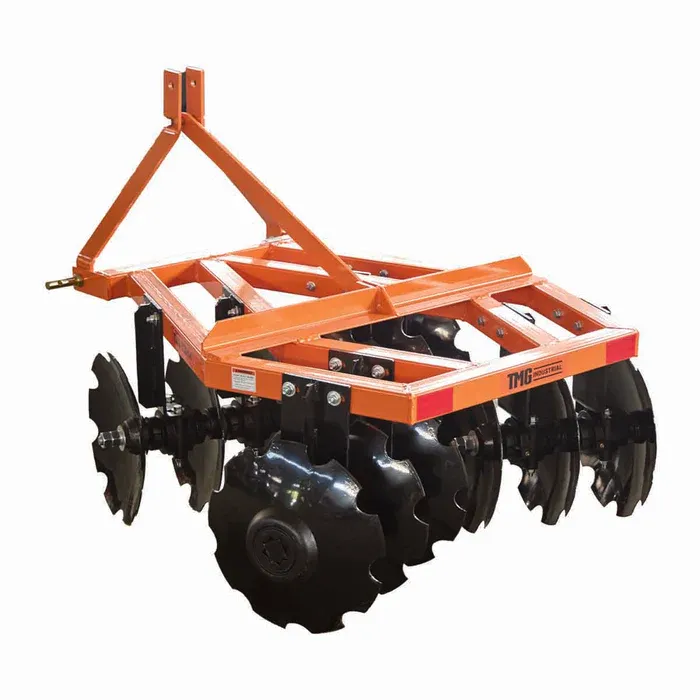
Owners of compact tractors in the twenty-to-thirty-horsepower range often reach for a disc harrow here, because it converts that rough furrow into a level, crumbly bed that seed can root into.
Understanding why the implement behaves as it does helps a grower set it correctly and avoid wasted passes.
Slicing, lifting and turning the soil
The working part is a row, or gang, of concave steel discs on a common shaft. Each disc is dished like a shallow bowl and set at an angle to the direction of travel.
As the tractor pulls the gang forward, the angled, dished face slices into the soil, lifts a slab of it, and rolls it over, breaking the larger lumps as they tumble. A disc harrow therefore performs secondary tillage, the refining step that follows ploughing.
The gang angle is the master control. A steeper angle makes each disc bite deeper and turn more soil, working aggressively; a shallower angle skims and levels, leaving a finer finish.
Why the notched edge bites where a smooth disc slips
On hard, dry summer ground, or where crop residue and matted grass cover the surface, a smooth-edged disc can ride over the top and skid without cutting. The scalloped, notched rim solves this.
The notches concentrate the weight onto a series of points rather than a continuous edge, so each point pierces the crust. It is the principle of a serrated bread knife, which grips and saws through a tough crust where a straight blade would slide.
Classifying harrows by edge and by arrangement
Two distinctions matter most. The first is the disc edge: a notched disc harrow cuts hard, trashy ground aggressively, while smooth discs give a finer tilth on soil that is already loose.
•Single-gang and offset layouts pull harder and bite deeper, suited to first passes on tough ground.
•Tandem layouts, with gangs throwing soil in opposing directions, leave the surface level and even.
The aggression-versus-finish trade-off
Every choice trades cutting power against smoothness. A steep angle and a notched edge break the worst clods quickly, but leave ridges and an open surface that needs a second, gentler pass.
A shallow angle on already-worked soil produces a fine, firm seedbed in one go, yet would barely scratch unbroken ground. The skilled approach is to start aggressive and finish gentle, reading the soil between passes.
A practical compact-tractor example
Consider a Devon smallholder reseeding a one-acre paddock behind a twenty-five-horsepower compact tractor. A forty-eight-inch disc harrow on a Category 1 three-point hitch matches the tractor's width and lifting capacity, so the unit rises clear at the headland.
A first pass at a steep angle shatters the ploughed clods, and a shallower second pass levels the soil, producing a bed ready for grass seed without a separate power harrow.
Weighing the strengths and the limits
The strengths of a disc harrow are its simplicity, its tolerance of stones and residue, and the way one implement spans coarse breaking and fine levelling through angle alone.
The limits are equally honest, for on very wet clay the discs smear rather than crumble, so timing and a dry summer tilth matter as much as the disc harrow itself.
























Sign in to leave a comment.