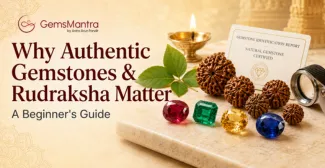

Authentic gemstones and Rudraksha are important for people exploring Vedic astrology and spiritual traditions. Natural, untreated stones and genuine Rudraksha beads are different from synthetic or altered products. Certification and proper verification help buyers identify authentic products and make informed choices.
What Makes Authentic Gemstones and Rudraksha Genuine?
A genuine gemstone, in gemological terms, is one that is natural (formed in the earth, not synthesised in a lab) and whose properties and treatment status are accurately described. Here is what that means in practice:
• Natural: formed in the earth over geological time, not created in a laboratory. Lab-grown stones are chemically identical to natural ones but do not carry the same Vedic significance or market value.
• Untreated: not subjected to heat, fracture filling, or colour enhancement. For astrological use, "No Treatment" or "No Heat" on a lab certificate is the standard to look for.
• Certified: accompanied by a report from a recognised gemological laboratory (GIA, IGI, or a Government-accredited lab) that independently confirms the stone's identity, origin, carat weight, colour, clarity, and treatment status.
• Verifiable: the certificate carries a number that can be checked online against the issuing lab's database.
Treatment is particularly worth understanding. Heating sapphires to improve colour and clarity is standard practice in the gem trade — but sellers are required to disclose it. A certificate that says "Heat Treatment: None" is significantly more meaningful for astrological use than one that simply says “Natural Corundum.”
What Makes a Rudraksha Authentic?
Rudraksha beads (Elaeocarpus ganitrus seeds) are classified by their Mukhi count — the number of naturally formed lines running from the crown to the base of the bead. A 5 Mukhi has five such lines, a 7 Mukhi has seven, and so on up to 21 and beyond.
Authentic verification for Rudraksha goes beyond surface inspection because the lines can be carved or painted onto imitation beads. The most reliable method currently in use is X-ray verification — a scan that shows the internal structure of the bead, confirming that the seed chambers inside match the Mukhi count on the surface. A bead with seven external lines should have seven internal chambers. If it does not, it is not genuine.
Beyond X-ray verification, Gemtrue, IGL, and ISO certifications are used to document and certify authentic Rudraksha — the certificate should carry a verifiable number, just like a gemstone certificate.
Common Myths About Gemstones and Rudraksha
Several widespread misconceptions make it harder for beginners to evaluate what they are looking at. Here are the most common:
❌ Myth: An expensive gemstone is always genuine.
✅ Fact: Price is not a reliable indicator of authenticity. Treated or synthetic stones can be priced high. A certified natural stone at a fair market price is more reliable than an expensive stone with no certificate.
❌ Myth: If it passes the water test or milk test, it is real.
✅ Fact: These folk tests have no gemological basis. A synthetic stone or treated stone will pass them just as easily as a genuine one. A lab certificate is the only reliable verification method.
❌ Myth: All Rudraksha from Nepal are genuine.
✅ Fact: Genuine Nepali Rudraksha does exist and is highly regarded — but the origin label does not guarantee authenticity. Fake beads are sold with "Nepali" labels regularly. Verification must come from the bead's structure, not its claimed origin.
❌ Myth: You can wear any gemstone without consulting an astrologer.
✅ Fact: For decorative use, personal choice applies. For astrological planetary remedies, wearing the wrong gemstone can — in Vedic tradition — have unintended effects depending on your birth chart. Consultation before wearing a Navratna stone is genuinely advised.
Practical Starting Points for Beginners
If you are new to this space and trying to make sense of it, here are some grounded starting points:
• Ask for a verifiable lab certificate before purchasing any gemstone. Check the certificate number against the issuing lab's online database.
• For Rudraksha, ask specifically whether the bead has been X-ray verified and whether a Gemtrue/IGL/ISO certificate is included.
• For astrological gemstones, speak to a qualified Vedic astrologer before buying. Your Rashi (Moon Sign) and full birth chart determine which stone is appropriate — not just your sun sign.
• Be cautious of unusually low prices for high-value stones. Genuine untreated Yellow Sapphires, Blue Sapphires, and Emeralds have market prices that do not vary dramatically between sellers. A price significantly below market rate is a reason to ask more questions.
• Look for platforms that publish their certification standards clearly — and make it easy to verify what they have certified.
For those who want to explore further, GemsMantra — a platform founded by Vedic astrologer Astro Arun Pandit — publishes educational guides on gemstone certification, Rudraksha authentication, and Vedic astrology for readers at every level of familiarity with these traditions.
A Note on Spiritual Products and Expectations
Gemstones and Rudraksha are part of a Vedic spiritual tradition that has been practised across India for centuries. In that tradition, they are worn with intention, chosen with knowledge, and treated with care. They are not medicine and do not diagnose, treat, or cure any condition. No specific outcome is guaranteed by wearing any stone or bead. Individual experiences vary. The most important thing a beginner can do is approach this space with curiosity, a willingness to learn, and a healthy instinct for verifiable information.
Conclusion
The single most valuable thing someone new to gemstones or Rudraksha can bring to the experience is the habit of asking questions. What certificate does this stone have? Can I verify that certificate? Has this Rudraksha been X-ray verified? What does my birth chart actually suggest?
The answers to those questions are available — and the tradition they come from is worth understanding before engaging with it. Beginning with knowledge rather than impulse is, in the spirit of the Vedic approach to these things, exactly the right starting point.
Frequently Asked Questions
Q1. What is the difference between a natural and a synthetic gemstone?
A natural gemstone is formed in the earth over geological time. A synthetic gemstone is created in a laboratory and has the same chemical composition as the natural stone but is not formed naturally. For Vedic astrological purposes, only natural, untreated gemstones are traditionally recommended. A GIA, IGI, or Govt-recognised lab certificate will confirm whether a stone is natural or synthetic.
Q2. How do I know if a Rudraksha is genuine?
The most reliable method is X-ray verification — a scan that confirms the internal seed chambers match the visible Mukhi count on the bead's surface. A Gemtrue, IGL, or ISO certificate accompanying the bead provides additional documented verification. Surface tests like the water test or float test have no gemological basis and should not be relied upon.
Q3. Do I need to consult an astrologer before wearing a gemstone?
For decorative jewellery, personal preference applies. For astrological planetary remedies (Rashi Ratna), a qualified Vedic astrologer should ideally review your complete birth chart before recommending a specific stone. The same Moon Sign can have very different planetary configurations for different individuals, which changes what is appropriate for each person.
Q4. What does "untreated" mean on a gemstone certificate?
"Untreated" or "No Treatment" on a gemstone certificate means the stone has not been subjected to heat, fracture filling, beryllium diffusion, or other enhancement processes. For Vedic astrological use, an untreated stone is traditionally required — because the treatment is believed to diminish the stone's natural planetary energy. Always check the treatment section of a gemstone certificate before purchasing for astrological purposes.
Q5. Is the most expensive Rudraksha always the best quality?
Not necessarily. Price in the Rudraksha market is influenced by Mukhi count (higher Mukhis are rarer and more expensive), size (larger Nepali beads cost more), and origin (Nepali beads generally cost more than Indonesian). A well-priced, X-ray verified and certified lower-Mukhi bead is a more reliable choice than an expensive higher-Mukhi bead with no certification. Authenticity, confirmed by verification, matters more than price.



























Sign in to leave a comment.