
Medically reviewed by Dr. Katelyn Lehman, Licensed Clinical Psychologist, Founder of Quantum Clinic, and creator of The Coherence Method™. With over 15 years of clinical experience, Dr. Lehman specializes in anxiety, trauma, nervous system regulation, and emotional resilience using evidence-based psychological approaches.
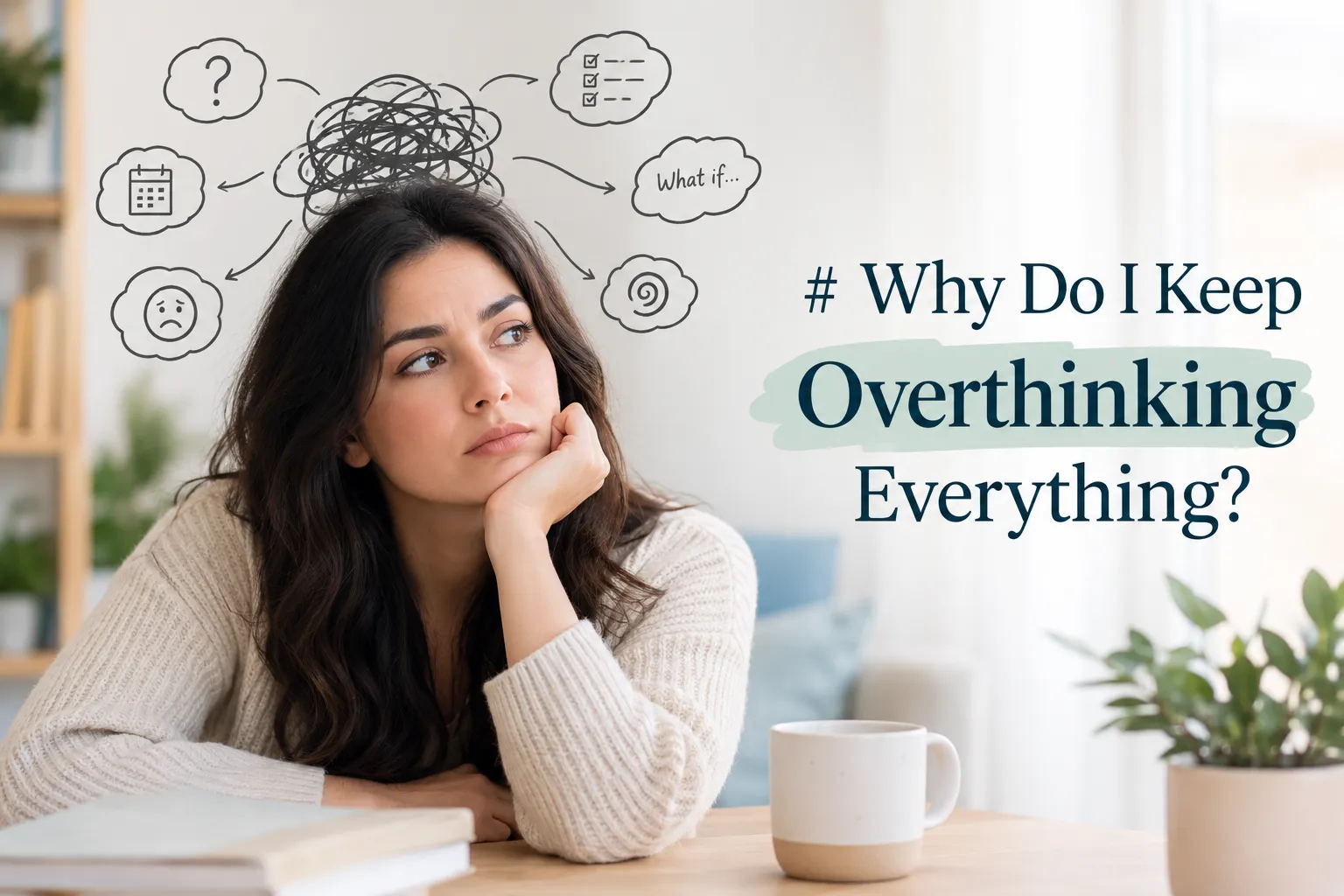
Have you ever replayed the same conversation over and over, worried about a decision long after making it, or imagined every possible worst-case scenario? If so, you're not alone. Many people ask, "Why do I overthink everything?" when repetitive thoughts begin interfering with their sleep, relationships, work, or overall well-being.
Occasional overthinking is a normal response to uncertainty. However, when repetitive thoughts become difficult to control, they may contribute to anxiety, emotional exhaustion, and chronic stress. Understanding why you overthink everything is the first step toward breaking the cycle.
In this article, you'll learn what overthinking is, why it happens, the signs of chronic overthinking, how anxiety and overthinking are connected, and practical, science-backed strategies to help calm racing thoughts and regain mental clarity.
If this sounds familiar, you're not alone. Overthinking is a common response to stress and uncertainty, and it doesn't mean something is wrong with you. With the right strategies, consistent practice, and support when needed, it can become easier to manage.
What Is Overthinking?
Overthinking is the habit of repeatedly thinking about a problem, decision, or situation without reaching a solution. Rather than helping you solve the issue, it often increases stress and uncertainty.
Chronic overthinking turns occasional worry into a persistent pattern of repetitive thinking that becomes difficult to control. It becomes an exhausting cycle where self-doubt and "what if" scenarios take over, leaving little room for clarity or resolution.
Rumination is a specific type of overthinking in which you repeatedly revisit past events or mistakes, often leading to feelings of guilt or regret. Instead of moving forward, you become stuck replaying the same thoughts without finding a solution.
Racing thoughts, on the other hand, are rapid, difficult-to-control thoughts that often occur during stress or anxiety. They can make your mind feel overwhelmed, jumping quickly from one worry to another without giving you time to process or respond calmly.
These patterns often overlap, making it difficult to relax, make decisions, or focus on the present moment.
If you often replay conversations, second-guess decisions, or imagine worst-case scenarios long after a situation has ended, you may be experiencing overthinking.
Key Takeaway: Overthinking is more than thinking deeply. It involves repetitive thoughts that increase stress without leading to solutions. Recognizing this pattern is the first step toward breaking the cycle.
Is Overthinking Normal?
Yes. Occasional overthinking is normal during stressful or uncertain situations. However, frequent overthinking that affects daily life may indicate anxiety or chronic stress.
Occasional overthinking is normal, especially during stressful or uncertain situations. However, when it becomes frequent, difficult to control, or interferes with daily life, it may be a sign of chronic overthinking or anxiety that deserves attention.
Why Do I Overthink Everything?
You may overthink because your brain is trying to protect you from uncertainty, mistakes, or emotional pain. While overthinking feels like problem-solving, it often keeps you stuck instead of helping you move forward.
1. Anxiety
When you're anxious, your brain constantly scans for possible threats. Overthinking becomes an attempt to prepare for situations that may never happen.
2. Uncertainty
Many people struggle with uncertainty. When you don't know what will happen next, your mind may keep searching for answers, even when none are available.
3. Perfectionism
If you believe every decision has to be perfect, it's easy to spend hours analyzing every option instead of making a choice.
4. Fear of Mistakes
People who fear failure often replay conversations or decisions because they're trying to avoid making another mistake. Unfortunately, this habit usually creates more self-doubt instead of confidence.
5. Past Trauma
Past difficult experiences can make your brain more alert to potential danger. As a result, you may overanalyze situations in an effort to prevent getting hurt again.
6. Chronic Stress
When your mind and body are under constant stress, it's harder to switch off your thoughts. Everyday situations may begin to feel bigger and more threatening than they really are.
Most people experience more than one of these triggers at the same time. Identifying your primary trigger can help you choose strategies that are more likely to work for you.
7. Quick Self-Check
Ask yourself which statement feels most like you:
- I worry about things that might happen.
- I struggle with uncertainty.
- I want every decision to be perfect.
- I keep replaying my mistakes.
- Past experiences make it hard to feel safe.
- I feel stressed most of the time.
Identifying the main trigger behind your overthinking can help you choose strategies that address the root cause rather than just the symptoms.
Key Takeaway: Overthinking is often driven by anxiety, uncertainty, perfectionism, or chronic stress. Addressing the underlying cause is usually more effective than trying to suppress the thoughts themselves.
What Are the Signs of Chronic Overthinking?
You don't need to experience every sign to be struggling with overthinking. Even recognizing two or three of these patterns can help you identify chronic overthinking early and take steps to break the cycle.
| Healthy Reflection | Chronic Overthinking |
| Helps solve problems | Repeats the same thoughts |
| Ends with decisions | Creates indecision |
| Short-term | Lasts for hours or days |
| Leads to action | Leads to avoidance |
| Improves clarity | Increases anxiety |
If your thinking consistently falls into the right-hand column, you may be stuck in a cycle of chronic overthinking rather than healthy reflection. The good news is that these patterns can change. With the right strategies and consistent practice, you can learn to interrupt the cycle and regain mental clarity.
How Does Overthinking Affect Your Mental and Physical Health?
Overthinking can affect sleep, concentration, stress hormones, muscle tension, and emotional exhaustion — showing up in the body just as much as the mind.
Sleep. A mind that keeps replaying thoughts often struggles to switch off at bedtime, which can make it harder to fall asleep or lead to lying awake with racing thoughts. Over time, this can chip away at sleep quality even when total hours in bed seem adequate.
Concentration. When mental energy is tied up in repetitive thinking, there's less available for the task in front of you. This can make it harder to focus, follow through on tasks, or retain what you're reading or hearing.
Stress hormones. Persistent overthinking keeps the body's stress response mildly activated for longer periods, which can involve elevated cortisol. This doesn't mean every overthinking episode causes lasting harm, but sustained patterns can keep the body in a low-grade state of alert.
Muscle tension. Many people carry overthinking physically — tight shoulders, a clenched jaw, or a tense neck — often without consciously noticing it, since the body tends to mirror a mind that hasn't fully relaxed.
Emotional exhaustion. Constantly processing and re-processing the same concerns takes energy. Over time, this can leave people feeling emotionally drained, even without any major event having occurred that day.
None of this means occasional overthinking is dangerous — it's a normal part of being human. But when these patterns become frequent or prolonged, they're worth paying attention to, since the body and mind are closely connected.
If you're noticing these signs in your own body, that's a signal worth acting on — the strategies in the next section are designed specifically to interrupt this physical and mental toll before it builds further.
How Can You Stop Overthinking?
You can reduce overthinking by consistently practicing thought awareness, grounding exercises, slow breathing, healthy sleep habits, and stress management techniques. No single strategy works instantly, but small daily habits can make a meaningful difference over time.
1.Practice Thought Awareness
The first step is simply noticing when you've slipped into overthinking rather than getting swept along by it. Try mentally labeling the thought by saying, "This is overthinking." This creates a small but powerful gap between you and the thought, making it easier to step back instead of getting pulled deeper into the cycle.
You don't have to stop the thought immediately. Simply noticing it is often the first step toward interrupting the cycle.
2.Challenge Unhelpful Thoughts
Ask yourself questions such as, "Is this thought based on facts or fear?" or "What would I say to a friend in this situation?" These questions can help you see the situation more objectively and reduce the intensity of the thought.
3. Use Grounding Exercises
When your mind is spinning, grounding techniques bring your attention back to the present moment. A simple method: name 5 things you can see, 4 you can touch, 3 you can hear, 2 you can smell, and 1 you can taste — shifting focus away from looping thoughts and into your immediate surroundings.
Try this the next time you notice yourself replaying the same thought for more than a few minutes. It can help shift your attention away from repetitive thinking and back to the present moment.
4. Practice Slow Breathing
Slow, controlled breathing signals to your nervous system that it's safe to settle. Try 4-2-6 breathing — inhale for 4 counts, hold for 2, and exhale for 6. The longer exhale in particular helps activate your body's natural calming response.
Practice this for 3 to 5 minutes whenever you notice your mind beginning to spiral.
5. Limit Mental Overload
An overloaded mind has less capacity to manage overthinking. Small changes can make a real difference:
- Focus on one task at a time instead of multitasking.
- Take short breaks throughout the day.
- Limit doom scrolling and excessive social media use.
6. Improve Sleep Habits
Since a tired mind is more prone to rumination, consistent sleep — a regular bedtime, less screen time before bed, and a calm wind-down routine — can meaningfully reduce how often overthinking takes hold.
Better sleep helps your brain recover, making it easier to manage anxious or repetitive thoughts during the day.
7. Talk With Someone You Trust
Sometimes the most effective way to interrupt overthinking is simply saying it out loud. Sharing what's on your mind with someone you trust can offer perspective, reduce the sense of carrying it alone, and often makes the thoughts feel more manageable.
Sometimes hearing your thoughts out loud makes them feel less overwhelming and easier to manage.
Key Takeaway: Small, consistent habits—such as grounding exercises, slow breathing, and challenging unhelpful thoughts—can gradually reduce overthinking over time.
Can Anxiety Cause Overthinking?
Yes. Anxiety and overthinking are closely linked and often reinforce one another. Anxiety is your body's natural response to uncertainty or perceived threats, and one of its most common mental symptoms is racing thoughts. These are rapid, difficult-to-control thoughts that jump from one worry to another.
When racing thoughts repeatedly focus on the same concern without reaching a solution, they can develop into rumination. Rumination involves replaying the same thought, problem, or past event in an attempt to find certainty, even though this repetition rarely provides an answer.
Over time, this creates a self-reinforcing cycle. Anxiety triggers racing thoughts, racing thoughts develop into rumination, and rumination keeps your mind focused on possible threats or problems. As a result, anxiety remains active, making overthinking even more difficult to break.
The good news is that this cycle can be interrupted. By managing anxiety through healthy coping strategies, mindfulness, or professional support when needed, it often becomes easier to reduce overthinking as well.
What Is Chronic Overthinking?
Chronic overthinking is a persistent pattern of repetitive thoughts that increases stress, anxiety, and mental exhaustion without leading to solutions.
What Is Rumination?
Rumination is repeatedly thinking about past events, mistakes, or negative emotions without finding a solution. Unlike healthy reflection, rumination keeps you emotionally stuck instead of helping you move forward.
What Are Racing Thoughts?
Racing thoughts are rapid, difficult-to-control thoughts that often occur during stress or anxiety.
When Should You Seek Professional Help?
Consider speaking with a licensed mental health professional if overthinking affects your work, relationships, sleep, or daily functioning, or if it continues despite consistent self-help strategies. Professional support can help you identify the underlying causes of overthinking and develop personalized strategies to manage it effectively.
How Do You Know If You're Overthinking Too Much?
You may be overthinking if repetitive thoughts interfere with your sleep, concentration, decision-making, or daily activities.
Start Today to Reduce Overthinking
You don't need to do everything at once. Start with one or two small actions today and build from there.
- Practice the 4-2-6 breathing exercise for 5 minutes.
- Write down one repetitive thought that's been on your mind.
- Challenge one negative assumption by asking, "Is this thought based on facts or fear?"
- Limit social media for 30 minutes.
- Take a short walk, even if it's just for 10 minutes.
- Talk to someone you trust about what's been on your mind.
Conclusion
Overthinking is a common response to uncertainty, but it doesn't have to control your life. By recognizing your thought patterns, practicing evidence-based coping strategies, and seeking professional support when needed, you can gradually reduce overthinking and improve your emotional well-being. Small, consistent changes often make the biggest difference over time.
Every small step you take today can help quiet your mind tomorrow. Lasting progress comes from consistency, not perfection.
Medical Disclaimer: This article is for educational purposes only and is not intended to replace professional medical advice, diagnosis, or treatment. If your symptoms are severe, persistent, or interfere with your daily life, consult a licensed mental health professional for personalized advice and treatment.
Frequently Asked Questions
Why can't I stop overthinking?
People often overthink because of anxiety, uncertainty, perfectionism, fear of mistakes, trauma, or chronic stress. The mind tries to create certainty by repeatedly analyzing situations that feel uncertain or unpredictable.
Is overthinking a sign of anxiety?
Yes. Anxiety and overthinking commonly occur together. Anxiety can trigger racing thoughts, which may develop into rumination and repetitive thinking patterns.
Can chronic overthinking go away?
Yes. With consistent self-care, healthy coping strategies, and professional support when needed, many people learn to manage chronic overthinking and reduce its impact over time.
What's the difference between overthinking and rumination?
Overthinking involves repeatedly analyzing situations or decisions, while rumination focuses on replaying past events, mistakes, or negative experiences without reaching a solution.
How can I calm racing thoughts quickly?
Slow breathing, grounding exercises, stepping away from stressful situations, and focusing on the present moment may help calm racing thoughts in the short term.
When should I seek professional help for overthinking?
Consider speaking with a licensed mental health professional if overthinking affects your work, relationships, sleep, or daily functioning, or if it occurs alongside persistent anxiety or frequent panic attacks.


















Sign in to leave a comment.