

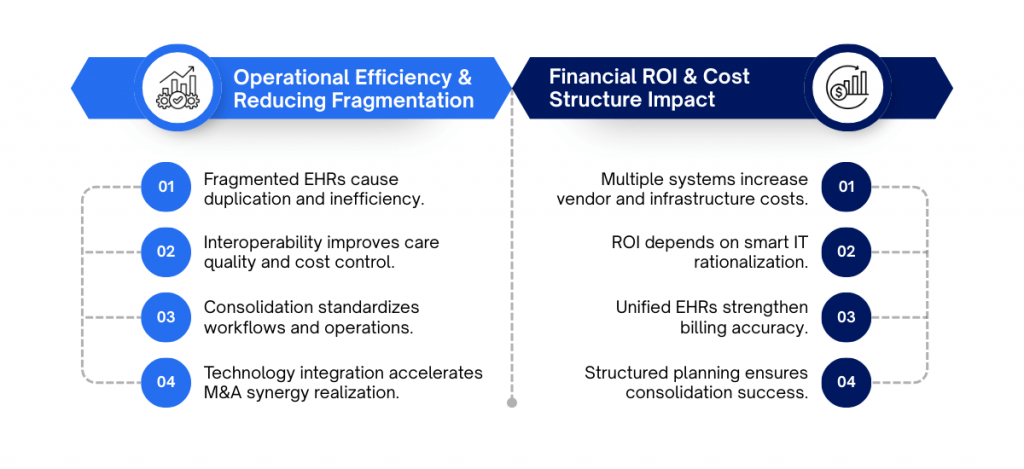
1. Operational Efficiency and Reducing Fragmentation
Fragmented EHR environments increase redundancy. HIMSS interoperability surveys consistently show that health systems with mature healthcare EHR interoperability frameworks report measurable operational gains:
Reduced duplicate diagnostic testing
Faster referral coordination
Improved care transitions
The Office of the National Coordinator for Health IT (ONC) has repeatedly emphasized that interoperability directly impacts care quality and cost containment. In its interoperability progress reports, ONC notes steady improvement in data exchange adoption yet fragmentation remains a barrier in multi-system environments.
Consolidated EHRs improve:
Unified scheduling
Standardized clinical workflows
Enterprise-level analytics
Centralized revenue cycle management
From a financial perspective, McKinsey research on post-merger healthcare integration highlights that technology harmonization is one of the most controllable levers for synergy realization, particularly in large integrated delivery networks (IDNs).
2. Financial ROI and Cost Structure Impact
Maintaining multiple EHR systems means:
Multiple vendor contracts
Parallel hosting infrastructure
Duplicate cybersecurity frameworks
Redundant support teams
Healthcare IT spending continues to rise. According to Gartner healthcare IT forecasts, provider IT budgets are projected to grow steadily through 2026, largely driven by digital transformation and cybersecurity investments. Accurately modeling EHR merger cost and ROI requires evaluating infrastructure rationalization, staffing alignment, and long-term analytics gains.
EHR consolidation helps reduce long-term cost duplication but only if executed correctly. Importantly, revenue cycle performance is also affected. Fragmented documentation contributes to billing inconsistencies. Standardized coding within unified EHR systems improves claims integrity and denial management, critical as value-based reimbursement expands. While every merger differs, an internal EHR system consolidation checklist often includes data profiling, workflow standardization, security alignment, and stakeholder governance mapping.

Sign in to leave a comment.