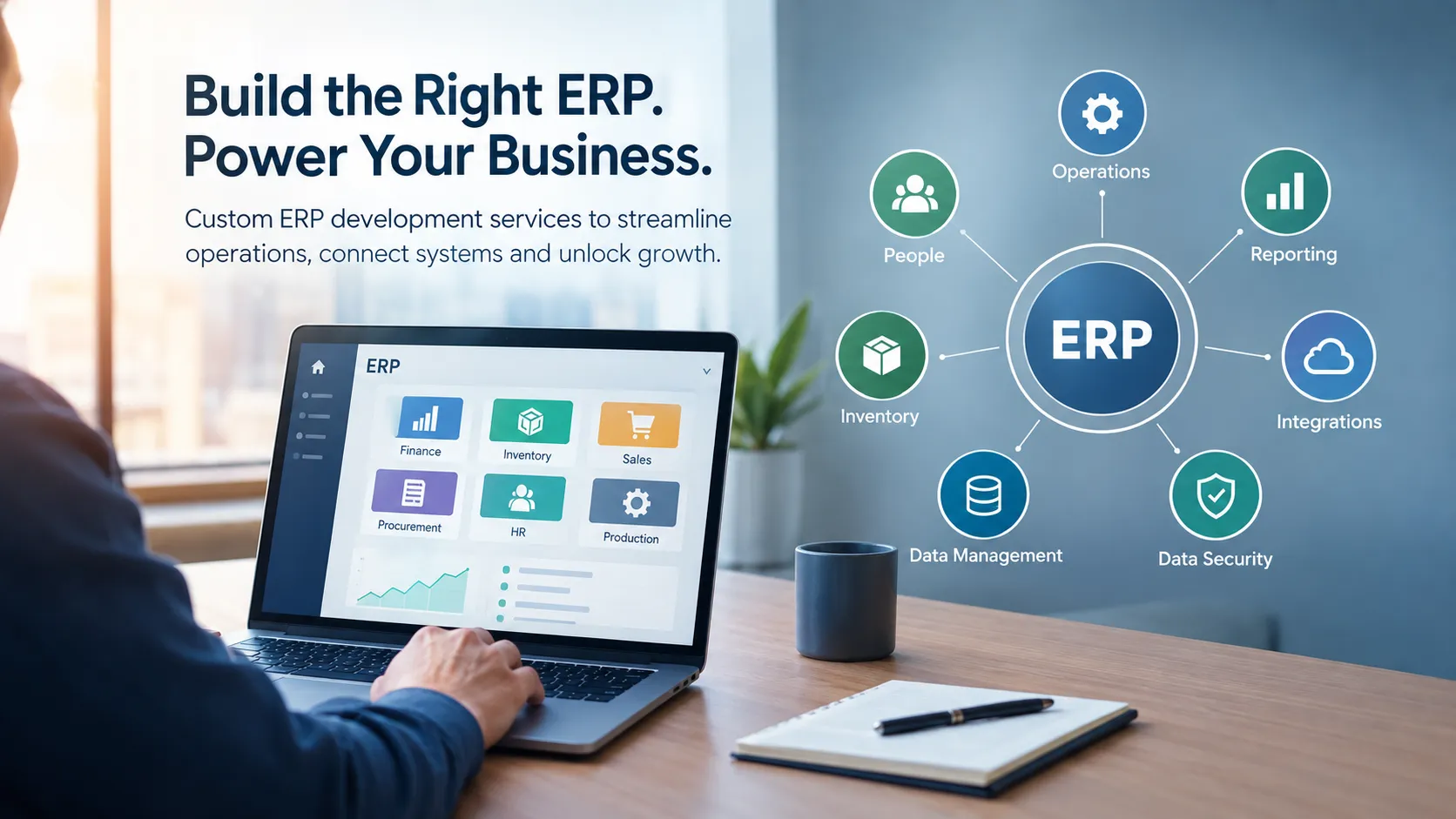


A manufacturing company can have accurate sales data, a capable finance team, and a modern ERP platform, yet still spend hours reconciling orders, inventory, purchasing, and production every week. The problem is often not the ERP software. It is the gap between how the business actually operates and how the system was designed to represent those operations.
That gap is where ERP Development Services become strategically important.
For CTOs, founders, and operations leaders, the question is no longer simply which ERP platform to select. The more important question is how the ERP should model processes, ownership, exceptions, integrations, data, and decision points before development begins.
This is also why enterprise teams should evaluate how ERP Development Services work in enterprise environments alongside platform capabilities, integration requirements, and operating-model changes.
McKinsey reports that only 20% of companies capture more than half of the projected benefits from ERP investments. The implication is important: buying or implementing an ERP does not automatically produce business value.
Why ERP Projects Lose Value Before Go-Live
ERP projects lose value when technology decisions are made before the operating model is sufficiently understood.
A common pattern looks like this:
- The business lists required modules.
- The implementation team maps those modules to standard features.
- Custom development begins around missing functionality.
- Integrations are added after the core workflows are already defined.
- Exceptions appear during UAT.
- Teams request changes that were actually missing requirements.
Timeline and cost increase.
The systemic gap is that teams often document what the system should contain instead of defining how work should move through the business.
McKinsey research found that three-quarters of ERP transformation projects fail to stay on schedule or within budget, while two-thirds have a negative ROI. The same research identifies weak business-IT integration, poor project management, waterfall delivery, misaligned incentives, and insufficient focus on business value as major contributors.
The lesson is straightforward: ERP development should begin with process architecture, not screens.
A Better ERP Development Services Framework
1. Design the workflow before the module
The first principle of ERP Development Services is to model the business transaction before selecting the technical implementation.
For example, a procurement workflow should answer:
Who creates the request?
Who approves it?
When is a purchase order generated?
What happens when quantities change?
Which documents are mandatory?
How does the transaction affect inventory and finance?
What happens when the supplier partially fulfils the order?
These questions expose requirements that a simple "Purchasing Module" checklist will miss.
Unlike module-first implementations, workflow-first development gives technical teams a clear sequence of business states, permissions, validations, integrations, and exceptions.
2. Separate standardization from customization
The second principle is to customize only where the business process creates measurable differentiation or compliance requirements.
McKinsey notes that ERP programs can benefit from standardizing processes while carefully evaluating the trade-off between standardization and customization. Its ERP research also reports that agile ERP approaches can reduce program cost by 10% and increase program value by 20% in the situations studied.
The decision should therefore be evidence-based:
Keep standard functionality when:
The process is common, stable, and well-supported by the platform.
Customize when:
The process is commercially important, legally required, operationally unique, or impossible to support without excessive manual work.
Integrate when:
Another system already owns the required capability or data.
This distinction prevents the ERP from becoming a collection of one-off features that are expensive to maintain.
3. Treat integrations and data as part of the architecture
The third principle is that integrations should be designed with the ERP, not attached after development.
Sales platforms, payment gateways, logistics systems, marketplaces, payroll tools, CRM platforms, and external databases can all become sources of conflicting records.
A practical architecture should define the system of record for every critical entity.
For example:
| Business entity | System of record | ERP responsibility |
|---|---|---|
| Customer | CRM | Financial/customer reference |
| Product | ERP | Master data |
| Order | Commerce platform | Fulfilment and accounting |
| Payment | Payment gateway | Reconciliation |
| Inventory | ERP/WMS | Availability and movement |
This prevents duplicate ownership and reduces reconciliation work after launch.
What We Learned from a Real Implementation
In one Oodles ERP project for Green Energy Africa, the client needed to improve operational control across accounting, inventory, POS, attendance, and communication workflows.
Oodles first assessed functional and non-functional requirements and created detailed requirement documentation before customizing the ERP. The implementation then covered accounting, inventory, POS, attendance, and WhatsApp integration, followed by five days of department-level training.
The important lesson was not simply that modules were implemented. The project connected requirements analysis, customization, integration, training, and post-implementation support as one delivery process.
A separate Oodles implementation for Virbac India demonstrates the same principle in a more planning-intensive environment. The solution connected sales forecasting, production planning, procurement, stock levels, Bill of Materials data, role-based access, and audit controls into a single planning platform.
These projects illustrate why ERP development should be treated as operating-model engineering rather than software configuration alone.
After working across ERP implementations and integrations, Oodles approaches ERP architecture around business workflows, platform capabilities, integrations, and long-term maintainability.
- ERP value is determined by how accurately the system represents business workflows, not by the number of modules implemented.
- Requirements should define transactions, approvals, exceptions, data ownership, and integrations before development begins.
- Standard ERP functionality should be preferred unless customization has a clear operational, commercial, or compliance justification.
- Integration architecture should establish a system of record for every important business entity.
- User validation should happen throughout development instead of being postponed until final UAT.
- ERP success should be measured against business outcomes such as cycle time, reconciliation effort, operational visibility, and decision quality.
If your organization is evaluating a new ERP, rebuilding an existing platform, or connecting fragmented business systems, explore our ERP Development Services for a business-led architecture and implementation approach.
Q: What are ERP Development Services?
A: ERP Development Services cover the design, customization, integration, development, testing, deployment, and ongoing improvement of enterprise resource planning systems. The work can include workflow automation, custom modules, third-party integrations, data migration, reporting, and role-based access.
Q: Why do ERP projects exceed their original scope?
A: ERP projects commonly expand because requirements, integrations, data ownership, and exception workflows were not sufficiently defined before development. McKinsey research found that three-quarters of ERP transformation projects fail to stay on schedule or within budget.
Q: Should a company customize its ERP or use standard functionality?
A: Companies should use standard functionality where it adequately supports stable processes and customize only when differentiation, compliance, or operational requirements justify the additional complexity. The decision should consider maintenance cost, upgrade impact, business value, and integration requirements.
Q: How long does ERP development take?
A: ERP development timelines depend on the number of workflows, integrations, business units, data migration requirements, customization level, and testing scope. A clearly defined MVP or phased rollout can shorten the first deployment compared with attempting to implement every requirement simultaneously.
Q: How can ERP Development Services improve business outcomes?
A: ERP Development Services can improve outcomes by connecting previously fragmented workflows, automating repetitive transactions, establishing controlled data ownership, improving reporting, and reducing manual reconciliation. The expected improvement should be defined through measurable business KPIs before development begins.






















Sign in to leave a comment.