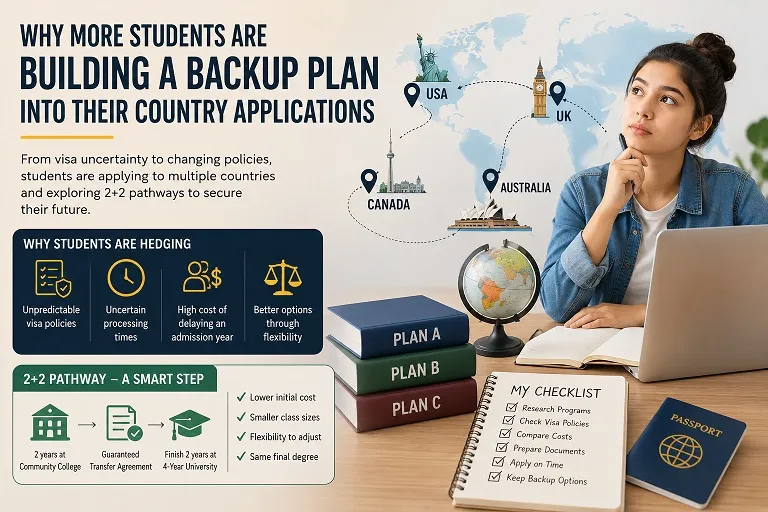

Ask a counselor what's changed most about study-abroad advising in the last two years, and you'll hear some version of the same answer: nobody applies to just one country anymore. A backup plan for country applications used to be a niche move for cautious students. Now it's close to standard practice — students are running parallel applications to the US, UK, Canada, and Australia at the same time, treating the whole process less like a single bet and more like a portfolio.
This isn't panic. It's pattern recognition. Visa policy shifts, tightening work-rights rules, and unpredictable processing times have made single-country strategies feel riskier than they used to. Community colleges are seeing the same instinct play out closer to home, with more students choosing a “low-risk start” through 2+2 pathway programs instead of committing straight to a four-year university. The common thread is hedging — and it's worth understanding why it's happening and what it actually means for the students doing it.
What's Driving the Shift Toward Multi-Country Applications
A decade ago, most international students picked a target country early and built their entire application strategy around it. That approach made sense when policy was relatively stable and outcomes were predictable. It doesn't hold up as well now.
Immigration and visa rules have become genuinely volatile. A student who commits fully to one country can watch the rules shift mid-process — a change to post-study work rights, a new duration-of-status requirement, a sudden cap on visa categories — and have no fallback. Students have noticed. Counseling forums and admissions consultants report a sharp rise in students asking not “which country is best for me” but “which two or three countries should I apply to in parallel.”
There's also a financial logic underneath the emotional one. Application fees, standardized testing, and document preparation across multiple countries add real cost, but families increasingly view it as insurance rather than overspending. Losing an admission cycle to a policy change or a single rejected visa application costs far more — in time, in delayed income, in disrupted plans — than the extra application fees ever would.
Finally, there's a generational shift in how risk itself is perceived. Students applying now grew up watching older siblings and cousins navigate sudden immigration policy changes in real time. That visibility has made hedging feel less like overcaution and more like common sense.
Inside the Hedge: How Students Are Actually Structuring Their Applications
The mechanics of a backup plan for country applications usually follow a recognizable pattern, even if the specific countries vary by student.
The Primary-Secondary Split
Most students still have a genuine first choice — often driven by program strength, cost, or family ties — but they pair it with one or two secondary countries chosen specifically for lower application friction or more predictable visa timelines. Canada and Australia frequently appear as secondary options for students whose primary target is the US or UK, largely because their point-based or streamlined visa systems feel more transparent to applicants.
The Community College Pivot
Domestically, the same hedging instinct shows up as the rise of 2+2 pathway enrollment. Instead of applying directly to a four-year university, students start at a community college with a guaranteed transfer agreement, complete general education requirements at a lower cost, and transfer into the four-year institution once academically and financially settled. It's a lower-stakes entry point that still ends at the same degree — just with more checkpoints along the way to adjust course if something changes.
Admissions offices report that community college applicants increasingly describe this choice explicitly as risk management, not a fallback for weaker students. Many arrive with strong academic records and treat the 2+2 route as a deliberate first move rather than a compromise.
Timing the Parallel Track
The logistics matter here. Students running multiple applications simultaneously need staggered deadlines, separate document sets tailored to each country's requirements, and a clear-eyed sense of which offer they'll actually accept if more than one comes through. Done well, it's a genuine strategy. Done poorly, it turns into a scattershot approach that dilutes the quality of every individual application.
What This Means for Students Planning Their Own Strategy
If you're weighing whether to build a backup plan into your own applications, the honest answer is: probably yes, but with discipline. A hedge only works if each application is still strong on its own merits — applying broadly doesn't excuse a weak personal statement or a rushed set of supporting documents for any single country.
Start by ranking countries not just by preference but by the stability of their current student visa and post-study work policies. A country with clear, well-documented rules is easier to plan around than one mid-transition. Build your primary application first, then treat your secondary country as a genuinely competitive application, not an afterthought.
If a 2+2 pathway is on the table, look closely at the transfer agreement itself. Not every “pathway” program guarantees admission into the partner four-year institution — some only guarantee that credits will transfer, which is a very different promise. Read the fine print before assuming the low-risk start is as low-risk as it sounds.
This is also where good academic support matters more, not less. Managing coursework across a transitional pathway, or juggling application requirements across multiple education systems, adds real cognitive load on top of an already demanding academic schedule. Platforms like Expertsmind have become a go-to resource for students navigating that kind of pressure, offering subject-specific academic support across disciplines so students can keep their grades steady while managing a more complex application timeline.
Finally, get honest with yourself about what you'll do if two acceptances land at once. Decide your priorities — cost, program quality, visa stability, distance from home — before the offers arrive, not after. Students who hedge well tend to be the ones who've already thought through the decision tree in advance.
The Broader Implication: Hedging Is Becoming the Default, Not the Exception
What's happening here is bigger than individual student strategy. Universities and community colleges are starting to build their own systems around the assumption that applicants are hedging. Admissions offices are seeing lower yield-predictability from single applications, which is pushing some institutions to expand waitlist management and rolling admissions to compensate. Community colleges with strong 2+2 agreements are marketing them more explicitly, recognizing that “low-risk start” has become a genuine selling point rather than a consolation option.
For international education broadly, this points toward a more distributed future — one where a handful of countries no longer dominate as the obvious default and where students treat global mobility itself as the flexible asset, not any single destination. Institutions that adapt their advising and admissions processes to this reality, rather than treating multi-country applicants as an edge case, are likely to see stronger, more resilient enrollment numbers over the next several admissions cycles.
For students, the takeaway isn't that any one country has become unreliable. It's that certainty itself has become the scarcer resource — and building a real backup plan is simply how a growing number of students are choosing to manage that.
FAQs
Is it normal to apply to more than one country for university?
Yes — applying to multiple countries as a backup plan has become increasingly common, especially given how much visa and work-rights policy has shifted in recent years. Admissions offices now regularly see applicants running parallel country strategies.
Does applying to a backup country hurt my chances at my first-choice country?
No, as long as each application is prepared with equal care. A backup plan for country applications only backfires when students spread themselves too thin and submit weaker materials everywhere.
What is a 2+2 pathway program, and is it a good backup option?
A 2+2 pathway lets you complete two years at a community college with a transfer agreement into a four-year university for the final two years. It's a genuinely low-risk start for students who want flexibility, lower initial costs, or more time to firm up their plans.
How many countries should I realistically apply to?
Most advisors suggest one primary target and one or two secondary countries — enough to create a real hedge without overwhelming your ability to prepare a strong application for each one.
Will a community college transfer hurt my final degree's value?
No. As long as the 2+2 agreement guarantees admission (not just credit transfer) into an accredited four-year program, the final degree is identical to one earned by a student who started there directly.
What should I check before trusting a transfer agreement?
Confirm whether the agreement guarantees admission or only credit transfer, check the current articulation agreement is active and not expired, and ask how many students from your intended major actually transferred successfully in the past two admissions cycles.

























Sign in to leave a comment.