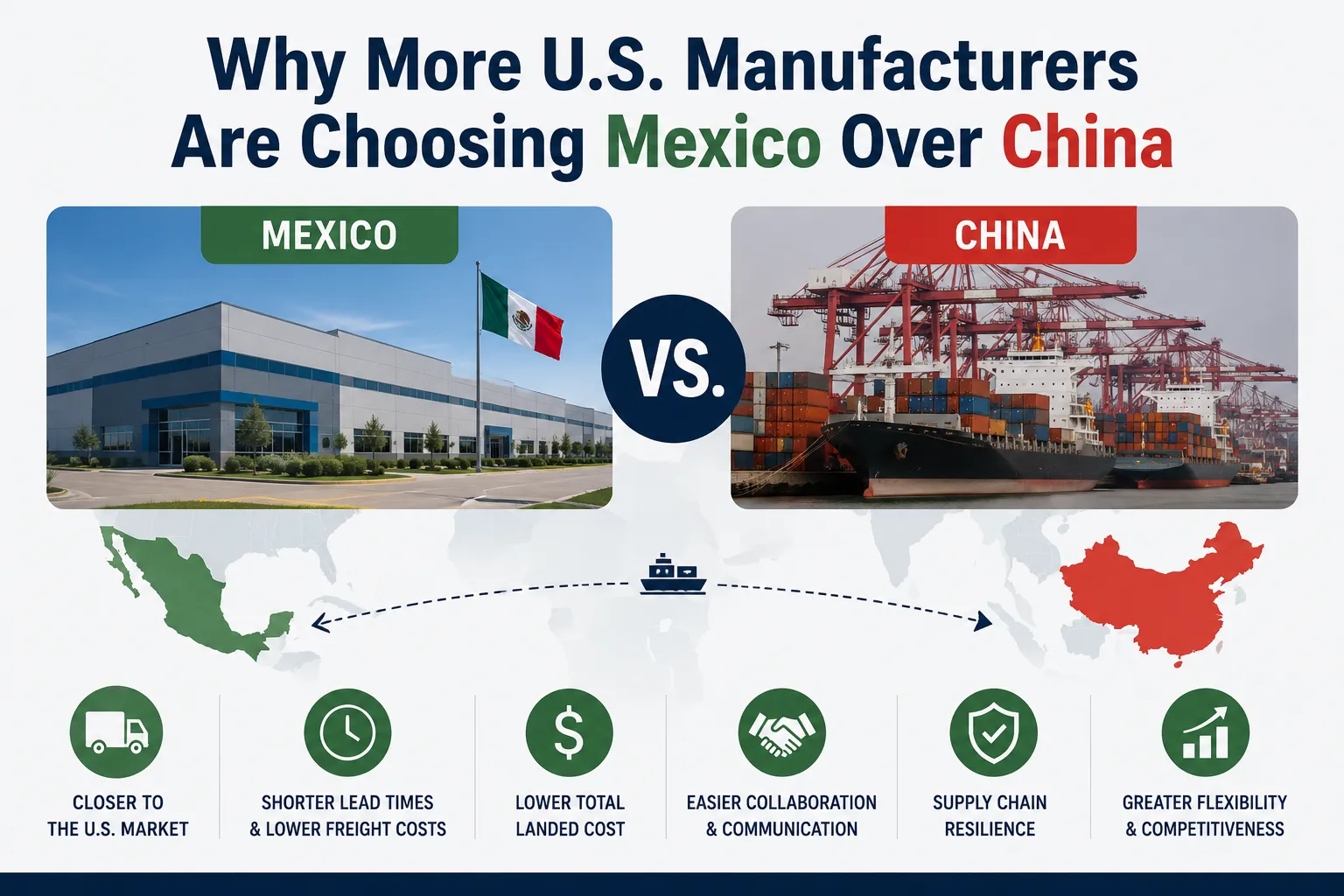

For more than two decades, China was the default destination for companies looking to reduce manufacturing costs. Low labor rates, massive production capacity, and a well-established supplier network made it an attractive choice for businesses of all sizes. Today, however, the conversation has shifted. Companies are no longer asking whether they should diversify their supply chains, they're asking where they should move next.
Increasingly, the answer is Mexico.
The debate around manufacturing in Mexico vs China has become one of the most important strategic discussions for manufacturers. Rising geopolitical uncertainty, longer shipping times, higher freight costs, and the need for supply chain resilience have encouraged many U.S. businesses to explore Mexico nearshoring as a smarter long-term strategy.
Here's why more manufacturers are choosing Mexico manufacturing and how the move can create lasting operational advantages.
The Supply Chain Has Changed
The global supply chain disruptions of recent years exposed the risks of relying on suppliers located thousands of miles away. Delays at ports, container shortages, changing tariffs, and transportation bottlenecks forced manufacturers to rethink their sourcing strategies.
Many businesses realized that the lowest labor cost doesn't always result in the lowest total cost.
Today, manufacturers are placing greater value on flexibility, reliability, and speed. Being able to respond quickly to customer demand is often more valuable than saving a few dollars per unit.
That's one of the biggest reasons why Mexico has become an increasingly attractive manufacturing destination.
Manufacturing in Mexico vs China: The Key Differences
When comparing manufacturing in Mexico vs China, labor costs are only one part of the equation. Companies should also consider transportation, inventory, communication, quality control, and overall supply chain risk.
Proximity to the U.S. Market
Mexico shares a nearly 2,000-mile border with the United States, creating a significant logistics advantage.
Instead of waiting several weeks for ocean freight from Asia, products manufactured in Mexico can often reach U.S. distribution centers within days.
Shorter transit times provide several benefits:
- Faster order fulfillment
- Lower transportation costs
- Reduced inventory requirements
- Improved production planning
- Greater responsiveness to market changes
For companies serving North American customers, proximity alone can dramatically improve supply chain performance.
USMCA Creates Trade Advantages
Another major advantage of Mexico manufacturing is access to the United States-Mexico-Canada Agreement (USMCA).
The agreement supports regional trade by reducing barriers between the three countries and providing favorable conditions for qualifying products.
For many manufacturers, this means:
- Reduced tariff exposure
- Simplified cross-border trade
- Better long-term planning
- Improved cost predictability
While every product should be evaluated individually, USMCA continues to make Mexico an attractive manufacturing partner for U.S. businesses.
Lower Total Landed Cost
Many companies focus heavily on factory pricing when evaluating suppliers.
However, successful sourcing decisions are based on total landed cost, which includes:
- Manufacturing expenses
- Transportation
- Customs and duties
- Warehousing
- Inventory carrying costs
- Packaging
- Handling fees
Although labor costs in China may still be competitive in some industries, longer shipping distances and additional logistics expenses often narrow the gap.
Many manufacturers discover that Mexico nearshoring results in a lower overall cost once every factor is considered.
Better Supply Chain Visibility
Managing suppliers is much easier when they're located nearby.
Factory visits, quality inspections, engineering reviews, and production meetings become significantly more practical when travel takes hours instead of days.
Improved visibility allows companies to:
- Resolve production issues faster
- Conduct regular supplier audits
- Improve communication
- Strengthen supplier relationships
- Reduce quality risks
This level of collaboration is difficult to achieve when manufacturing operations are located on another continent.
Faster Response to Customer Demand
Customer expectations continue to evolve.
Many industries now require:
- Smaller production runs
- Faster product launches
- Frequent design updates
- Shorter delivery windows
These requirements favor manufacturers with shorter supply chains.
By producing closer to customers, companies gain the flexibility to adjust production schedules without waiting weeks for overseas shipments.
That responsiveness often becomes a competitive advantage.
Easier Collaboration Between Teams
Successful manufacturing depends on effective communication.
Working with suppliers in similar time zones makes collaboration much more efficient.
Engineering teams can review production changes in real time.
Procurement managers can resolve issues quickly.
Executives can visit manufacturing facilities without extensive international travel.
These improvements may seem small individually, but together they create smoother operations and faster decision-making.
Mexico's Growing Manufacturing Ecosystem
Mexico is no longer viewed simply as a low-cost manufacturing destination.
Over the past two decades, the country has developed sophisticated industrial clusters supporting industries such as:
- Automotive
- Aerospace
- Electronics
- Medical devices
- Consumer products
- Appliances
- Industrial equipment
These manufacturing hubs provide access to experienced suppliers, skilled labor, logistics providers, and specialized service companies.
For businesses entering the market, this established ecosystem reduces many of the challenges associated with launching production in a new country.
Risk Diversification Matters More Than Ever
One lesson many companies have learned is that relying on a single sourcing region creates unnecessary risk.
Supplier diversification has become a core business strategy.
Rather than moving every product immediately, many organizations begin by shifting selected product lines or components to Mexico while maintaining existing relationships elsewhere.
This balanced approach reduces supply chain risk while providing greater flexibility during periods of disruption.
Quality and Continuous Improvement
Nearshoring isn't just about location.
Operational excellence still plays a critical role in long-term success.
Manufacturers that invest in lean manufacturing principles, supplier development, and continuous improvement often achieve stronger results than those focused solely on cost reduction.
Working closely with suppliers enables businesses to:
- Improve production efficiency
- Reduce defects
- Standardize processes
- Increase throughput
- Lower waste
These improvements contribute directly to profitability and customer satisfaction.
Choosing the Right Manufacturing Partner
Moving production to Mexico requires careful planning.
Selecting the right supplier involves much more than comparing pricing.
Companies should evaluate:
- Manufacturing capabilities
- Quality management systems
- Production capacity
- Financial stability
- Industry experience
- Supply chain integration
- Communication practices
- Compliance requirements
Conducting factory audits and supplier qualification before production begins helps reduce future risks.
Many businesses also work with experienced sourcing specialists to identify qualified manufacturing partners and manage the transition.
Is Mexico Right for Every Company?
Not necessarily.
China continues to offer advantages for certain products, particularly those requiring highly specialized supplier ecosystems or very large production volumes.
However, for many manufacturers serving North America, Mexico provides significant strategic advantages beyond labor costs.
The decision should be based on your product, customer base, production requirements, logistics needs, and long-term business goals—not simply hourly wage comparisons.
A thorough supply chain assessment can help determine which manufacturing location offers the best overall value.
Final Thoughts
The conversation around manufacturing in Mexico vs China has evolved considerably. Today's manufacturers are looking beyond labor rates to evaluate the full picture—lead times, logistics, quality, flexibility, risk, and customer service.
For many U.S. companies, Mexico nearshoring offers a practical way to strengthen supply chains while improving operational agility. Shorter transit times, closer supplier relationships, trade advantages under USMCA, and an expanding industrial base make Mexico manufacturing an increasingly attractive option for businesses seeking long-term resilience.
Every company's supply chain is different, and there is no one-size-fits-all solution. The key is to evaluate total landed cost, operational performance, and strategic goals before making a sourcing decision. With the right planning and the right partners, manufacturing in Mexico can become more than an alternative to China—it can become a foundation for sustainable growth and a more competitive supply chain.




























Sign in to leave a comment.