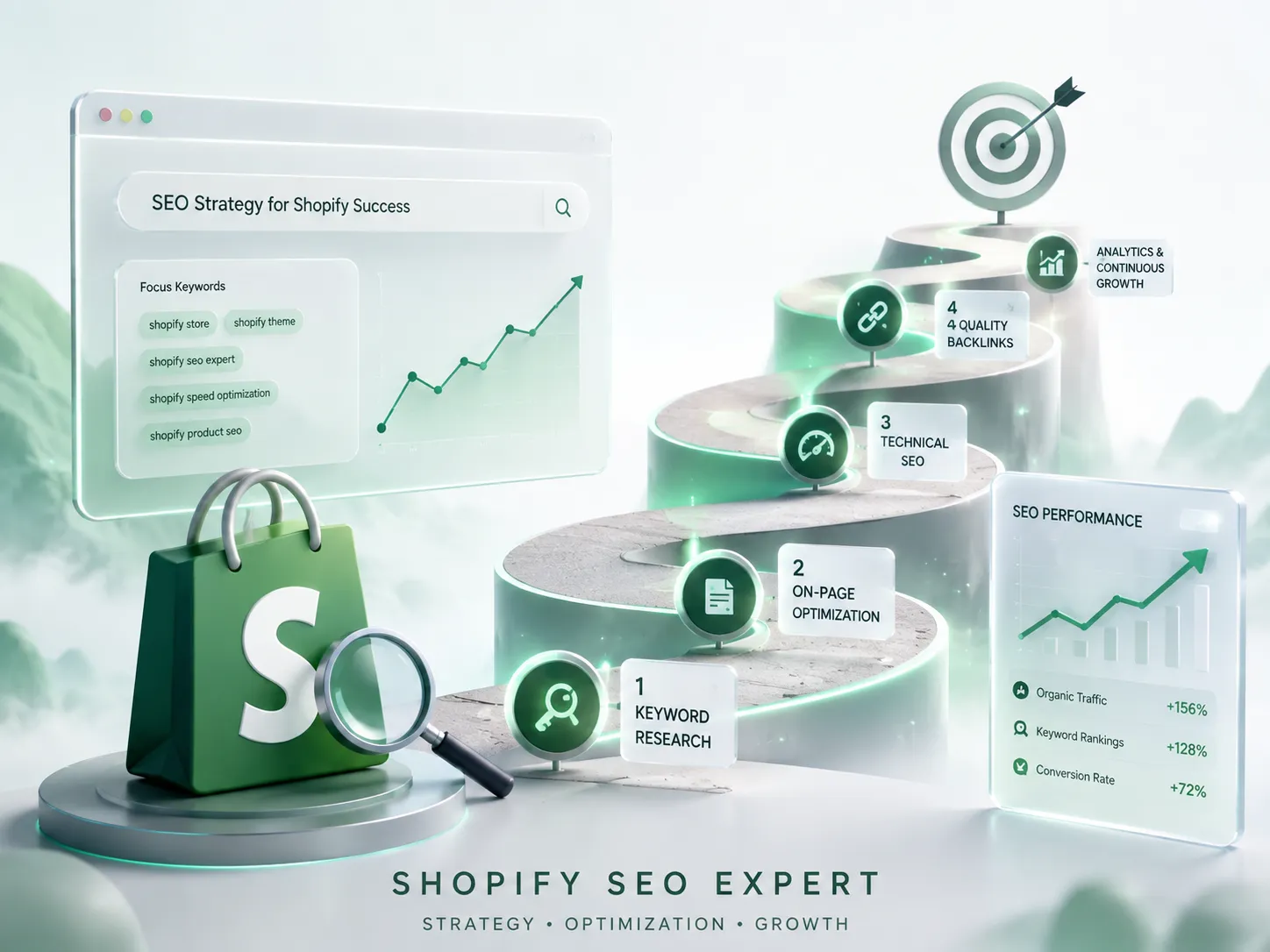

Why Do Shopify Stores Struggle With SEO More Than Other Platforms?
Shopify was built for speed to launch, not speed to rank. The platform generates URLs automatically, applies default title tags across templates, and often creates multiple paths to the same product through collections, tags, and variants. Search engines see this as duplication, even when a human visitor would not notice anything wrong.
A store owner adding products daily has no reason to notice that /collections/all and /collections/summer-sale might both be indexing the same fifty items, splitting ranking signals instead of combining them. This is not a mistake anyone made on purpose. It is simply how the platform behaves out of the box, and it is precisely the kind of issue a store owner without SEO training will not catch until traffic has already stalled.
What Does a Shopify SEO Expert Actually Look At First?

Before writing a single blog post or building a single link, an experienced Shopify SEO experts runs through a short list of structural checks:
Crawl and indexation. Which pages is Google actually indexing, and which ones are being skipped or blocked by accident through robots.txt or canonical tag errors?
Duplicate content sources. Are variant URLs, tag pages, or filtered collection pages creating near-identical content that competes against itself?
Site speed under real load. Not a single speed test score, but how the store performs once ten apps, a review widget, and a chat bubble are all running at the same time.
Product page depth. Are descriptions unique, or copied word-for-word from manufacturer feeds that dozens of competing stores are also using?
Mobile rendering. Since most Shopify traffic and nearly all Google indexing today is mobile-first, does the store actually load cleanly and quickly on a phone, not just a desktop browser?
Only after this groundwork is solid does content strategy, link building, or keyword expansion make sense. Building content on top of a broken technical foundation is like decorating a house before checking whether the roof leaks.
How Is Shopify SEO Different From General SEO Work?
| Factor | General Website SEO | Shopify-Specific SEO |
|---|---|---|
| URL structure | Fully customizable | Partially fixed by platform, needs workarounds |
| Duplicate content risk | Depends on CMS setup | High by default, from variants and collections |
| App-related speed issues | Rare | Common, since most stores run 10+ apps |
| Product page uniqueness | Controlled by writer | Often inherited from supplier feeds |
| Schema markup | Manually added | Needs Shopify-aware implementation for products, reviews, and FAQs |
| Site architecture | Built freely | Shaped by theme and collection logic |
This is why generic SEO advice, the kind written for WordPress blogs or custom-built sites, often falls flat when applied directly to a Shopify store. The platform has its own rules, and an expert who works inside Shopify daily knows where those rules quietly work against visibility.
What Results Should a Store Owner Realistically Expect?
SEO on Shopify is not instant, and any expert who promises first-page rankings within weeks is overselling. A realistic timeline looks like this:
- Weeks 1 to 4: Technical fixes go live. Indexation issues resolve, duplicate URLs get canonicalized, page speed improves.
- Month 2 to 3: Search engines begin re-crawling and re-evaluating the site. Impressions in Google Search Console typically rise before clicks do.
- Month 3 to 6: Rankings for lower-competition, long-tail product and category terms start moving up. Organic traffic becomes measurable rather than anecdotal.
- Month 6 onward: Compounding effect. Content, backlinks, and technical health work together, and rankings for more competitive terms become achievable.
Stores that skip the technical phase and jump straight to content often see the opposite pattern: traffic to blog posts grows, but product and collection pages, the pages that actually generate revenue, stay flat.
Common Mistakes Store Owners Make Before Hiring an Expert
A few patterns show up repeatedly across underperforming Shopify stores:
- Installing an SEO app and assuming it is enough. Apps can automate meta tags and alt text, but they cannot fix architectural duplication or rewrite thin product copy.
- Chasing keyword volume instead of intent. Ranking for a high-volume term that does not match what a buyer is actually searching for wastes effort and rarely converts.
- Ignoring collection pages. Product pages get all the attention, while collection pages, which often carry more ranking weight, are left with default, empty descriptions.
- Treating SEO as a one-time project. Search engines reward consistency. A single audit followed by months of silence tends to plateau, then slide backward as competitors keep publishing.
- Overloading the theme with apps. Every added app is a potential speed cost. Stacking review widgets, upsell tools, and trackers without auditing their combined impact is one of the fastest ways to undo months of SEO progress.
How Should a Store Owner Choose Who to Work With?
Not every freelancer or agency claiming SEO expertise has actually worked inside Shopify's specific constraints. A few questions separate genuine platform experience from generic SEO knowledge:
- Can they explain, specifically, how Shopify handles canonical tags on collection and variant pages?
- Have they worked with Shopify's native structured data limitations, and do they know when a custom schema implementation is needed?
- Can they show past examples of organic traffic growth on stores using the same platform, not just general websites?
- Do they talk about technical health, content, and link building as a connected system, rather than selling isolated services?
A store owner does not need to become an SEO expert themselves. But asking these questions before hiring makes it much easier to tell the difference between someone who understands Shopify and someone applying a one-size-fits-all playbook to a platform they do not fully know.
Frequently Asked Questions
How long does Shopify SEO take to show results? Most stores start seeing measurable movement in search impressions within 8 to 12 weeks, with meaningful traffic and ranking gains building over 3 to 6 months.
Can Shopify SEO apps replace hiring an expert? Apps handle repetitive tasks like meta tag generation, but they cannot diagnose structural duplication, rewrite product copy for uniqueness, or make judgment calls about site architecture.
Does switching Shopify themes affect SEO? Yes. Theme choice affects page speed, mobile rendering, and how cleanly structured data can be implemented, all of which influence rankings.
Is blogging necessary for Shopify SEO to work? Blogging helps target informational search terms and build topical authority, but it is not a substitute for fixing technical and product page issues first.
About RankMyShopify
RankMyShopify is a Shopify-exclusive SEO and digital marketing agency founded in 2009, with offices in Punjab, India and the USA, serving ecommerce brands across India, the USA, the UK, Australia, and Canada. Because the agency works exclusively within the Shopify ecosystem, its team understands the platform's specific technical behavior, from collection duplication to app-driven speed issues, rather than applying generic SEO methods borrowed from other platforms.






















Sign in to leave a comment.