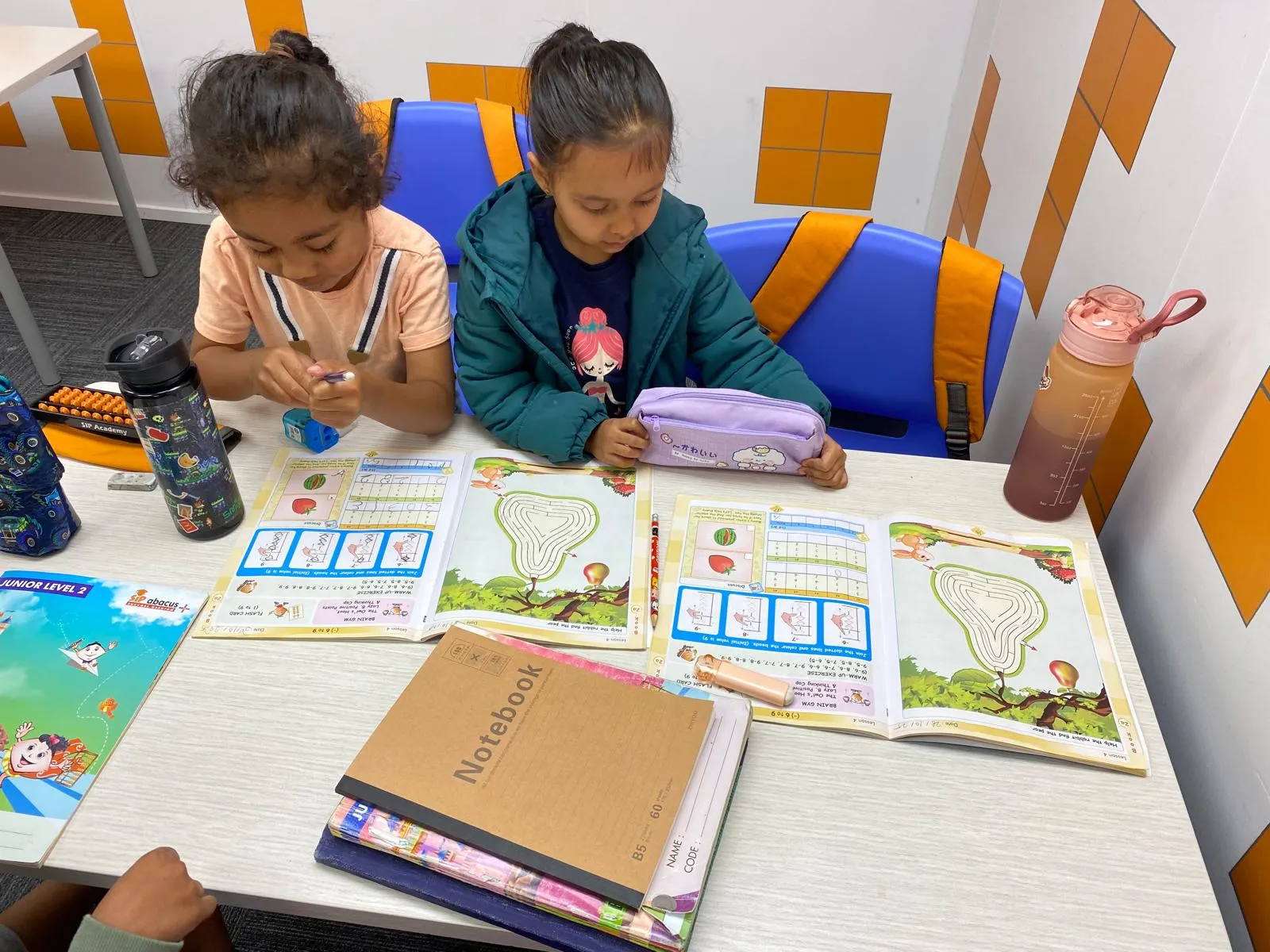

Many children can memorise multiplication tables, addition facts, and mathematical rules without truly understanding how numbers work. While memorisation has a place in learning mathematics, number sense provides something more valuable: the ability to understand numbers, recognise relationships, estimate, reason, and choose effective strategies to solve problems.
Strong number sense helps children move beyond simply asking, “What is the answer?” and encourages them to think, “Why does this answer make sense?”
For parents looking to develop confident and independent learners, building maths skills for kids should involve more than repeated worksheets and memorised facts. Approaches such as mental maths and abacus maths can encourage children to visualise numbers, recognise patterns, and calculate with greater confidence.
SIP abacus focuses on developing foundational mathematical abilities that can support children both inside and outside the classroom.
What Is Number Sense?
Number sense is a child’s understanding of numbers and how they relate to one another. It includes recognising quantities, comparing numbers, estimating, understanding place value, identifying patterns, and selecting appropriate strategies for calculations.
For example, a child with strong number sense may know that 49 + 21 is close to 50 + 20, so the answer should be around 70. They are not relying only on a memorised fact. They are using relationships between numbers to reason.
This type of thinking is an important part of developing practical maths skills for kids.
Number sense also develops gradually. Children build it through experiences with counting, grouping, comparing, calculating, estimating, and explaining their thinking.
Number Sense vs Memorising Maths Facts
Memorising facts can help children calculate quickly. Knowing that 7 × 8 = 56, for instance, is useful. However, memorisation alone does not necessarily mean a child understands multiplication.
Consider a child who knows that 7 × 8 = 56 but struggles to answer:
- Is 7 × 8 greater or smaller than 7 × 10?
- What is 56 ÷ 7?
- How could you calculate 7 × 8 without remembering the fact?
- Is 56 a reasonable answer to 7 × 9?
A child with stronger number sense can use known relationships to work through unfamiliar questions.
For example:
7 × 8 = 7 × 10 − 7 × 2
That means:
70 − 14 = 56
The child is not simply recalling an answer. They are reasoning with numbers.
This distinction is important because mathematical learning involves applying knowledge in new situations, not just reproducing information from memory.
Why Number Sense Is Important for Children1. It Builds Mathematical Confidence
Children can become anxious when mathematics feels like a collection of rules they must remember. Number sense gives them different ways to approach a problem.
When children understand that numbers can be broken apart, combined, compared, and represented in different ways, they have more tools available when they make a mistake or forget a fact.
This can make mathematical problem-solving feel more manageable.
2. It Supports Mental Maths
Mental maths involves performing calculations without depending entirely on written methods or calculators.
Good mental calculation depends heavily on understanding numbers.
For example, instead of calculating 99 + 37 using a formal written method, a child may think:
99 + 1 = 100
37 − 1 = 36
100 + 36 = 136
This strategy is based on number relationships.
Regular practice with mental maths can therefore help children become more flexible and efficient when working with numbers.
3. It Strengthens Problem-Solving
Real-life mathematics rarely tells children which formula or operation to use.
A child may need to decide whether to add, subtract, multiply, divide, estimate, or compare.
Strong number sense helps them interpret the problem and choose a sensible approach.
For example, if a child sees that a shop has 48 apples and sells approximately half, they can estimate that about 24 remain without needing to perform a lengthy calculation.
This ability to estimate and reason is one of the most useful maths skills for kids to develop.
4. It Helps Children Recognise Patterns
Mathematics is full of patterns.
Children may notice that:
- Even numbers can be divided into groups of two.
- Multiples of five end in 0 or 5.
- Adding 10 increases the tens place by one.
- Multiplying by 10 changes the place-value relationship.
- Numbers can often be decomposed in several ways.
Recognising patterns allows children to make connections instead of treating every calculation as a completely new problem.
How Abacus Maths Can Support Number Sense
Abacus maths provides children with a visual and hands-on way to represent quantities and perform calculations.
Instead of seeing numbers only as symbols written on a page, children interact with physical representations of numbers. With consistent practice, they can gradually develop the ability to visualise calculations mentally.
For example, when children work with an abacus, they can observe how quantities change as beads are added or removed. This can reinforce concepts such as place value, grouping, addition, subtraction, and numerical relationships.
The goal should not simply be faster calculation. Effective abacus maths learning can also encourage concentration, visualisation, accuracy, and structured mathematical thinking.
SIP abacus uses abacus-based learning as part of a broader approach to helping children develop confidence with numbers.
Number Sense and Maths Skills for Kids
Developing strong maths skills for kids requires a balanced approach.
Children benefit from learning important mathematical facts, but they should also understand why those facts work and how they can be used.
Parents and educators can encourage number sense by asking questions such as:
- “How do you know?”
- “Can you find another way?”
- “Does that answer make sense?”
- “Can you estimate first?”
- “Which number is closer?”
- “What happens if we change this number?”
- “Can you explain your strategy?”
These questions encourage children to communicate mathematical reasoning rather than simply provide an answer.
Can Maths Classes Online Develop Number Sense?
With the growth of digital education, maths classes online can provide children with additional opportunities to practise mathematical concepts from home.
The effectiveness of online learning depends on the quality of instruction, interaction, age-appropriate activities, regular practice, and feedback.
Well-designed maths classes online can incorporate mental calculation, visual demonstrations, interactive questions, and problem-solving activities.
Parents should look for programmes that focus on understanding and application rather than excessive repetition of isolated facts.
For younger learners especially, online lessons should be engaging and structured, with opportunities to ask questions and receive guidance.
Practical Ways Parents Can Build Number Sense at Home
Parents do not need complicated equipment to encourage mathematical thinking.
Use Everyday Situations
Ask children to estimate the number of items in a basket, compare prices, divide snacks into equal groups, or work out how much change they might receive.
Encourage Multiple Strategies
If a child solves a calculation correctly, ask whether they can find another way.
For example, 25 + 18 can be solved as:
25 + 10 + 8 = 43
or:
25 + 20 − 2 = 43
Showing children that there can be multiple strategies encourages flexibility.
Practise Mental Calculations
Give children short calculations to solve mentally during everyday activities. Keep the questions age-appropriate and focus on reasoning rather than speed alone.
Make Estimation a Habit
Before calculating an exact answer, ask children to estimate.
If they calculate 198 + 204 and get 902, their estimate of around 400 should immediately help them recognise that something has gone wrong.
Talk About Numbers
Simple conversations about numbers can build mathematical language and confidence.
Ask questions such as, “Which is bigger?”, “How much more?”, “What would happen if we doubled it?” or “Can you split that number into two easier numbers?”
Why SIP abacus Emphasises Understanding
A strong mathematics foundation is not built overnight. Children need repeated opportunities to explore numbers, practise calculations, make connections, and explain their thinking.
SIP abacus can help support this development through structured abacus maths, mental maths, and age-appropriate mathematical practice.
The focus should be on helping children become comfortable with numbers while developing concentration, calculation ability, and problem-solving habits.
For parents, the key takeaway is simple: faster calculation is useful, but understanding numbers is more powerful.
Frequently Asked Questions1. What is number sense in mathematics?
Number sense is the ability to understand numbers, quantities, relationships, patterns, and numerical operations. It helps children estimate, compare, calculate, and solve unfamiliar problems using logical strategies.
2. Is memorising maths facts important?
Yes. Memorising basic facts can improve calculation fluency, but memorisation works best when combined with conceptual understanding. Children should know mathematical facts while also understanding how numbers relate to each other.
3. How does number sense help with mental maths?
Number sense gives children strategies for breaking numbers apart, making adjustments, estimating, and identifying efficient calculation methods. These abilities make mental maths more flexible and meaningful.
4. Can abacus maths improve mathematical skills?
Abacus maths can provide a visual and practical way for children to work with quantities and calculations. With appropriate instruction and regular practice, it can support calculation fluency, concentration, visualisation, and confidence.
5. Are maths classes online suitable for children?
Maths classes online can be suitable when lessons are age-appropriate, interactive, structured, and supported by effective teaching. Parents should consider whether the programme develops understanding and problem-solving rather than focusing exclusively on memorisation.
6. How can parents develop maths skills for kids at home?
Parents can encourage estimation, mental calculations, number comparisons, pattern recognition, and everyday problem-solving. Asking children to explain how they reached an answer is particularly useful for developing mathematical reasoning.
7. When should children start developing number sense?
Number sense begins developing from an early age through counting, comparing quantities, recognising patterns, and playing with numbers. Continued practice throughout primary school can strengthen these foundational skills.
Conclusion
Memorising mathematical facts can make certain calculations faster, but number sense gives children the deeper foundation they need to use mathematics confidently.
When children understand how numbers work, they can estimate answers, recognise patterns, choose efficient strategies, check whether an answer is reasonable, and approach unfamiliar problems with greater confidence.
Combining conceptual learning with mental maths, abacus maths, practical activities, and quality maths classes online can provide valuable opportunities for developing well-rounded maths skills for kids.
For parents considering a structured approach, SIP abacus offers an opportunity to introduce children to abacus-based mathematical learning while supporting broader numerical confidence.
Ultimately, the goal of mathematics education is not simply to help children remember more answers. It is to help them understand numbers, think mathematically, and know what to do when they encounter a problem they have never seen before.


























Sign in to leave a comment.