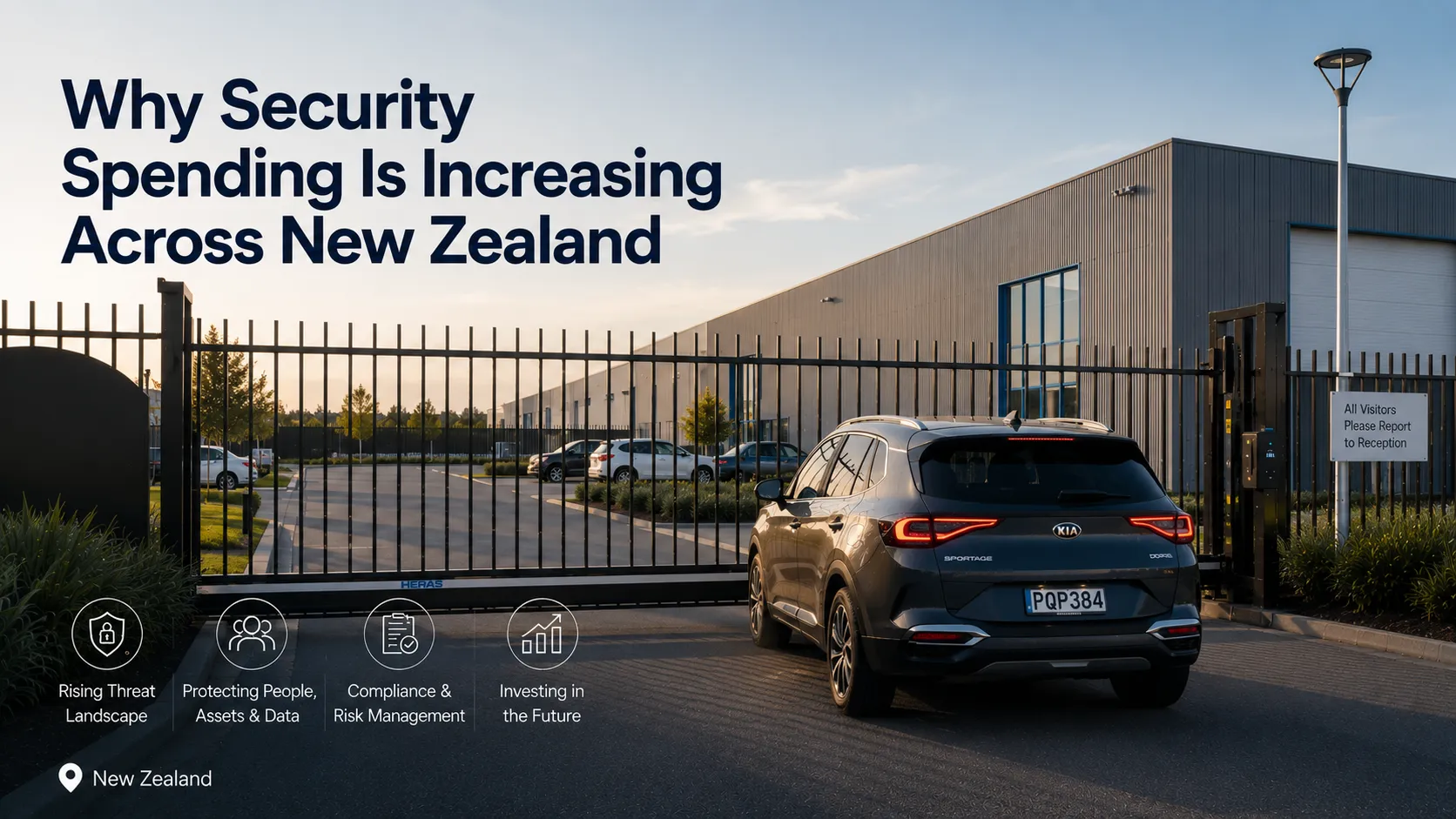

If you look around New Zealand right now, it's not hard to see why security has become a bigger conversation than it was five or ten years ago.
Businesses are thinking more carefully about who can access their sites. Property owners are reviewing how secure their facilities really are. Infrastructure operators are investing in systems that can better manage both people and vehicles. Even residential developments are placing greater emphasis on controlled access and perimeter security.
Security has always been important, but for many organisations, it has shifted from being a nice-to-have consideration to a critical part of everyday operations.
At Aero, we've seen this change first-hand through the growing demand for gate automation, access control, traffic management systems, barriers and perimeter security solutions across a wide range of industries.
Security Is No Longer Just About Preventing Theft
Traditionally, security spending was often driven by concerns around break-ins, vandalism or theft. Those concerns still exist, but the conversation has become much broader.
Today, organisations want to know who is entering their sites, when they entered, where they can go and how access can be managed efficiently.
A warehouse might need to control vehicle access without slowing down deliveries. A commercial office may need different access levels for staff, contractors and visitors. An apartment complex may need a secure way to manage residents while still allowing access for couriers and service providers.
The focus has shifted from simply keeping people out to managing authorised access more effectively.
That is where access control systems, automated gates, intercoms, barriers and intelligent entry solutions are becoming increasingly important.
Commercial Properties Are Facing New Challenges
Many businesses are operating in environments that are more complex than ever before.
Staff work different hours. Contractors come and go throughout the day. Deliveries arrive outside traditional business hours. Multiple tenants may share the same building. Some facilities operate around the clock.
Managing access manually is becoming less practical.
As a result, many businesses are investing in systems that allow them to control access remotely, track activity and make changes quickly when needed. Instead of relying on physical keys or manual processes, businesses can use mobile credentials, keypads, card readers, intercom systems and cloud-based management platforms.
The goal is not necessarily to create more restrictions. In many cases, it is about making access simpler while maintaining a higher level of security.
Infrastructure Investment Is Driving Growth
New Zealand is also seeing significant investment in infrastructure, transport facilities, logistics hubs, commercial developments and large-scale residential projects.
These types of projects often require much more than a basic gate or access point.
Vehicle movement needs to be managed safely. High traffic volumes need to be accommodated. Different user groups need different levels of access. Security requirements need to be balanced with operational efficiency.
This is where technologies such as automated barriers, vehicle access systems, turnstiles, parking management solutions and integrated access control platforms play an increasingly important role.
As facilities become larger and more complex, the systems used to secure them need to evolve as well.
Perimeter Security Is Receiving More Attention
One trend we've noticed is that many organisations are taking a closer look at perimeter security.
Often, security discussions focus on cameras, alarms or internal access control systems. While these are all important, the perimeter is usually where the first security decision is made.
Can vehicles enter the site? Can visitors access restricted areas? Are entry points being monitored and controlled effectively?
An automated gate or access control system does much more than open and close an entrance. It creates a controlled access point that helps determine who can enter, when they can enter and under what conditions.
For many sites, that first layer of security is becoming one of the most important.
Technology Is Making Security More Accessible
Another reason security spending is increasing is that the technology itself has become more capable and more accessible.
Systems that were once reserved for large commercial facilities are now being adopted by smaller businesses, residential developments and even private homeowners.
Cloud-based management platforms allow users to monitor and manage access remotely. Mobile credentials reduce the need for physical cards and keys. Vehicle detection systems improve traffic flow. Number plate recognition is becoming more common. Integration between different security systems is improving every year.
These advancements allow organisations to implement solutions that are both practical and scalable.
Security no longer needs to be complicated to be effective.
Where Aero Fits Into the Conversation
At Aero NZ, we sit in an interesting position within the industry because we work across a wide range of sectors and applications.
We support installers, security professionals, electricians, commercial operators and project teams throughout New Zealand. Through those relationships, we get to see how security challenges are evolving and how organisations are responding.
What we're seeing is a clear trend towards smarter access management, stronger perimeter security and greater investment in technologies that improve both security and operational efficiency.
Automated gates, barriers, turnstiles, parking systems and access control platforms are no longer being viewed as standalone products. They are becoming part of a larger security strategy that helps organisations protect assets, manage risk and improve the way their facilities operate.
Looking Ahead
The reality is that security will continue to evolve as technology advances and the needs of businesses change.
The organisations that are investing today are not simply reacting to current challenges. They are preparing for future growth, changing operational requirements and increasing expectations around safety and access management.
While the tools may continue to change, the goal remains the same.
Create environments that are secure, efficient and easy for authorised users to access.
That is why security spending is increasing across New Zealand, and based on what we're seeing throughout the industry, that trend is unlikely to slow down any time soon.

























Sign in to leave a comment.