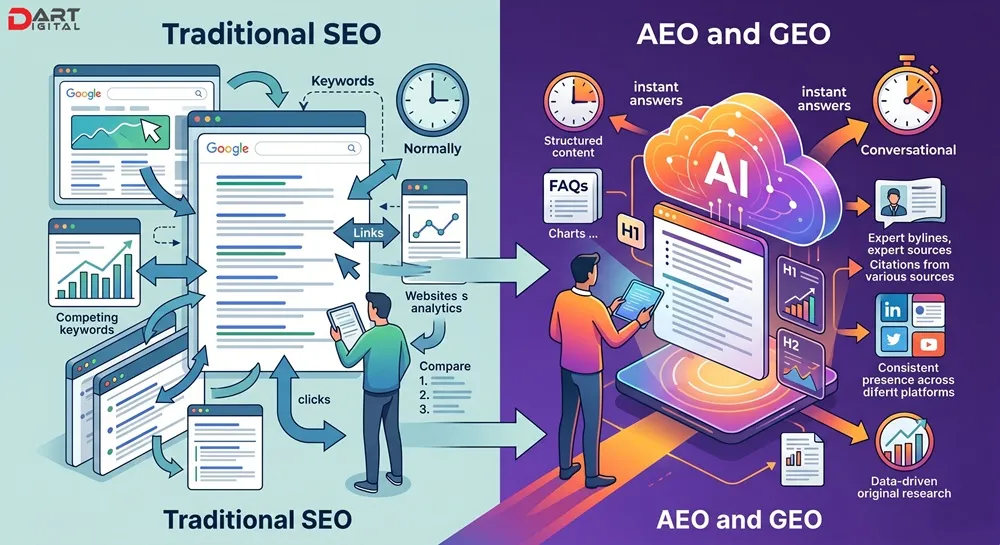

Long gone are the days when digital marketing revolved around ranking on Google. Businesses invested heavily in keywords, backlinks and technical optimisation to appear on top of every search. While SEO remains important, it is no longer the key to success on its own in this ever-evolving market.
Search behaviour has shifted from opening links to expecting instant answers and conversational responses after AI took over. Personalised insights and conversations redefined how visibility is working in the digital space. To move with the market, you need to have the skills of AEO and GEO.
THE LIMITATION OF TRADITIONAL SEO
SEO focuses on improving rankings for the same keywords. Ranking alone doesn’t guarantee visibility, especially when users rarely go beyond the top results. The competition to be the top result is so high that even highly optimised results might appear on the next page.
SEO's dependence on users clicking links today is a big limitation, as users can now get answers directly from search results without visiting any website. Traditional SEO requires users to search and compare multiple links by reading content to get the most appropriate answer. This process is so slow compared to the answers they get from tools like ChatGPT and Gemini, as they give direct answers without too much time wasted on research.
THE RISE OF ANSWER-BASED SEARCH (AEO)
Platforms like Bixby and Siri have changed how people interact with information on the internet. Instead of searching, users just ask a question, and the platforms provide direct answers, not a list of links.
This is how AEO has transformed the digital market. It has reduced search queries to conversations in natural language, making content more question-driven. It has made structured content critical with FAQs, concise explanations, and clear formatting, as they determine if your content has immediate value to give precise answers for questions in conversation.
INTEGRATION OF GEO
The emergence of AI platforms like ChatGPT and Claude has taken this market to another level, as they generate responses by combining multiple sources and don’t just answer.
After the emergence of GEO, brands no longer compete just for rankings like in SEO but to be included in AI-generated answers.
AI prioritises meaning, depth and relevance over keyword repetition; users rely on summaries of AI, making authority and credibility more important than clicks. The insights, examples and structured understanding are provided in the content. This has made the brand make a presence across multiple platforms to be recognised by AI systems. This has made digital marketing transform into a trust-driven, intelligence-based ecosystem where quality matters more than quantity of keywords.
HOW TO TRANSITION FROM SEO TO AEO AND GEO
The shift from traditional SEO to AEO and GEO isn’t about abandoning rankings entirely. It’s about expanding strategies to survive in an AI-driven search landscape.
STEP 1: Restructuring your content for AI comprehension
AI systems don’t read content the way humans do. You need to have clear hierarchies (proper heading structure with H1, H2, etc.).
Direct answers should not be buried in paragraphs, and numbered lists and bullet points help in better scans and data and statistics to back the claim. Make your information appear above for scans. Clear source attribution and citations with FAQ sections help you to make it to the user’s conversations.
STEP 2: Focus on authority signals over keyword rankings. GEO systems don’t care for rank 1 for a keyword.
They care if you’re a trusted and authoritative source on that topic. These signals are recognised by maintaining consistency across multiple platforms and bylines from experts.
Citations from sources and data-backed claims and original research are some factors among AEO and GEO, with engagement and community participation giving a plus point to your years of expertise.
STEP 3: AEO demands question-driven content.
Content strategy should shift and identify the exact questions the audience can ask. The answers should be concise and complete; real examples and comparisons with data specific to the situation help to make your content get selected by your favourite AI.
STEP 4: depth over volume.
GEO shifts from quantity to quality. Instead of publishing many keyword-driven articles, creating fewer and highly authoritative pieces backed by research, examples and continuous updates makes you more valuable to these bots.
STEP 5: Create multi-platform content.
Repurpose your idea across the formats – long-form articles, LinkedIn posts, threads, reels and Twitter posts. Consistent presence across various platforms helps you to make an image and authority, thus increasing your visibility and credibility in AI-driven search.
CONCLUSION
If you are looking for digital visibility in 2026, keywords are not enough; you have to conduct data-driven research and structure content suitable for being recognised by AI to capture the market share. Domination in the market doesn’t come by clicks; it will lead to invisibility. It comes through citations and content with proper formatting and concise, precise paragraphs that are easy for AI to use in answering queries and provides your link for the bibliography.



























Sign in to leave a comment.