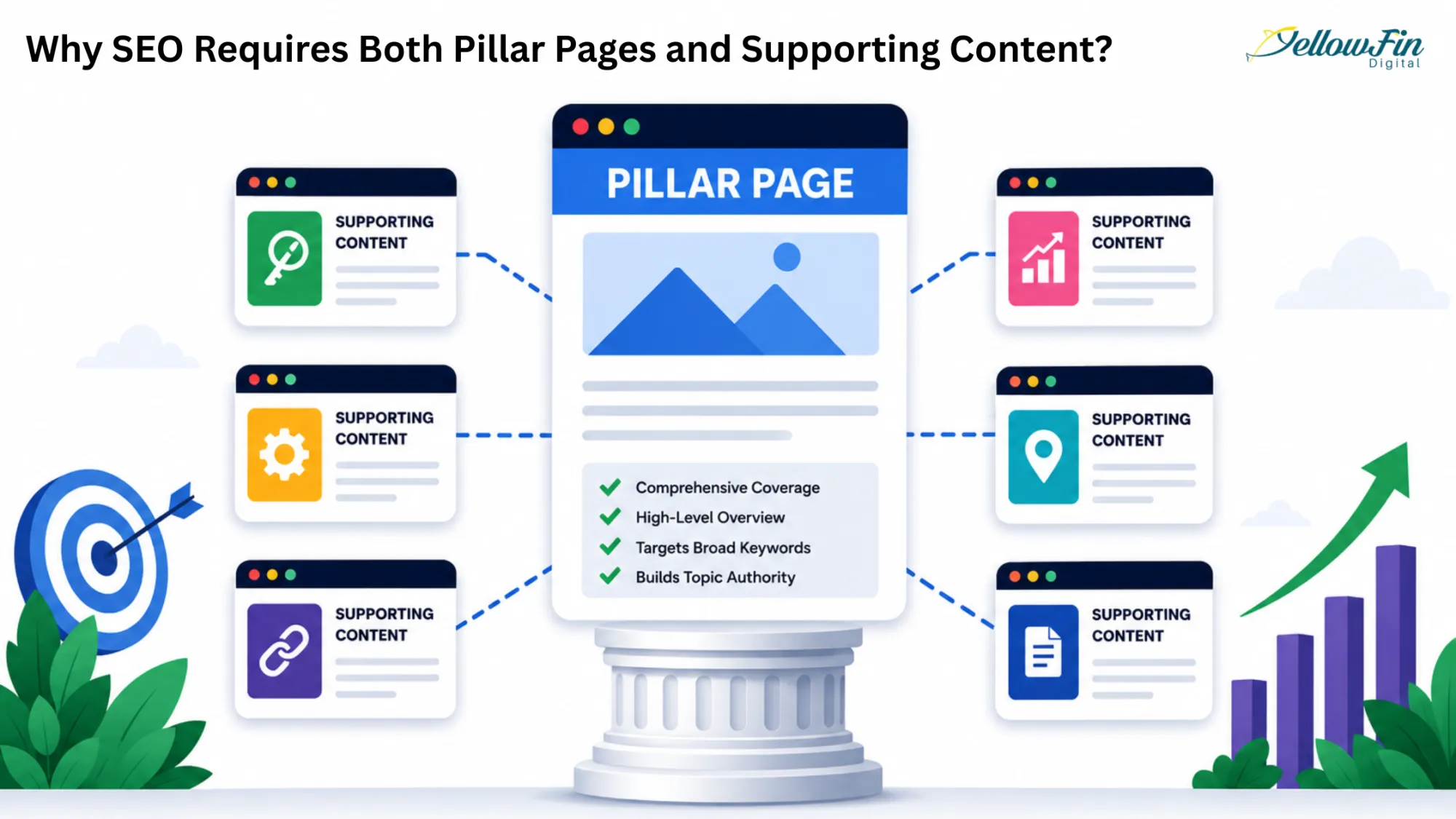

Are you consistently posting blog articles but not getting good search engine results or regular traffic? You may not know how important pillar page SEO is for higher rankings. An experienced SEO company will tell you that it is not enough to post a few blogs.
According to HubSpot, businesses that cluster their content see higher search visibility and engagement. Nowadays, SEO is not limited to keyword research alone; it also includes several other elements.
The search engine assesses the interconnectivity of your webpages when determining their ranking. Pillar pages and their associated content are examples of such elements. This blog discusses the importance of SEO for both pillar pages and supporting content.
Understanding Pillar Page SEO
A pillar page is a large-scale page that covers the full range of information about a single subject. The primary purpose of such a page is to serve as an authoritative source on the topic and lead to several smaller articles that go into detail about various subtopics.
For example, if your blog’s theme is digital marketing, your pillar page might target SEO services. Other blog articles would cover such topics as:
- SEO audits
- Technical SEO
- Local SEO
- Keyword Research
- Link Building
- On-Page SEO
By creating such a hierarchy, you will demonstrate that your company understands the issue well. The main function of a pillar page is its high volume, driven by its comprehensive approach to the topic.
Why Supporting Content Matters In SEO?
It is not enough to write pillar pages that provide a broad explanation of the subject. SEO requires additional, more targeted, and detailed supporting articles. They help your blog rank for long-tail keywords that people enter into Google every day.
Such articles are beneficial for your users as well, since they give additional details that a pillar page cannot include. For example, your blog might have a pillar page devoted to the topic, Website SEO. The following supporting articles should be connected with it:
- Best Practices For Internal Linking For SEO
- How To Improve Website Speed
- Common Technical SEO Mistakes
- How To Perform SEO Audits
- Benefits Of Local SEO
In this manner, you will improve your website's connectivity and boost its SEO.
Search Engines Prefer Organized Websites
Google uses topical relationships and internal linking signals to better understand how pages relate to one another. If the website’s structure makes it easier to understand what it is about, it will rank higher. The content hub structure will help search engines to figure out such details as:
- The depth of your knowledge about the subject.
- Main topic of your website.
- Connection of different pages within your website.
- Most important articles for your website.
If the content architecture is messy, then the search engine will be unable to understand what your website is about. It is one of the main pillars of modern SEO strategy.
SEO Benefits From Proper Internal Linking
Another important benefit of using pillar pages and their supporting blogs in an SEO campaign is an improved linking structure. Internal links will help Google and other search engines crawl the website more effectively and quickly. Besides, they will direct users from one article to another, thereby increasing their engagement rate on the website.
As a result, such a link-building strategy will:
- Improve user experience.
- Improve keyword relevance.
- Help you distribute your authority better.
- Increase the time users spend on the website.
- Boost the efficiency of crawler operations.
Let us imagine that your pillar page targets eCommerce SEO. Then your supporting articles can cover the issues such as:
- Schema Markup
- Product Page Optimization
- Mobile SEO
And each blog would include a backlink to the main pillar page and vice versa. That is how you significantly improve your pillar page’s SEO.
Using Pillar Pages To Build Topic Authority
In recent years, search engines have increasingly taken topic authority into account. Publishing unconnected blog articles might reduce this authority. Combining pillar pages and supportive content allows you to build topic authority SEO. It is achieved through comprehensive coverage of one topic.
By clustering SEO content by specific topics, businesses can rank better for related terms. The best pillar page SEO strategy involves creating multiple topic clusters simultaneously. Let us look at some examples of topic clusters businesses commonly use to improve their SEO results.
- The healthcare website includes cluster pages related to medical billing, patient care, and telemedicine.
- The law firm website contains related cluster pages around family law and business law.
- The home improvement company contains cluster pages like remodeling, plumbing, and roofing.
In this manner, you can increase your website’s credibility for your customers and search engines.
Supporting Content Extends Your Keyword Targeting Range
A pillar page's content cannot cover all variants of different search queries related to the main topic. With the support of blogs, you can cover more search queries. Each supporting blog targets specific search intent and other relevant keywords that the pillar page missed. In this manner, you can increase traffic to your website.
For example, your pillar page on SEO services targets broad keywords. Other blogs will target specific keywords, such as:
- How to create a blog cluster strategy
- How often should you perform an SEO Audit
- What is the semantic SEO structure
- Benefits of Long-Form Content SEO
Such an approach will help you attract visitors at different stages of the purchase funnel.
Case Study Of Pillar Pages and Their Supporting Blogs
Imagine a digital marketing agency wants to rank first for SEO services.
Initially, the agency published blog posts without a clear content structure or clustering strategy. Thus, stagnant rankings on their search engine results, despite a few posts receiving some traffic.
Afterward, the agency created a pillar page devoted to complete SEO services. Further, the company published several blogs on the following topics:
- Mobile SEO
- Content Optimization
- Link Building
- Technical SEO
- Local SEO
- SEO Audits
All these blog articles contain links to the pillar page and vice versa. Over time, Google came to understand the agency’s content structure.
Thus, its rankings started to increase. After restructuring its content into topic clusters, the agency increased organic traffic by 43% in four months. It is how the content silo SEO improves SEO performance.
Pillar Pages Improve User Experience
SEO is more than ranking in search engines. A unique user experience is also one of the most essential factors in determining SEO success. People like browsing websites with a logical and clear structure. In this case, a pillar page will help optimize your visitors' navigation.
There is no need for users to look for the information manually. A well-designed content cluster will guide them to relevant information on the website. As a final consequence, you will get improved factors such as:
- Conversion opportunities
- Time on site.
- User engagement rate.
- Bounce rates.
A proper pillar page SEO strategy will help you keep your visitors engaged for longer.
Long-Form Content SEO Gets A Boost With Supporting Blogs
Nowadays, long-form content is valued for its rich, useful information. However, it works even better when supported by some other articles on the same subject. In this way, you will avoid making the pillar page too long while giving enough information to your users through blogs.
Also, supporting content will keep your website up to date and provide additional keywords.
SEO Planning Gets More Effective
The lack of structural content makes website planning more complicated. One problem with such websites is the risk of similar topics or duplicate content. Clustered content allows businesses to plan SEO more effectively. In particular, it will allow you to:
- Provide room for future SEO growth.
- Detect content gaps.
- Avoid overlapping topics.
- Make stronger keyword targeting.
- Organize your content better.
This structured SEO approach is very popular among SEO teams.
Boost Online Search Rankings With Pillar Page Search Engine Optimization Services
SEO demands much more than periodic blog posting. Businesses should have pillar pages and supporting content to create an interconnected website structure. Pillar pages provide comprehensive information on a single topic. Supporting content helps target additional keywords, improves internal linking for SEO, and increases authority on certain topics.
These two components allow you to build a robust semantic SEO network that benefits both website users and search engines.
From aiding website navigation to increasing keyword coverage, using these components is essential for achieving long-term SEO success and delivering effective search engine optimization services. If you want to implement cornerstone content SEO or content cluster SEO, including pillar pages and supporting content, is a priority for creating a scalable SEO system.





























Sign in to leave a comment.