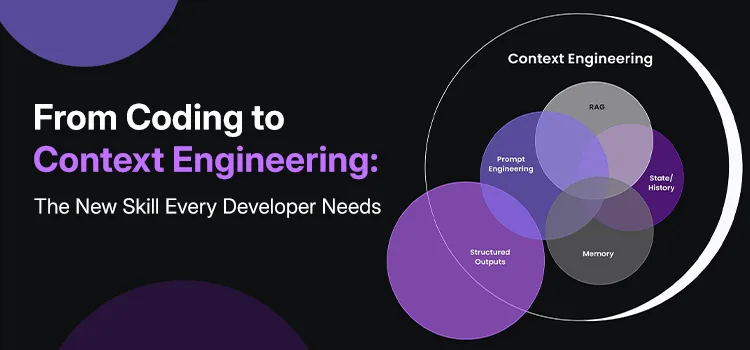

One of the most significant transformations of the software industry in recent times is being witnessed with the emergence of artificial intelligence. In the past few decades, software developers have been known for their proficiency in writing efficient code and developing scalable applications. With the advent of artificial intelligence, the importance of the developer's skills is shifting.
Coding alone can no longer be considered the competitive edge at present. There are AI-driven software solutions that help create code blocks, perform testing, offer optimization suggestions, and even create application parts. Therefore, it means that the emphasis shifts from coding itself to effective management of intelligent systems. It has led to the creation of an entirely new field known as Context Engineering for Developers.
Those businesses that invest in Software Development Services now seek people who know how to take advantage of the power of AI software development. The developers who study context engineering will play a vital role in creating the next digital generation of products.
What is Context Engineering?
Context engineering involves the proper delivery of information and commands to the AI so as to ensure that it comes up with the correct output.
In ordinary programming, the coder writes the steps of execution. Context engineering involves creating the environment for AI.
Traditional coding tells a computer exactly what to do.
Context engineering enables AI to understand what needs to be done and under what conditions.
The accuracy of AI outputs is proportionate to the accuracy of the context in which they were developed. Poor context means that the output is wrong, insufficient, or irrelevant. Good context gives good and relevant outputs.
Context engineering is emerging as a critical skill as AI software development becomes more embedded in enterprise workflows.
Why Coding Alone Is Not Enough Anymore?
With the development of generative AI, software development has been completely revolutionized.
Here’s what today’s AI code assistants can do:
- Generate code in multiple programming languages
- Create documentation automatically
- Propose fixes for bugs
- Create unit tests
- Optimize existing code bases
- Prototype faster
Even as these skills enhance productivity, the demand for programmers does not disappear but gets elevated to higher-order thinking skills.
These include:
- Clearly defining the goals
- Effectively structuring the requirements
- Understanding the business context
- Evaluating the outputs produced by the AI
- Maintaining consistency in architecture
- Adhering to security and compliance standards
In effect, context has become as important as syntax.
The developers who will flourish in the AI age will not be the ones who write the most code. They will be the ones who can give the best instructions, constraints, and guidance to intelligent systems.
The Connection Between Context Engineering and AI Software Development
Modern AI development relies heavily on contextual understanding.
Large Language Models (LLMs) and other AI systems do not think or reason.
They process information based on the data and instructions they receive.
The quality of their work depends on the developer’s ability to frame problems and provide the right context.
Imagine, for example, an AI system whose task is to build an application for managing customers.
Basic asks such as:
“Build me a CRM dashboard.”
This may lead to a generic solution.
But adding more context like:
- Industry you are targeting
- Roles of users
- Security requirements
- Performance requirements
- Integration requirements
- Compliance requirements
This will allow the AI to deliver much more relevant and useful results.
Context engineering helps transform AI from a code generator into a strategic development partner.
Key Areas of Context Engineering
Developers need to focus on some key areas to be effective context engineers. They are as follows:
1. Business Context
Understanding business goals is essential.
Developers need to feed AI systems with data on:
- Customer needs
- Industry requirements
- Business goals
- Competitive benefits
- User expectations
Without a business context, AI-generated solutions may be technically sound but commercially useless.
2. Technical Context
AI requires understanding the technical context.
This involves:
- Codebases
- APIs
- Databases
- Infrastructures
- Frameworks
- Tech stacks
By providing technical context, we can help AIs produce compatible outputs.
3. Architectural Context
Strong software architecture still counts in the age of AI.
Developers should communicate:
- The system’s design patterns
- The scalability requirements
- Performance constraints
- Security standards
- Integration strategies
Architectural context ensures AI-generated solutions fit into the larger system designs.
4. Operational Context
Applications are not standalone.
Developers should provide information on:
- Deployment environments
- Monitoring needs
- Maintenance procedures
- User workflows
- Operational limitations
This helps AI build solutions that are effective in real-world situations.
Advantages of Context Engineering to Software Development Services
The companies providing Software Development Services are now embracing artificial intelligence workflows. This has several advantages that include:
Quick Development Processes
Developers will have more time to define requirements for the project and validate the results because of reduced time spent on repetitive coding.
Better Quality
A rich context will lead to the generation of better solutions by artificial intelligence.
Improved Collaboration
Context engineering leads to an increased shared understanding between all parties involved.
Reduced Rework
A clear direction of context will minimize the need for rework during development.
Innovation
Developers can concentrate on solving complicated business problems and not repetitive tasks.
These advantages help businesses deliver projects faster while maintaining high-quality standards.
The Role of Development Tools in Context Engineering
In modern times, software development tools are becoming increasingly AI-powered.
Some of the capabilities that modern platforms provide include:
- AI-enabled coding
- Testing automation
- Smart debugging
- Coding suggestions
- Workflow automation
- Documentation generation
How effectively the developers utilize these capabilities depends on the context that they provide.
For instance, the built-in AI tool can help in generating the code rapidly. But the code generated may need significant changes if the project requirements, architecture, and business goals are not known.
With the continuous improvement of these tools, context engineering will be an essential skill for utilizing them.
Why Companies Want Developers Who Understand Context
Businesses are rapidly investing in AI-powered development environments.
As a result, hiring priorities are changing.
Companies are looking for more than technical skills from developers. Companies want people who can :
- Understand business needs
- Translate goals into AI instructions
- Build scalable infrastructures
- Work with AI results
- Optimize the development workflow
This is revolutionizing hiring practices around the world.
Businesses looking to Hire Dedicated Developers now prioritize candidates who can work effectively with AI systems and understand contextual design principles.
A developer who begins working on context engineering will have a huge competitive edge in the job market.
Practical Steps to Learn Context Engineering
The good news is that developers can begin developing context engineering skills immediately. They should learn the following:
Learn Prompt Engineering
Try out AI models and notice the impact of various instructions on their outputs.
You need to concentrate on:
- Clarity
- Specificity
- Constraints
- Examples
- Intended outcomes
Deepen Industry Insight
The more you know about business processes and industry problems, the more context you can offer.
Learn Software Architecture
Architecture knowledge enables developers to steer AI toward scalable, maintainable solutions. Key areas include:
- Microservices
- Event-driven systems
- Cloud-native architectures
- Security frameworks
- Performance optimization
Communication Skills
Context Engineering is all about communication. The developers have to learn to effectively communicate with the following:
- AI system
- Stakeholders
- Product manager
- Designers
- Technical people
Continuous Learning
The field of AI technology changes quickly. The developers have to constantly learn about new technologies and methodologies.
The Future of Software Development
The Future of Software Development is not going to be about AI taking the place of developers. Rather, it will be based on a partnership between developers and AI systems. In the years to come, developers will become:
- Context architects
- System designers
- Problem solvers
- AI system supervisors
- Business interpreters
Programming skills will continue to matter, yet not be limited to programming alone.
The most competitive specialists will be those capable of merging technical knowledge with contextual understanding.
Those companies that develop skills in context engineering will have a distinct edge.
Conclusion
The rate of evolution of the software development industry is becoming more rapid by the day. Although coding is essential for software developers, it no longer dictates their success alone.
Context engineering allows software developers to steer the AI process and achieve success in their projects.
Software Development Services can benefit from context engineering to speed up development processes. Context Engineering for Developers is your way forward to stay relevant and useful in the era of increasing AI influence.
The future is not about people who know how to write code. The future is about people who are able to create context for AI to make smarter and faster solutions. With the growth of AI software development, context engineering will be one of the key skills for Software engineers.




























Sign in to leave a comment.