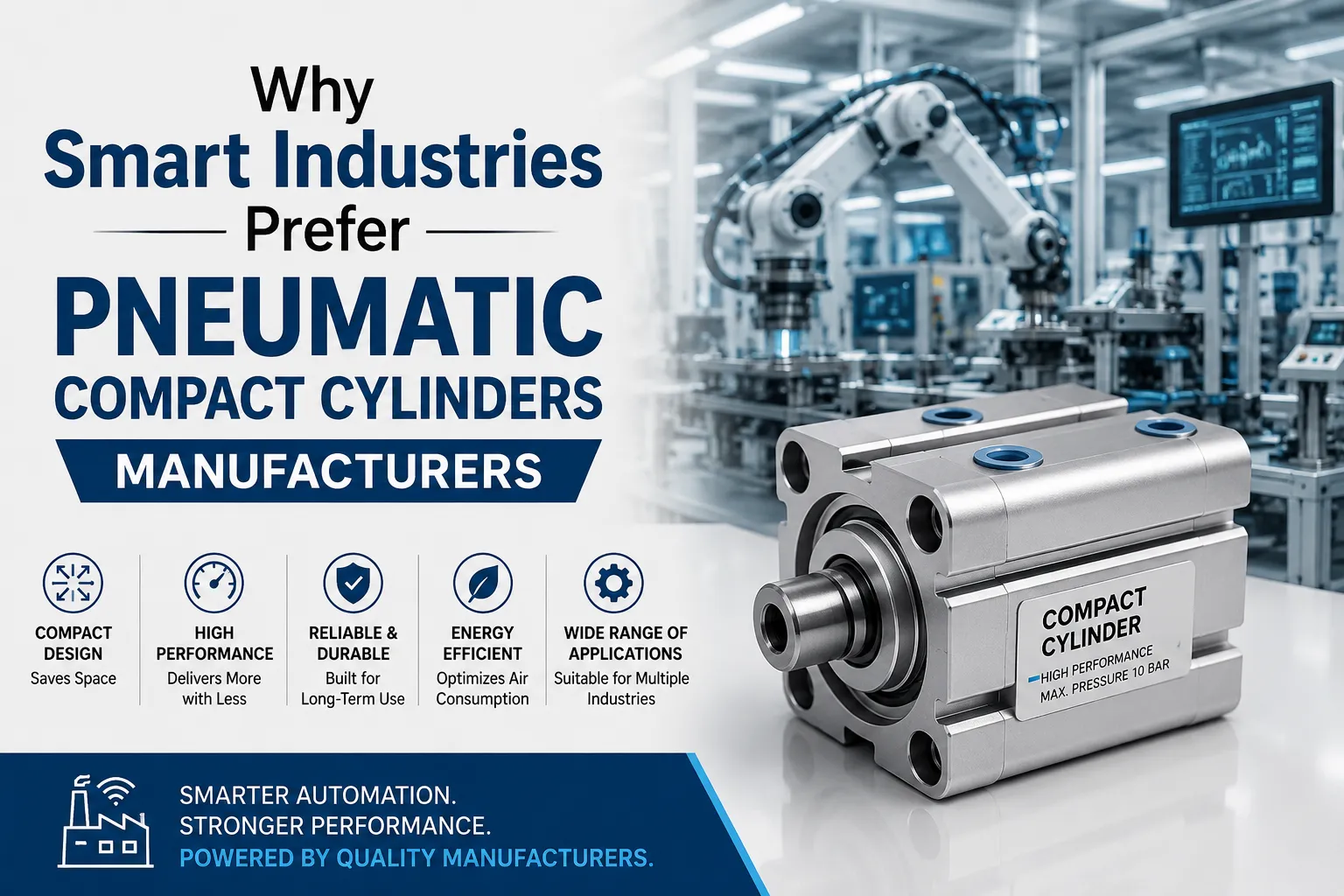

A packaging line stops for 47 minutes because one compact cylinder fails near the end of a shift. Production backs up. Operators start bypassing safety timing. Procurement gets blamed. That's usually the moment buyers start taking Pneumatic Compact Cylinders Manufacturers seriously instead of treating cylinders like interchangeable catalogue items.
Most buyers focus on unit price first. That mistake gets expensive fast. In Indian manufacturing alone, unplanned downtime can cost mid-sized factories lakhs every month depending on production volume and labour dependency. A poorly machined cylinder body or inconsistent seal quality rarely fails on day one. It fails after installation, during actual production pressure.
And yet, smart factories are changing how they source components. They now evaluate long-term air efficiency, mounting accuracy, replacement consistency, and supplier accountability before issuing repeat orders.
The Spec Detail Most Buyers Skip During Cylinder Procurement
Compact cylinders look simple from outside. Internally, the difference between a stable unit and a troublesome one is usually machining tolerance, seal material, and rod alignment.
Bore Size and Stroke Accuracy Matter More Than Catalogues Suggest
Most industrial Pneumatic Compact Cylinders operate in bore sizes ranging from 12 mm to 100 mm. Stroke accuracy becomes critical in automated assembly systems where repeatability affects final product quality.
Here's what many procurement teams miss: a 0.5 mm alignment variation can create repeated placement errors in high-speed automation lines.
Suppliers who avoid sharing tolerance ranges usually have inconsistent production control.
Aluminium Quality Changes Real-World Performance
Not all aluminium cylinder bodies behave the same under continuous factory vibration and compressed air cycles. High-grade anodized aluminium resists corrosion better and handles temperature fluctuations more reliably.
Cheap bodies crack near mounting threads first.
Nobody tells you this during sales meetings.
Seal Material Decides Service Life
Nitrile seals are common. Polyurethane lasts longer in aggressive industrial environments. Viton becomes necessary in high-temperature applications.
A supplier recommending one seal type for every industry probably doesn't understand application engineering properly.
Compact Design Helps Where Space Is Expensive
Modern robotics cells, PET moulding systems, and semiconductor assembly units often have limited mounting space. Compact cylinders reduce footprint without sacrificing force output.
Which means factories can increase automation density without redesigning the entire machine layout.
Why Evaluating Pneumatic Compact Cylinders Manufacturers Requires More Than a Price Sheet
1. Ask for Batch Consistency Records
Reliable manufacturers maintain production consistency across batches.
Bad answer: “All our products are tested.”
That statement means nothing unless the supplier can explain pressure testing frequency, leakage standards, and inspection methods.
2. Check Lead Time Stability, Not Just Quoted Delivery
Many buyers only verify first shipment timelines.
That's an incomplete perspective.
A supplier may take 9 days to deliver one time but take 38 on another. This creates inventory instability. Smart procurement teams instead check quarterly dispatch consistency.
3. Evaluate Spare Part Availability
Cylinder failure is manageable. Waiting three weeks for replacement seals is not.
Ask directly about seal kits, piston rods, and mounting accessories availability.
Bad answer: “We'll arrange after order confirmation.”
That usually means the supplier has no inventory planning.
4. Review Export Capability and Documentation
Factories selling machinery overseas need vendors who handle compliance paperwork, packing, and shipping standards.
An ISO-certified supplier exporting to 31 countries generally understands repeat quality expectations better than a trader operating from temporary stock.
5. Verify Technical Support Response Time
Some suppliers disappear after dispatch.
Which becomes painfully obvious during commissioning problems.
Ask how quickly their technical team responds to installation issues. Anything beyond 24 working hours for industrial support is slow by current manufacturing standards.
The Margin Protection Benefits Buyers Actually Care About
Reduced Air Leakage Lowers Operating Cost
Compressed air systems are expensive to run. Even minor leakage increases compressor load over time.
Studies from industrial energy audits regularly show compressed air systems losing 20–30% efficiency through leaks and poor component quality.
High-quality compact cylinders reduce seal failure frequency and maintain pressure stability longer.
Better Repeat Accuracy Reduces Product Rejection
In lines that have component packing or molding, cylinder imbalance affects the product negatively.
One drifting actuator makes thousands of unnoticeable blunders before the workforce notices them.
Lower Maintenance Frequency Improves Production Planning
Maintenance teams already deal with enough unplanned stoppages.
Reliable cylinders reduce emergency replacement cycles and improve preventive maintenance scheduling.
That matters more in multi-shift operations running 18–20 hours daily.
Compact Installation Saves Machine Space
Machine builders increasingly prefer compact pneumatic systems because factory floor space is expensive, especially near urban industrial clusters in India.
Smaller actuator assemblies also simplify machine guarding and cable routing.
Reliable Suppliers Reduce Procurement Risk
A dependable supplier prevents documentation delays, dispatch confusion, and inconsistent specifications between orders.
That sounds basic. It isn't.
Many industrial buyers have experienced receiving slightly different dimensions in repeat batches without prior notice.
Integration with Angle Valves and Solenoid Systems Improves Automation
Modern pneumatic systems rarely work alone. To ensure that their automation setups work perfectly, buyers increasingly purchase Angle Valves, Motorized Solenoid Valve systems, and compact cylinders from the same seller.
Slow integration between cylinders and valves results in poor actuation timing and pressure fluctuation.
Reasons Why India is Notable for Pneumatic Systems Sourcing
India's industrial automation is growing investment across packaging, automotive, pharmaceuticals, textiles, and food processing. Therefore, demand for Pneumatic Compact Cylinders Suppliers in India is increasing to satisfy buyers who need faster dispatches, low freight costs, and local technical support.
The new supply chain reality all buyers are coming to understand is that purchasing from far off foreign sellers may reduce the initial price for each unit, but delays in replacements result in a loss of production.
Regional Manufacturing Strength Matters
Western India remains strong for machining infrastructure. Northern India has improved logistics access significantly. Southern India dominates several automation-heavy industries requiring precision pneumatic systems.
Which means location is now part of supply chain strategy, not just vendor identity.
Factories also increasingly prefer sourcing Angle Valves Suppliers in India and Motorized Solenoid Valve Suppliers in India from the same network to simplify procurement and spare management.
Single-vendor coordination reduces compatibility disputes.
What We've Learned After Supplying Industrial Buyers
At V.S Enterprises, we've worked with wholesalers, OEM buyers, machine builders, and procurement managers who care less about marketing language and more about repeat reliability.
We know where orders usually go wrong.
Sometimes it's poor packaging during interstate transport. Sometimes it's incorrect thread specifications buried inside purchase orders. In 2022, we stopped utilizing a lower-cost rod coating option when we kept getting feedback from PET molding customers that operated in more humid conditions. After we changed the coating, we saw a reduction in the rejection rate.
This is what real experience in the industry is.
We have also learned that buyers appreciate more honesty than over-promising. This is especially true when it comes to lead times. Instead of saying lead times are “up to” x days, saying it will require 7 additional production days is a more honest and proactive approach.
Technical Requirements Are More Important Than RFQs
If you are inquiring with Pneumatic Compact Cylinders Manufacturers in India, ensure you include the application specifics. This should include bore size, operating pressure, mounting style, stroke length, and industry, along with the expected annual volume.
Typically, we respond to technical inquiries within one working day.
For both OEM and wholesale buyers, MOQ negotiations are based on the specifications, as we tend to be more flexible than on the quantities.
And yes, custom configurations often take longer than buyers initially expect because machining tolerance verification cannot be rushed without increasing rejection risk.
Smart Procurement Teams Already Changed Their Sourcing Standards
The factories gaining production stability aren't necessarily buying the cheapest components anymore. They're buying from Pneumatic Compact Cylinders Manufacturers that understand consistency, response time, and industrial pressure realities. As automation expands across Indian manufacturing, supplier quality will matter even more over the next five years.
Here is another blog you might be interested in.
Smart Guide to Pneumatic Foot Pedal Manufacturers
FAQs
What the buyers want Pneumatic Compact Cylinders Manufacturers from India?
Compared to other regions, Indian Manufacturers’ dispatched faster, had easier technical communication, and offered more cost-effective freight services. In addition, many buyers reported preferring more easily accessible local Emergency Procurement Support, Replacement Part Availability and Procurement.
Usage of Pneumatic Compact Cylinders in Automation Systems:
Space for installation is always a given but the required force output should be maintained. This is very important in the design in robotics cells, compact machines, and PET moulding systems where the space for design and mounts is a constraint.
Angle Valves are commonly used in which type of industries?
Angle Valves are preferred in all steam systems, Food Processing Plants, Chemical Handling Lines, and Automation systems where a fast Shutoff is desirable. Choice is primarily means temperature and type of media being handled.
Why do all the Angle Valves manufacturing companies in India differ in the quality?
The answer is No.
Comparatively, some manufacturers concentrate on the quality of seals and machining accuracy while others focus largely on cost. These buyers should assure their self pressure rating, testing methods, and body material specifications before placing bulk orders.
What question should buyers ask Indian Motorized Solenoid Valve Manufacturers before they place the order?
Include coil life span, supply voltage, ingress protection rating, and operational cycles limit. Most valves are quality intermittent use, however, they may fail quickly in continuous use industrial applications.
Are Indian Motorized Solenoid Valve Suppliers able to meet customers' customs needs?
Both yes and no. Buyers should assume longer production times in cases of custom orders and make sure the producers are able to provide custom solutions, before they finalize their timelines for numerous specialized voltage configurations or various custom port sizes.
What are the reasons for wholesalers to choose Pneumatic Compact Cylinders Suppliers in India for long-term agreements?
Dependable suppliers in close proximity decrease the chances of risking prolonged downtime, ease the tedious process of keeping stock, and enhance simple communication in times of need to urgently dispatch. The buyers that run numerous factories find particular advantage in having an ongoing domestic support system.
























Sign in to leave a comment.