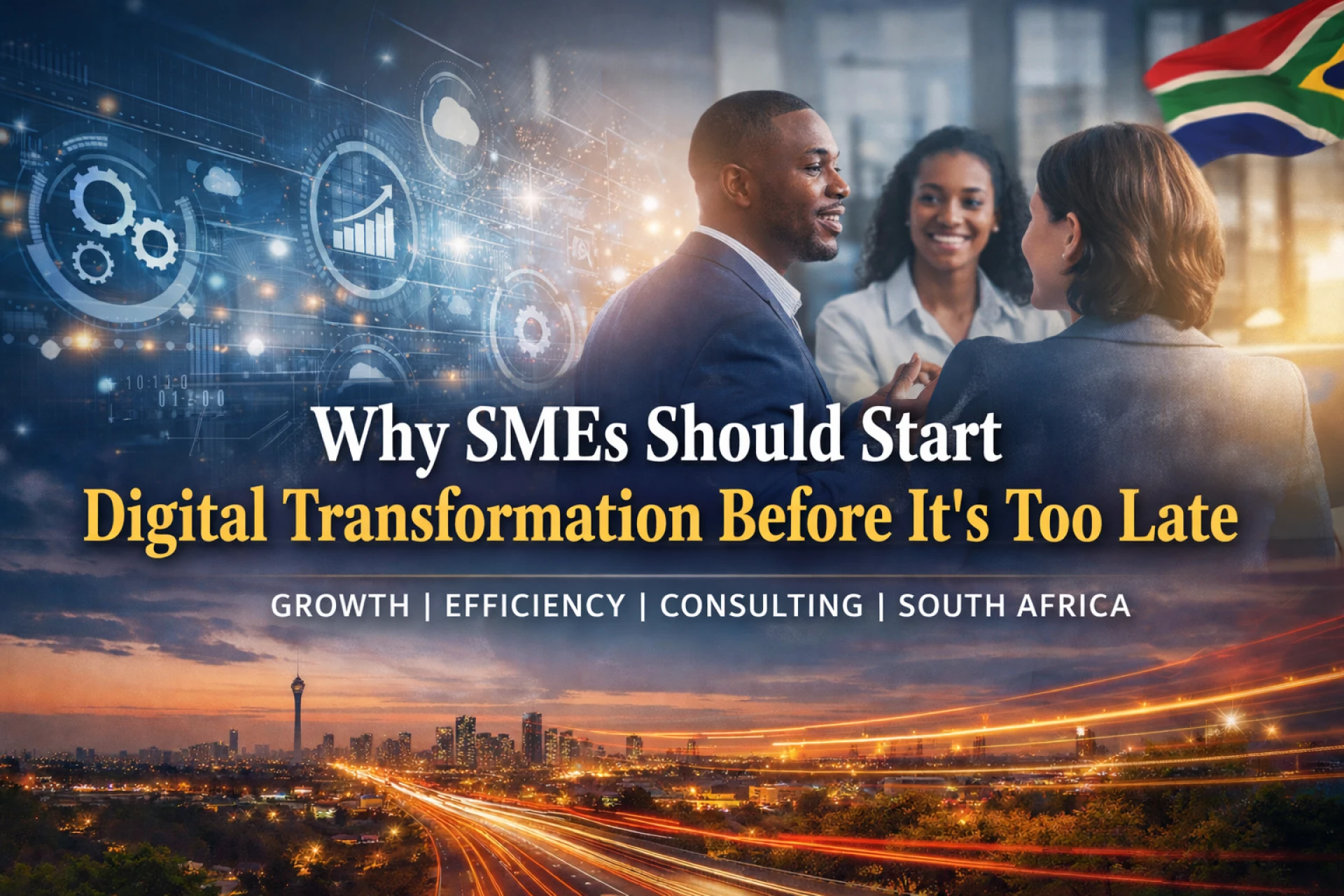

Why Digital Transformation Matters for SMEs in South Africa?
Digital transformation for SMEs is not just about adopting new technology. It is a business mindset focused on rethinking strategy, processes, culture, and customer experience to drive measurable outcomes. Successful digital transformation aligns technology with business goals, leadership vision, and continuous improvement.
Small and medium-sized enterprises (SMEs) are the backbone of most economies — especially in emerging markets like South Africa. Yet many SMEs still believe that digital transformation is something to worry about later, once the business is bigger, more stable, or less busy.
That mindset is risky.
In today’s economy, digital transformation is no longer optional for SMEs. It is a critical driver of survival, competitiveness, and sustainable growth. Businesses that delay transformation often find themselves reacting to change instead of leading it — and by the time they act, it may already be too late.
What Digital Transformation Means for SMEs
Digital transformation for SMEs is not about buying expensive software or becoming a tech company. It is about rethinking how the business operates, serves customers, and makes decisions using digital tools and data. in short it is complete business digital transformation strategy for Business growth.
For SMEs, digital transformation typically includes:
- Digitising manual or paper-based processes
- Improving customer experience across digital channels
- Using data to inform business decisions
- Automating repetitive tasks to reduce costs
- Enabling remote and flexible ways of working
The goal is simple: do more with less while delivering greater value to customers.
Why Waiting Is the Biggest Risk for SMEs
Many SME owners delay digital transformation due to perceived cost, complexity, or lack of internal skills. However, the real risk lies in doing nothing.
Here’s why delaying digital transformation puts SMEs at a disadvantage:
1. Customers Expect Digital Experiences
Customers today expect seamless, fast, and personalised experiences — whether they are dealing with a large enterprise or a small business.
If your SME cannot:
- Respond quickly
- Offer online services or self-service options
- Communicate consistently across channels
customers will move to competitors who can.
2. Larger Competitors Are Becoming More Agile
Digital tools have levelled the playing field. Large organisations are becoming faster and more customer-centric, while digitally mature SMEs are scaling rapidly.
SMEs that delay digital transformation risk being squeezed from both sides — losing customers to larger firms and more digitally advanced small competitors.
3. Operational Inefficiencies Drain Profitability
Manual processes, disconnected systems, and poor data visibility increase operational costs and limit growth.
Digital transformation enables SMEs to:
- Streamline workflows
- Reduce errors
- Improve productivity
- Gain real-time business insights
In an environment of rising costs and economic pressure, efficiency is no longer optional.
Digital Transformation Is More Affordable Than Ever
One of the biggest misconceptions among SMEs is that digital transformation requires massive upfront investment.
In reality:
- Cloud-based solutions reduce capital expenditure
- Subscription pricing models make technology accessible
- Scalable platforms grow with your business
- Automation delivers quick returns on investment
With the right digital transformation strategy, SMEs can start small, focus on high-impact areas, and scale over time.
Digital Transformation Improves Decision-Making
Many SMEs rely on intuition and experience to make decisions. While valuable, this approach becomes risky as the business grows.
Digital transformation introduces:
- Centralised data
- Real-time reporting
- Performance dashboards
- Predictive insights
This allows SME leaders to make faster, more confident, data-driven decisions.
Cybersecurity and Business Resilience
As SMEs adopt more digital tools, cybersecurity becomes a critical consideration — not a barrier.
Digital transformation helps SMEs build resilience by:
- Securing data and systems
- Reducing dependency on manual processes
- Enabling business continuity and remote operations
- Protecting customer trust
Waiting until a breach or system failure occurs is far more costly than proactive transformation.
The Role of Digital Transformation Consulting for SMEs
SMEs do not need large internal IT teams to transform successfully. This is where digital transformation consulting services play a key role.
An experienced digital transformation consultant helps SMEs:
- Define a clear transformation vision
- Prioritise initiatives with the highest ROI
- Select the right technologies
- Manage change and adoption
- Measure success through business KPIs
The focus is always on practical, outcome-driven transformation, not unnecessary complexity.
Start Small, Start Now
Digital transformation is not a one-time project. It is an ongoing journey.
For SMEs, the best approach is to:
- Identify critical business pain points
- Define clear, measurable goals
- Implement targeted digital solutions
- Upskill teams gradually
- Continuously optimise and improve
Starting early allows SMEs to build digital maturity over time — without disruption or excessive risk.
Final Thoughts:
Digital transformation consulting is no longer about implementing tools or managing technology projects. The best consulting services focus on solving the next phase of business challenges — growth, efficiency, resilience, and competitiveness.
True digital transformation consultants act as strategic partners, helping organisations align business strategy, people, processes, and technology to deliver measurable outcomes. This new phase of consulting is practical, data-driven, and outcome-focused — not theoretical or technology-led.
For SMEs and growing organisations, choosing the right digital transformation consulting partner Like New Phase Solution can mean the difference between reacting to change and leading it. The future belongs to businesses that transform with purpose, clarity, and the right expertise guiding every step.
Sign in to leave a comment.