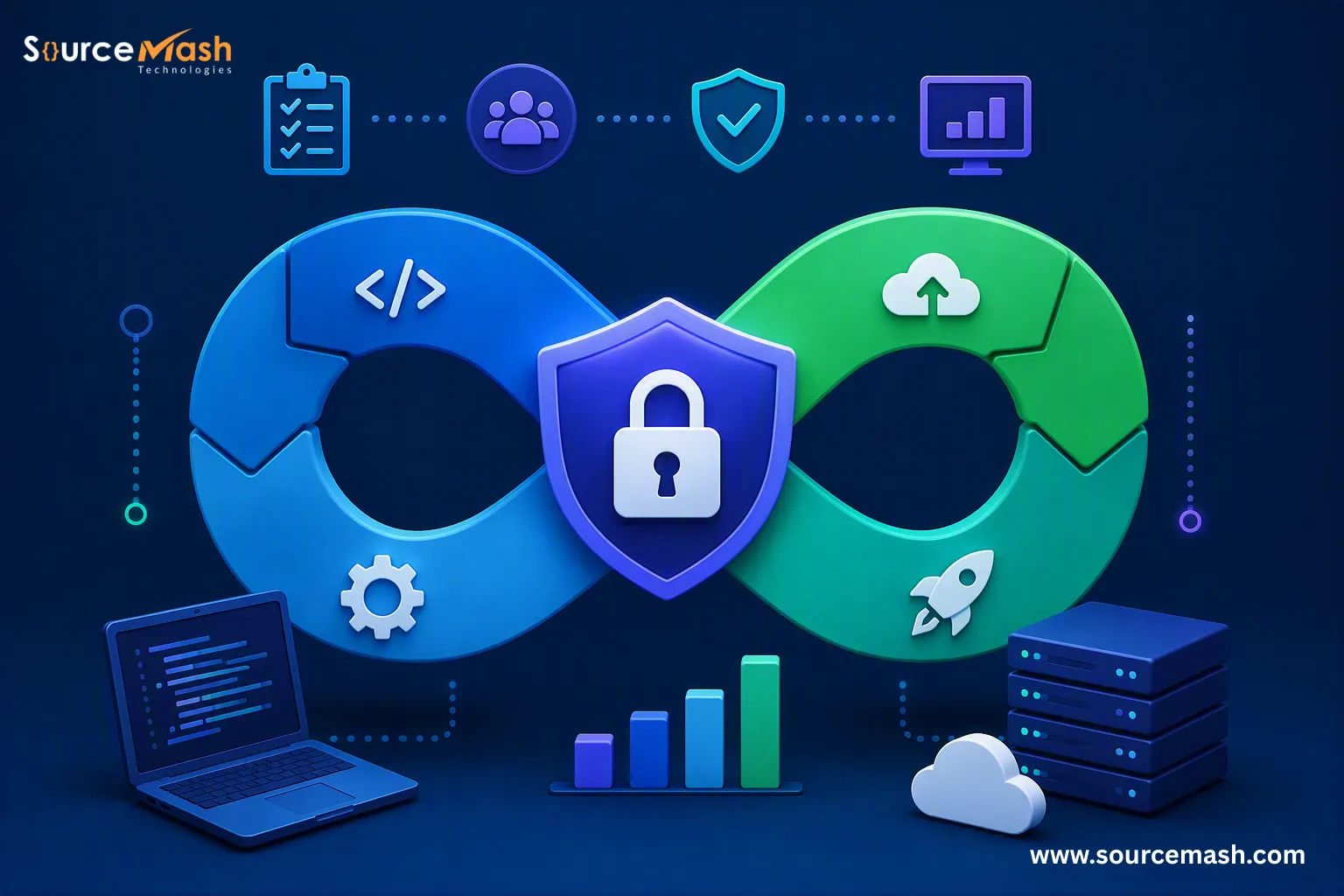

Modern software teams are expected to release applications quickly, maintain reliability, and respond to security risks without slowing development to a crawl. That combination is one reason DevSecOps has become increasingly important. Whether a business works with an internal engineering team or searches for a software development company in usa, understanding how security is integrated into the development process can help decision-makers evaluate software quality beyond features, deadlines, and cost.
DevSecOps brings development, security, and IT operations into a shared software delivery process. Instead of treating security testing as a final checkpoint before release, teams incorporate security activities throughout planning, coding, building, testing, deployment, and operations. National Institute of Standards and Technology guidance published in March 2026 demonstrates how its Secure Software Development Framework can be implemented through modern DevSecOps pipelines, while the updated OWASP DevSecOps guidance similarly maps security controls across the development lifecycle.
This change is not simply about adding more security tools. It represents a broader shift toward making security part of everyday software engineering.
What Is DevSecOps?
DevSecOps stands for Development, Security, and Operations.
Traditional software development frequently placed these responsibilities in separate stages:
Development → Testing → Security Review → Deployment → Operations
DevSecOps aims for a more continuous model:
Plan → Develop → Build → Test → Release → Deploy → Operate → Monitor → Improve
Security controls are integrated across these stages rather than concentrated near the end. The current National Institute of Standards and Technology DevSecOps reference model explicitly includes stages such as planning, development, building, testing, releasing, deploying, and operating, along with continuous security, monitoring, and feedback. The updated OWASP guideline organizes secure software development around similar lifecycle activities.
For example, a developer could receive an alert about a vulnerable dependency when creating a pull request rather than discovering the problem weeks later during a pre-release security assessment.
Why Are Companies Moving Toward DevSecOps?
1. Modern Release Cycles Leave Less Room for Late Security Testing
Continuous integration and continuous delivery have made frequent software changes practical. Security processes therefore need to operate at a similar pace.
Automated checks can be incorporated into CI/CD pipelines to examine source code, dependencies, containers, credentials, infrastructure configuration, and deployment artifacts. National Institute of Standards and Technology describes automation and standardization as important mechanisms for consistently applying secure-development practices across modern pipelines. OWASP likewise includes static analysis, software composition analysis, container security, secrets management, repository hardening, and other controls in its current DevSecOps guidance. [nist.gov], [github.com]
The practical goal is not to eliminate manual security work. Instead, routine checks can be automated while security specialists focus their attention on architecture, complex vulnerabilities, threat modelling, and higher-risk changes.
2. Software Supply Chains Have Become a Major Security Concern
Applications rarely consist entirely of code written internally. They typically rely on open-source libraries, packages, frameworks, containers, build systems, APIs, and other third-party components.
That dependency creates a software supply-chain challenge. A vulnerability or compromised component somewhere upstream may eventually affect applications that depend on it.
One response is the increasing use of a Software Bill of Materials (SBOM). An SBOM provides structured information about components contained within software, helping organizations understand dependencies and investigate whether identified vulnerabilities affect their systems. In August 2025, the Cybersecurity and Infrastructure Security Agency published draft updated minimum elements for SBOMs, reflecting growing adoption, automation needs, and the increasing maturity of software-transparency practices. [cisa.gov], [downloads....ations.gov]
In September 2025, Cybersecurity and Infrastructure Security Agency and international cybersecurity partners also published a shared vision promoting SBOM generation, analysis, and sharing as part of software security and supply-chain risk management.
A mature DevSecOps pipeline can therefore do more than scan application source code. It can also inventory dependencies, identify known vulnerabilities and preserve information about what went into a software build.
3. Security Problems Can Be Addressed Earlier
A central DevSecOps concept is sometimes described as shift left, meaning security activities happen earlier in development.
A team might introduce:
- secure-design reviews during planning;
- threat modelling before implementation;
- IDE or pre-commit checks while developers write code;
- secret detection before credentials reach repositories;
- Static Application Security Testing (SAST) during builds;
- Software Composition Analysis (SCA) for dependencies;
- container and infrastructure-as-code scanning;
- application testing before deployment;
- runtime monitoring after release.
Current OWASP DevSecOps guidance goes beyond simple shift-left security and describes security controls throughout design, development, build, test, release, deployment, and operations. National Institute of Standards and Technology similarly positions continuous security, monitoring, and feedback around the full DevSecOps lifecycle.
This is important because DevSecOps should not mean"run every security scanner as early as possible." Different risks are best detected at different points.
4. AI-Assisted Programming Is Changing the Security Equation
Artificial intelligence is now becoming part of mainstream developer workflows.
GitHub's 2025 Octoverse report stated that more than 1.1 million public repositories were using an LLM SDK and reported strong growth in AI-related development. The same report described generative AI as becoming a standard part of development activity on its platform.
This trend makes verification increasingly important. AI-generated or AI-assisted code still needs code review, testing, dependency analysis, security scanning, and appropriate human oversight.
The latest DevSecOps guidance reflects this change. National Institute of Standards and Technology's March 2026 DevSecOps material specifically addresses the role of artificial intelligence in software development, while OWASP's refreshed 2025/2026 guidance covers AI-assisted development and AI governance.
In practical terms, organizations increasingly need pipelines capable of validating code regardless of whether it was written manually, suggested by an AI coding assistant, or produced through an agent-assisted workflow.
5. Secure-by-Design Thinking Is Gaining Importance
Another trend supporting DevSecOps adoption is the move from security added later toward security designed in from the beginning.
Cybersecurity and Infrastructure Security Agency's Secure by Design initiative argues that technology manufacturers should treat customer security as a core business requirement and address security during product design rather than shifting most responsibility to users. Its guidance encourages software manufacturers to reduce exploitable flaws before products are widely released.
DevSecOps provides technical and operational mechanisms that can support this philosophy. Threat modelling, secure coding standards, automated testing, dependency controls and deployment safeguards can turn broad security objectives into repeatable engineering activities.
6. Automation Makes Security More Repeatable
One of DevSecOps' most practical advantages is consistency.
Instead of depending entirely on someone remembering a security checklist, organizations can define automated policies in their delivery pipeline.
National Institute of Standards and Technology's ongoing DevSecOps project specifically examines the implementation of SSDF security practices through modern pipelines and commercial technologies. OWASP's current guidance similarly emphasizes security activities distributed throughout development and delivery processes. [nist.gov], [github.com]
Automation is particularly useful for high-frequency development because the same baseline tests can be performed every time software changes.
DevOps vs. DevSecOps
The difference between the two approaches is more about responsibility than terminology.
| Area | DevOps | DevSecOps |
|---|---|---|
| Main emphasis | Development and operations | Development, operations and integrated security |
| Security | May operate as a separate process | Embedded throughout the lifecycle |
| Testing | Automated functional/quality testing | Functional plus automated security testing |
| Dependencies | Dependency management | Dependency management plus security analysis |
| Pipeline | CI/CD automation | CI/CD with security controls |
| Monitoring | Reliability and performance | Reliability, performance and security |
| Culture | Shared Dev/Ops responsibility | Security becomes a shared responsibility |
Modern guidance increasingly treats security as a lifecycle activity rather than an isolated gate. Both National Institute of Standards and Technology and OWASP describe security practices spanning multiple stages of software delivery.
What DevSecOps Does Not Solve
Despite its advantages, DevSecOps is not a guarantee of secure software.
Too many scanner alerts
Automated tools can produce false positives or large numbers of low-priority findings. If teams cannot prioritize results, developers may start ignoring warnings.
Tooling can become overly complex
Adding SAST, SCA, secrets detection, SBOM generation, container scanning and other technologies without a clear strategy can create pipeline delays and operational overhead.
Automation cannot replace security expertise
A scanner may identify a known insecure pattern, but architectural problems and business-logic vulnerabilities can require human analysis.
Culture remains important
Security tools provide limited value when developers view them only as obstacles. OWASP's current model explicitly treats people, process, and governance as three pillars of DevSecOps, highlighting that implementation is broader than technology alone.
Consequently, organizations should measure DevSecOps success by improvements in risk management and development practices, not simply by how many security products are installed.
A Practical DevSecOps Adoption Strategy
Companies do not necessarily need to rebuild their development process all at once.
A manageable approach is:
Step 1: Understand the existing workflow
Document how code currently moves from a developer's machine to production.
Step 2: Identify high-risk areas
Look at exposed secrets, vulnerable dependencies, access controls, cloud configuration, application architecture and existing vulnerability history.
Step 3: Establish basic automated checks
Start with controls that address meaningful risks rather than installing every available security tool.
Step 4: Secure source-code and CI/CD environments
Limit unnecessary privileges, protect credentials and carefully control who or what can modify workflows and deployment environments.
Step 5: Improve dependency visibility
Maintain accurate dependency information and consider automated SBOM generation where appropriate. Current Cybersecurity and Infrastructure Security Agency work emphasizes machine-processable SBOMs and their role in vulnerability and supply-chain risk management.
Step 6: Define meaningful security gates
Not every warning should stop a release. Organizations should establish risk-based rules for deciding which findings require remediation before deployment.
Step 7: Monitor production
Security does not stop when the application enters production. The DevSecOps lifecycle described by National Institute of Standards and Technology includes operations, continuous monitoring, security and feedback after deployment.
What to Watch in 2026 and Beyond
Several developments are shaping the next phase of DevSecOps.
AI governance is becoming part of application security. AI coding assistants and software-development agents create new questions about code provenance, validation, permissions, dependencies and human oversight. Both current National Institute of Standards and Technology and OWASP DevSecOps materials now explicitly address AI-related development concerns.
Software supply-chain visibility is becoming more structured. SBOMs, component identification, provenance and automated dependency management increasingly sit alongside source-code testing as normal DevSecOps concerns. Cybersecurity and Infrastructure Security Agency's 2025 SBOM work specifically emphasized automation, interoperability, software transparency and improved component information.
Security is moving toward continuous verification. Rather than depending on one security assessment immediately before deployment, modern frameworks emphasize controls covering multiple stages of software creation and operation. National Institute of Standards and Technology's 2026 project is particularly notable because it demonstrates SSDF practices through real DevSecOps implementations, including an initial environment built around Microsoft Azure.
Final Thoughts
Software development companies are adopting DevSecOps because modern applications have changed. Development is faster, software contains increasingly complex dependency chains, cloud environments are highly automated, and AI is becoming part of everyday programming.
DevSecOps responds to those conditions by making security a continuous engineering responsibility rather than a final inspection. Its real value comes from combining people, processes, automation, governance and continuous feedback, an approach reflected in current guidance from organizations such as National Institute of Standards and Technology and OWASP.
However, organizations should avoid treating DevSecOps as a collection of security tools. Effective implementation requires selecting controls according to actual risks, keeping automated alerts manageable, training developers, protecting the software supply chain and continuing security monitoring after applications reach production.
For teams evaluating their development practices, the most useful question is therefore not"Are we doing DevSecOps?" but"At each stage of our software lifecycle, do we have appropriate and repeatable ways to identify and reduce security risk?"


























Sign in to leave a comment.