Why Some Content Gets Clicked but Never Really Gets Read


Have you ever clicked an article because the title looked interesting, read the first few lines, and then left?
I have.
Sometimes the title promises exactly what we're looking for, but once we open the page, the content feels complicated, repetitive, or simply too long to get to the point.
That made me think about something important:
Getting a click is one thing. Keeping someone's attention is another.
And in digital marketing, both matter.
A Catchy Title Can Open the Door
Titles are important.
Whether it's a blog article, social media post, YouTube video, or email, the headline is often the first thing people notice.
A good title creates curiosity.
For example:
“SEO Tips for Businesses”
is clear, but:
“Your Website Is Getting Traffic — So Why Aren't People Staying?”
creates a question in the reader's mind.
They want to know the answer.
But there is a small problem.
Once someone clicks, the content has to deliver what the title promised.
Otherwise, the click doesn't mean much.
We Don't Read Online the Way We Read Books
When I read something online, I usually look at the heading first.
Then I scroll a little.
I notice the subheadings.
I read a few lines.
And if it feels useful, I continue.
I'm sure I'm not the only person who does this.
People online are often searching for quick answers. That doesn't mean every article has to be extremely short. Long-form content can be valuable too.
The important thing is that it should be easy to follow.
Long paragraphs without breaks can make even good information feel tiring.
Simple headings, short paragraphs, examples, and clear language make a big difference.
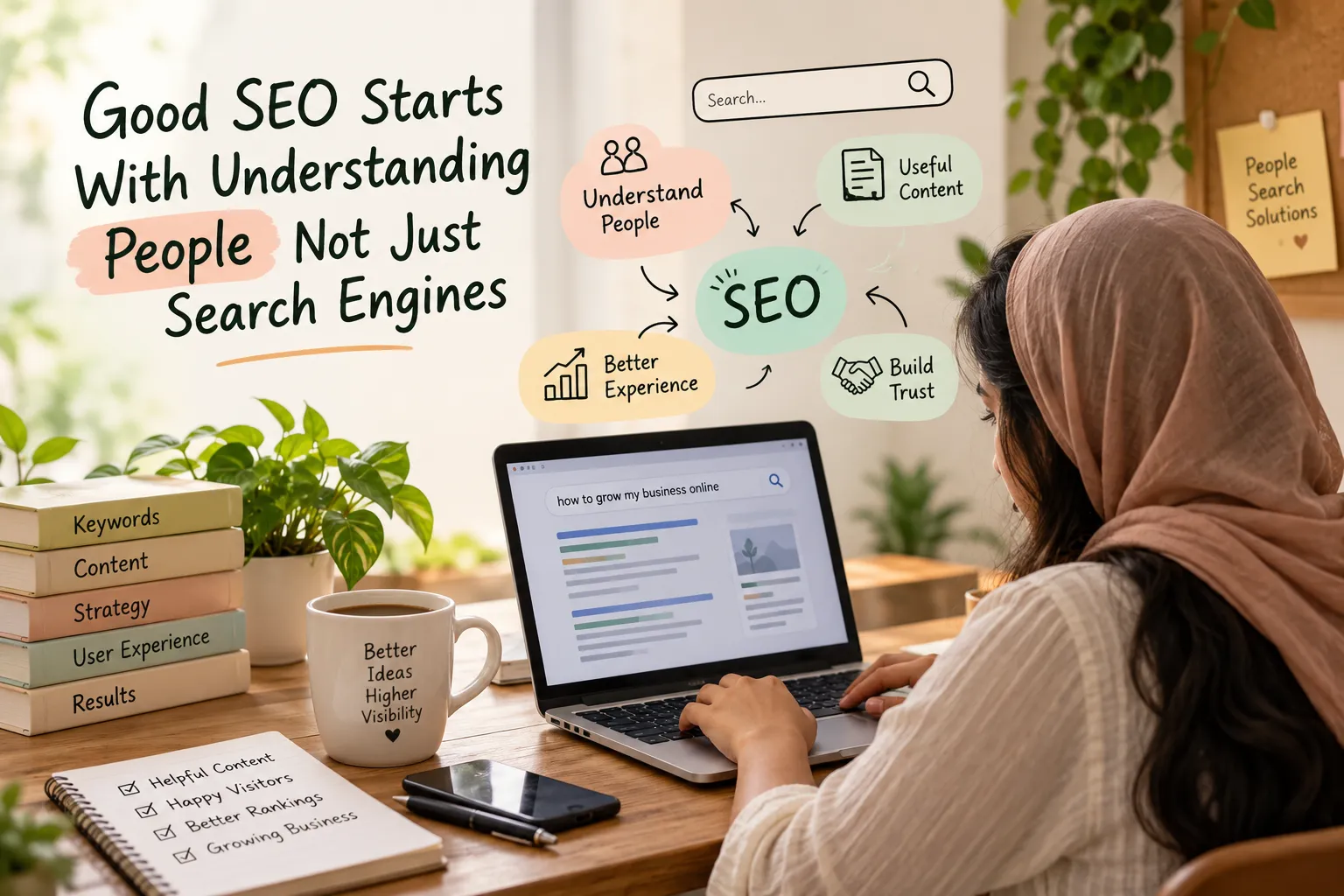
Writing for Google and Writing for People Shouldn't Be Two Different Things
This is something I think about often while learning and working with SEO.
We want Google to understand our content. So naturally, we think about keywords, headings, search intent, internal links, and other SEO elements.
But sometimes we become so focused on optimization that we forget someone actually has to read the content.
Imagine reading this:
"Looking for digital marketing services? Our digital marketing services provide the best digital marketing services for businesses searching for digital marketing services..."
Nobody wants to read that.
The keyword is there.
But the conversation is gone.
As a Freelance SEO Expert in Kerala, I believe keywords should support the content, not control it. If a phrase fits naturally, use it. If adding it makes a sentence sound strange, rewriting the sentence is usually better than forcing the keyword into it.
SEO should help people discover good content.
It shouldn't make good content difficult to read.
Sometimes Simple Language Works Better
There is a common belief that professional writing needs complicated words.
It doesn't.
If I can explain something in five simple words instead of ten difficult ones, the simpler version is often better.
This is especially important in digital marketing because your audience may include people with very different levels of knowledge.
For example, instead of saying:
"Implement a comprehensive search engine optimization strategy to enhance organic discoverability."
You could simply say:
"Use SEO to help more people find your website through Google."
Both sentences communicate a similar idea.
But which one would you rather read?
Probably the second.
Professional doesn't have to mean complicated.
Give the Reader Something Useful
Before publishing content, I think there is one simple question worth asking:
“What will someone get from reading this?”
Maybe they learn something.
Maybe they solve a small problem.
Maybe they discover a new idea.
Maybe they finally understand something that confused them before.
Or maybe the article simply makes them think differently.
There should be something waiting for the reader at the end.
If an article is written only to include keywords or increase word count, people can usually feel it.
Don't Stretch a Small Idea Into a Huge Article
We've all seen articles where the answer could have been given in three paragraphs, but it takes fifteen paragraphs to finally reach it.
That's frustrating.
Long articles aren't bad. Sometimes a topic genuinely needs depth.
But length should come from having more value to share, not from repeating the same idea in different ways.
If the answer is simple, give a simple answer.
If the topic needs explanation, explain it properly.
The reader's time matters too.
Your Personality Can Be Part of the Content
This is something I personally enjoy about writing.
An article doesn't always have to sound like a textbook.
You can ask questions.
You can share a small observation.
You can give a real example.
You can even admit that you're still learning something.
Those little touches make writing feel more human.
There are millions of articles online explaining SEO, marketing, social media, and business.
Information alone isn't always what makes one article different.
Sometimes it's how you explain it.
Before You Hit Publish
Read your article one more time.
But this time, don't read it like the person who wrote it.
Read it like someone who found it through Google.
Would you keep reading?
Can you understand the main idea?
Are there sentences that feel unnecessary?
Does the title match what the article actually delivers?
And most importantly:
Did the article respect your time?
If the answer is yes, you're probably on the right track.
Because getting someone to click is useful.
But creating something they genuinely want to finish reading?
That's much more valuable.






Sign in to leave a comment.