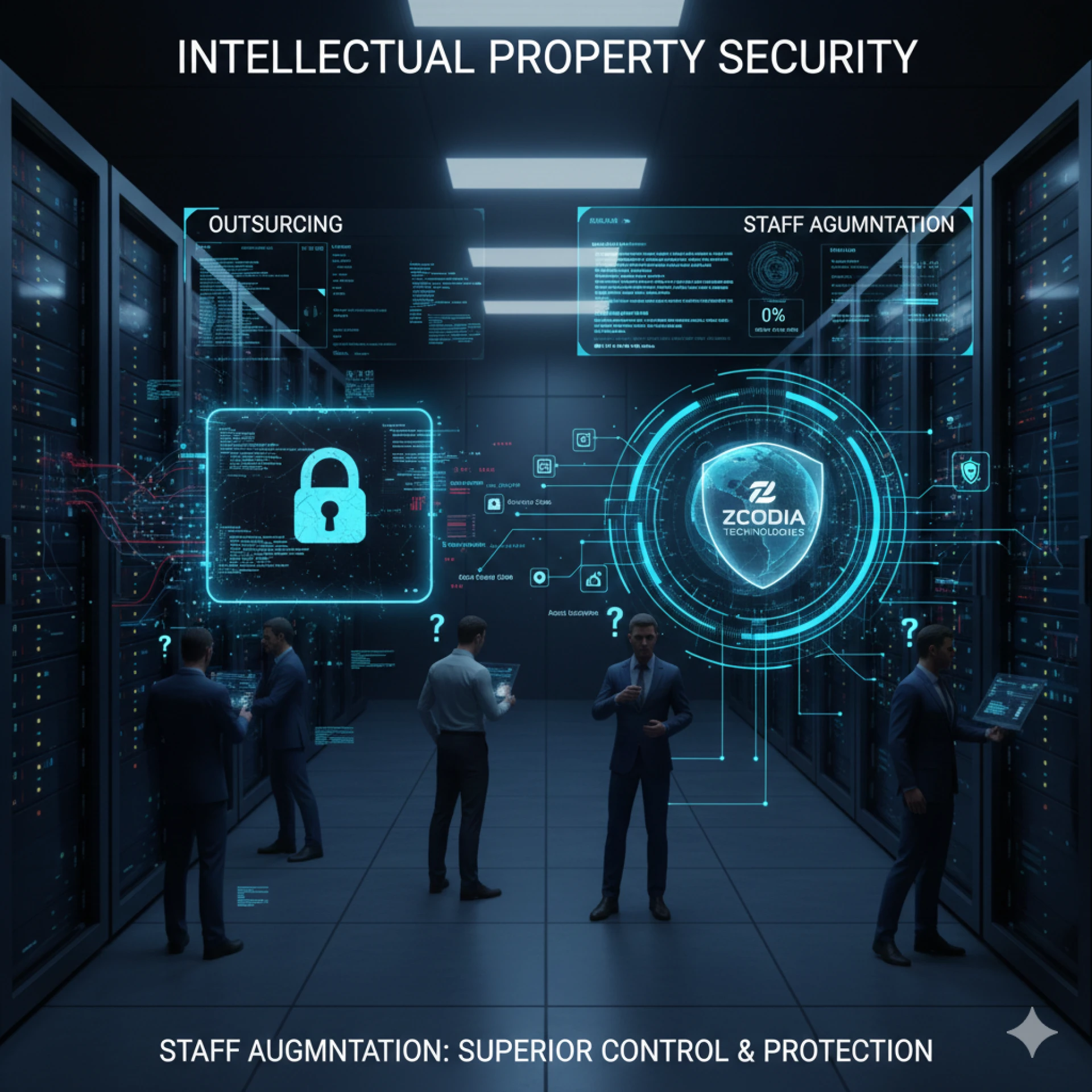
In the digital-first economy of 2026, a company’s value is no longer just in its physical assets or even its revenue—it is in its code, its algorithms, and its proprietary data. As Generative AI and automated reverse-engineering tools become more sophisticated, the risk of data leakage has reached a critical point. For CTOs and Founders, the choice between traditional outsourcing and staff augmentation is no longer just about cost or speed; it is about Intellectual Property Security.
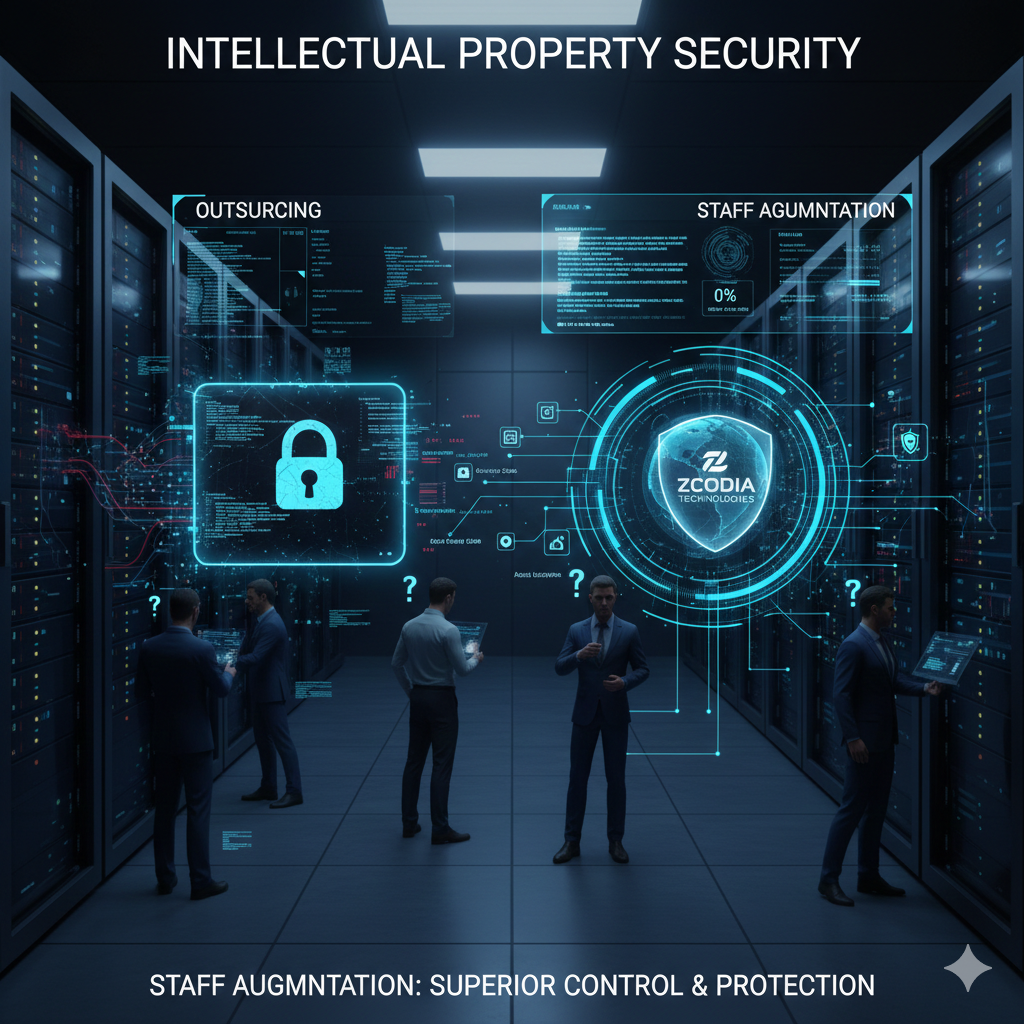
While outsourcing often involves handing over a project to a third-party vendor who manages it in an external environment, staff augmentation integrates developers directly into your internal ecosystem. This subtle difference in the "engagement model" creates a massive difference in the level of security and control you maintain over your IP.
1. Direct Control Over the Development Environment
One of the biggest security risks in traditional outsourcing is the "Black Box" effect. When you outsource, the code is often written on the vendor’s servers, using their hardware, and subject to their internal security protocols. You have limited visibility into who actually has access to your source code.
The Staff Augmentation Advantage
With staff augmentation, the developers work within your environment. They use your VPNs, your GitHub/GitLab repositories, and your enterprise-grade security tools (like CrowdStrike or Okta).
Every line of code is written directly into your infrastructure. There is no "transfer" of code at the end of the project because it never left your digital perimeter in the first place. This level of direct control is the first and most vital layer of Intellectual Property Security.
2. Granular Access Management and Zero-Trust Protocols
In an outsourcing model, the vendor often has "bulk" access to your documentation and data to complete the project. If the vendor’s local network is compromised, your entire project is at risk.
Principle of Least Privilege (PoLP)
Staff augmentation allows you to implement "Zero-Trust" architecture. You can give an augmented developer access to a specific microservice without exposing the rest of your monolithic architecture. Because they are managed by your internal leads, you can monitor their activity logs in real-time. According to 2025 security benchmarks, organizations that use internal environmental controls for external staff see a 65% reduction in unauthorized data access compared to those using standard outsourcing.
3. Eliminating "Sub-Contracting" Risks
A hidden danger in the outsourcing industry is sub-contracting. To meet deadlines or reduce costs, some outsourcing firms sub-contract portions of your project to smaller, less secure agencies without your knowledge. This creates a "supply chain" of IP risk that is nearly impossible to track.
100% Transparency
Staff augmentation is built on transparency. You interview and select the specific individual who will work on your team. There is a direct, identifiable link between you, the developer, and the specialized technology staffing partner. There are no "hidden" hands touching your code. This vertical accountability ensures that your trade secrets stay within a tight, vetted circle.
4. Legal Enforceability and Direct NDAs
While outsourcing contracts are often between two companies, they can become legally murky if a breach occurs in a foreign jurisdiction. Proving that a specific individual at a large outsourcing firm leaked data is a legal nightmare.
Individual Accountability
In a staff augmentation model, you often have double-layered protection. You have a Master Service Agreement (MSA) with the staffing agency and, frequently, a direct Non-Disclosure Agreement (NDA) with the individual developer. Because the developer is integrated into your daily workflow, they are subject to your internal compliance training and security workshops. This "human-centric" approach to security creates a culture of responsibility that a distant vendor simply cannot replicate.
5. Protecting the "Secret Sauce" in the Age of AI
With the rise of Agentic AI, the danger is no longer just someone stealing your code—it’s someone using your proprietary code to train their own internal AI models.
Data Leakage Prevention
If an outsourcing firm uses your project to "train" its junior staff or its internal code-assistants, your IP is effectively being "leaked" into their future products. In a staff augmentation model, your internal security team can enforce "No-AI Training" policies on the developer's machine. You can ensure that no proprietary snippets are ever fed into public LLMs, a level of oversight that is virtually impossible to enforce when a vendor is working in their own silo.
6. Long-Term Knowledge Retention and IP Integrity
IP is more than just code; it is the "Why" behind the code—the architectural decisions and logic. In outsourcing, when the contract ends, that knowledge leaves with the vendor.
Continuous Knowledge Transfer
Augmented developers work alongside your permanent staff. Every day, they are transferring their logic and architectural understanding to your core team through peer reviews and Slack huddles. This means that your "Intellectual Property" isn't just a zip file of code; it is a living part of your company's collective intelligence. If an augmented developer eventually rolls off the project, the "IP" remains securely stored in the minds of your permanent employees.
7. Security Benchmarks: Outsourcing vs. Augmentation
Current 2026 data indicates a rising trend in "Shadow IT" within outsourcing firms—where developers use unapproved third-party tools to speed up delivery.
Enforced Compliance
Augmented staff must follow your internal "Approved Tools List." They cannot use a random library or an unvetted API without your architect’s approval. This prevents the "IP Poisoning" that occurs when non-compliant or copyleft-licensed code is accidentally integrated into a proprietary product. Organizations using staff augmentation report 40% fewer licensing compliance issues than those using traditional project-based outsourcing.
8. Conclusion: Security is a Strategic Investment
In 2026, a security breach isn't just a PR crisis; it is an existential threat. When you choose staff augmentation, you aren't just "renting a developer"—you are extending your secure perimeter.
Intellectual Property Security is best maintained when the developers are an integral part of your team, subject to your rules, and working within your walls. While outsourcing may offer an "all-in-one" convenience, the cost of that convenience is often a loss of control. For businesses built on proprietary innovation, staff augmentation is the only logical choice to ensure that today’s development doesn't become tomorrow’s liability.
























Sign in to leave a comment.