
The Middle East is once again witnessing rising instability as tensions between Iran and the United Arab Emirates continue to escalate despite an officially declared ceasefire. What was initially described as a temporary truce aimed at reducing military confrontations in the Gulf region now appears increasingly fragile, with fresh missile attacks, naval clashes, and growing diplomatic accusations threatening to push the region toward another dangerous conflict.
Over the past several days, reports from international media outlets and military officials have confirmed repeated incidents involving Iranian missile launches, drone strikes, and maritime confrontations near the Strait of Hormuz. The UAE has accused Iran of targeting civilian facilities and energy infrastructure, while Tehran claims the United States and its Gulf allies violated the ceasefire first through military operations in strategic Gulf waters.
The renewed confrontation has alarmed world leaders, shaken global oil markets, and raised fears that the ceasefire may collapse entirely if diplomatic efforts fail to contain the growing hostilities.
The Fragile Ceasefire That Never Fully Stabilized
The ceasefire between Iran and the United States, supported indirectly by Gulf nations including the UAE, was always considered temporary and unstable. Although the agreement reduced large-scale military strikes for several weeks, tensions in the region never fully disappeared.
The primary goal of the ceasefire was to prevent further escalation around the Strait of Hormuz, one of the world’s most strategically important waterways. However, continued military movements, naval patrols, and disagreements over shipping access created an environment where even minor incidents could quickly trigger retaliation.
The situation worsened after the United States launched efforts to reopen commercial shipping lanes through the Strait of Hormuz under military escort operations. Iran viewed these operations as a violation of the ceasefire and warned foreign military forces against entering what it considers sensitive security zones.
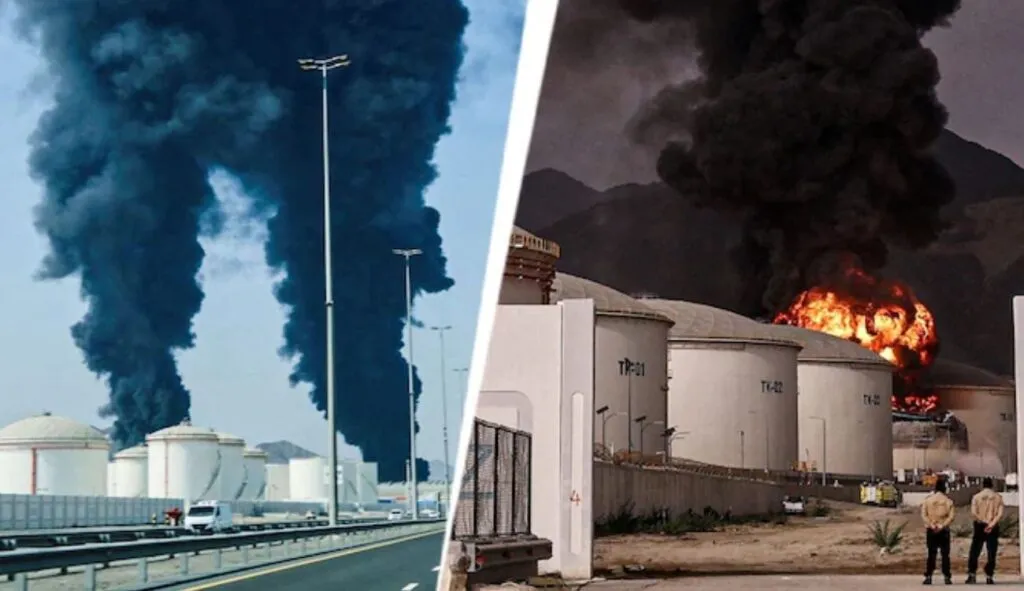
Shortly afterward, the UAE reported missile and drone attacks allegedly originating from Iranian territory. Emirati officials stated that several missiles were intercepted, although some attacks caused fires and damage near the Fujairah oil industrial zone.
This sequence of events has transformed the ceasefire from a diplomatic breakthrough into a deeply contested arrangement where both sides accuse each other of provocation.
Why the UAE Has Become Central to the Conflict
The UAE’s growing role in the conflict is closely tied to its strategic partnership with the United States and its importance in global energy trade. The country hosts key military and commercial infrastructure that is vital to Western and Gulf security operations.
Fujairah, one of the UAE’s most important ports, has become particularly significant because it allows oil exports to bypass the Strait of Hormuz. This makes the facility strategically valuable during periods of maritime disruption.
Analysts believe Iran views the UAE not only as a regional rival but also as a critical ally supporting American efforts in the Gulf. By targeting Emirati infrastructure and demonstrating military reach, Tehran may be attempting to pressure both Abu Dhabi and Washington simultaneously.
Recent attacks have reportedly included ballistic missiles, cruise missiles, and drones aimed at civilian and industrial targets in the UAE. Emirati defense systems intercepted many of the incoming threats, but the incidents still exposed the vulnerability of Gulf infrastructure.
The escalation also sends a broader message to Gulf countries that continued alignment with U.S. military operations could carry direct security consequences.
The Strait of Hormuz Remains the Core Flashpoint
Much of the current crisis revolves around the Strait of Hormuz, the narrow waterway connecting the Persian Gulf to global shipping lanes. Nearly a fifth of the world’s oil supply passes through this corridor, making it one of the most sensitive geopolitical chokepoints on Earth.
The ceasefire initially sought to stabilize the Strait after months of attacks on commercial vessels and military confrontations. However, the situation rapidly deteriorated when U.S. forces attempted to escort commercial ships through the area under a mission aimed at restoring maritime trade.
According to multiple reports, American naval forces fired on Iranian boats accused of threatening civilian shipping. Iran responded by accusing the United States of illegal military aggression and ceasefire violations.
The conflict intensified further when reports emerged that no major commercial shipping companies had crossed the Strait for several days because of security fears. Maritime analysts warned that continued instability could severely disrupt global oil supplies and increase economic uncertainty worldwide.
The Strait of Hormuz has therefore become more than a regional flashpoint. It now represents a direct threat to international trade, energy prices, and economic stability.
Rising Oil Prices and Global Economic Concerns
One of the most immediate consequences of the escalating Iran-UAE conflict has been volatility in global energy markets. Oil prices have surged as fears grow over potential supply disruptions in the Gulf.
Energy traders are particularly concerned about attacks near Fujairah because the port handles massive volumes of crude oil exports. Any prolonged disruption to operations there could affect global fuel supplies, especially in Asia and Europe.
India, China, Japan, and several European nations rely heavily on Gulf oil shipments, making the region’s stability critically important for their economies. Rising crude prices could increase inflation, transportation costs, and fuel prices globally.
The uncertainty surrounding the ceasefire has also affected shipping insurance costs and maritime logistics. Several shipping companies are reportedly delaying operations or rerouting vessels away from high-risk Gulf areas.
This economic pressure is one reason why world powers continue urging restraint despite ongoing military exchanges.
Conflicting Narratives Fuel the Escalation
One of the major reasons the conflict continues escalating is the complete lack of agreement over who violated the ceasefire first. Iran insists that American military actions in the Strait of Hormuz and strikes on Iranian-linked vessels crossed red lines established under the truce.
The United States and the UAE, meanwhile, argue that Iranian missile and drone attacks endangered civilian shipping and regional security, forcing defensive responses.
This clash of narratives makes diplomacy extremely difficult. Each side portrays itself as acting defensively while blaming the other for destabilization.
Online discussions and international commentary reflect growing skepticism about whether the ceasefire still exists in any meaningful sense. Many observers argue that although leaders continue using the term “ceasefire,” active military exchanges suggest the truce has already broken down in practice.
As military incidents continue, political leaders on all sides face increasing pressure from domestic audiences to respond aggressively rather than compromise.
Diplomatic Efforts Continue Amid Growing Tensions
Despite the escalating violence, diplomatic negotiations are still ongoing behind the scenes. Several countries, including Pakistan and Gulf intermediaries, are reportedly attempting to prevent a total collapse of talks between Iran and the United States.
However, every new missile launch or naval clash weakens the chances of a stable agreement. Diplomacy becomes significantly harder when military operations continue simultaneously.
International organizations and regional governments have repeatedly called for restraint, warning that another major Middle East conflict could destabilize the entire region. Concerns are particularly high because the conflict now involves multiple interconnected issues, including maritime security, oil exports, sanctions, military alliances, and regional influence.
Even if large-scale war is avoided, continued instability could create a prolonged period of economic disruption and geopolitical uncertainty.
Conclusion
The escalating Iran-UAE conflict demonstrates how fragile ceasefires in the Middle East can quickly unravel when deeper geopolitical tensions remain unresolved. Although the ceasefire technically remains in place, repeated missile strikes, naval confrontations, and accusations from all sides suggest that the region is still dangerously close to broader conflict.
The UAE’s strategic role in Gulf security and global energy exports has made it a central target in Iran’s confrontation with the United States and its allies. Meanwhile, the Strait of Hormuz continues to serve as the core battleground where military, economic, and political interests collide.
As oil prices rise and international shipping faces increasing risks, the consequences of continued escalation are being felt far beyond the Middle East itself. Global markets, energy security, and diplomatic stability now depend heavily on whether regional leaders can prevent the fragile truce from collapsing entirely.
For now, the ceasefire survives more in political statements than in reality on the ground. Unless meaningful diplomatic progress is achieved soon, the Iran-UAE confrontation could evolve into a much larger regional crisis with worldwide consequences.
Visit: https://indiabbcnews.com/why-iran-is-striking-uae-amid-ceasefire/































Sign in to leave a comment.