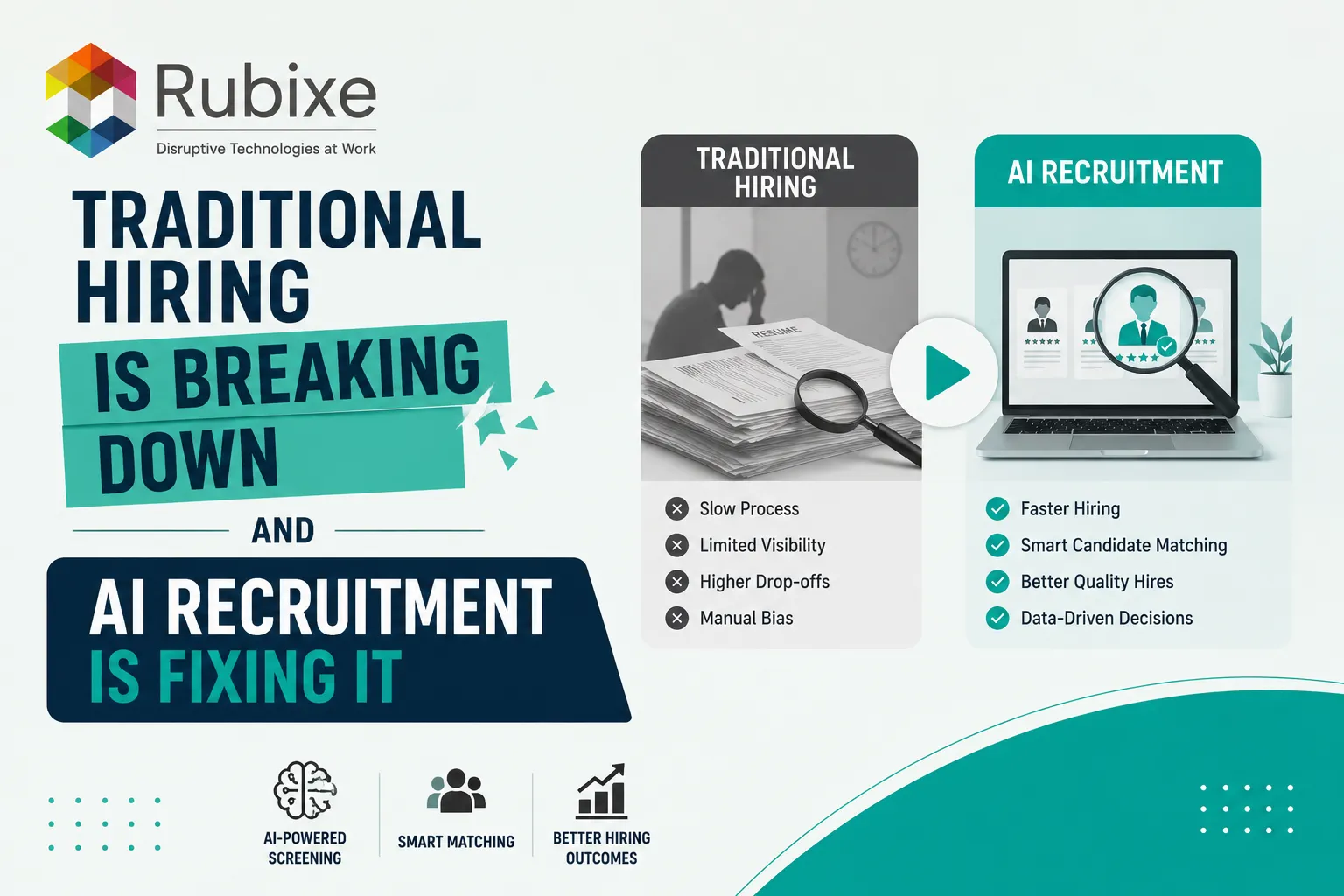

Most hiring teams are drowning. A single mid-level job posting can pull in several hundred applications within days, and the honest truth is that almost no recruiter is reading all of them carefully. Resumes get skimmed for a few seconds, keyword-matched against a job description, and either advanced or discarded — often without a human ever really evaluating whether the candidate could actually do the job. This is exactly the gap that artificial intelligence recruitment was built to close, not by removing people from hiring decisions, but by handling the volume problem that human recruiters were never equipped to solve manually in the first place.
The shift isn't theoretical anymore. Companies across industries, from fast-growing startups to large enterprises, are quietly rebuilding their hiring pipelines around AI-assisted screening, matching, and scheduling, because the old process simply doesn't scale to the volume of applications modern job platforms generate. What used to take a team of recruiters several weeks to sort through manually can now be triaged in hours, freeing that same team to spend their time actually talking to strong candidates instead of clearing an inbox.
Where Traditional Hiring Actually Breaks Down
Before looking at what AI changes, it helps to understand exactly where the traditional process fails:
- Resume screening bottlenecks — a recruiter manually reviewing hundreds of resumes per role introduces both delay and inconsistency
- Keyword-based ATS filtering — older applicant tracking systems reject qualified candidates simply for phrasing their experience differently than the job description
- Scheduling friction — coordinating interview times across multiple stakeholders can add days or weeks to a hiring timeline
- Unconscious bias in early screening — human reviewers, even well-intentioned ones, apply inconsistent standards across candidates depending on fatigue, mood, or unrelated context
- Slow time-to-hire — by the time a decision is made, strong candidates have often already accepted offers elsewhere
Each of these compounds. A slow, inconsistent, biased process doesn't just frustrate hiring teams — it actively costs companies their best candidates, who are rarely still available three or four weeks into a drawn-out process.
What This Shift Actually Involves
This broader shift toward AI-assisted hiring covers a fairly wide set of tools and techniques, not a single product. The core functions typically include:
- Resume parsing and semantic matching, which evaluates actual skills and experience rather than exact keyword overlap
- Automated candidate ranking, surfacing the strongest applicants first instead of relying on manual sorting
- Chatbot-driven initial screening, handling basic qualification questions before a human recruiter gets involved
- Interview scheduling automation, removing the back-and-forth email chains that slow everything down
- Predictive analytics on candidate fit, using historical hiring data to flag likely strong performers
None of these remove the recruiter from the process entirely. What they do is compress the time recruiters spend on repetitive administrative work, freeing them to focus on the parts of hiring that genuinely require human judgment — culture fit, negotiation, and final decision-making.
Traditional Hiring vs. AI Assisted Hiring
| Factor | Traditional Hiring | AI-Assisted Hiring |
| Resume review speed | Manual, hours per batch | Automated, near-instant ranking |
| Screening consistency | Varies by recruiter and day | Consistent criteria applied every time |
| Time-to-first-interview | Often 1–2 weeks | Frequently reduced to a few days |
| Candidate matching basis | Keyword overlap | Semantic skill and experience matching |
| Scalability | Breaks down at high application volume | Handles volume without added headcount |
The gap widens significantly the moment a company is hiring for more than a handful of roles simultaneously, which is why this shift has moved fastest in high-volume hiring environments first, particularly in tech, retail, and customer service roles.
AI Recruiting Tools Worth Understanding
Not all AI recruiting tools solve the same problem, and buyers often assume one platform covers the entire pipeline when in reality most specialize. Broadly, the category splits into:
- Tools focused purely on sourcing, surfacing passive candidates who match a role's requirements
- Tools focused on screening, ranking inbound applicants against a defined skill profile
- Tools focused on assessment, running structured skills tests or simulations before a human interview
- Tools focused on scheduling and coordination, removing logistical friction from the process entirely
Companies evaluating this space should map their actual bottleneck first — sourcing, screening, or scheduling — rather than buying a broad platform that solves a problem they don't actually have. Many teams overspend on assessment tools when their real bottleneck is simply getting resumes reviewed faster.
Choosing an AI Hiring Platform
Selecting the right platform comes down to a few practical evaluation points:
- Integration with existing ATS systems, since a tool that requires abandoning current infrastructure adds unnecessary friction
- Transparency in ranking logic, since a black-box scoring system creates both trust and compliance concerns
- Bias auditing capabilities, given that poorly trained models can quietly reproduce the same biases they're meant to remove
- Candidate experience impact, since overly automated processes can feel impersonal if not implemented thoughtfully
- Reporting and analytics depth, to actually measure whether the tool is improving hiring outcomes over time
Firms like Rubixe have worked with hiring teams specifically on integrating an AI hiring platform into existing workflows, rather than treating AI adoption as a wholesale replacement of the recruitment process, which tends to produce a smoother transition for both recruiters and candidates.
Common Concerns Worth Addressing Directly
A few concerns come up consistently when companies consider adopting AI in talent acquisition, and most are worth addressing directly rather than dismissing:
- "Will AI introduce bias into hiring?" — Poorly trained or unaudited systems can, which is why bias testing should be a non-negotiable part of any implementation, not an afterthought
- "Will candidates feel like they're talking to a machine the whole time?" — This depends entirely on implementation; the best setups use automation for early-stage filtering and hand off to humans well before final decisions
- "Is this only useful for large companies with high hiring volume?" — No, even smaller teams benefit from reduced screening time, though the impact is most visible at scale
- "Does this replace recruiters?" — In practice, it shifts recruiter time away from administrative screening and toward relationship-building and final-stage evaluation
Getting Implementation Right
Adoption tends to go smoothly when companies treat this as a phased rollout rather than an overnight switch. A practical sequence usually looks like:
- Start with a single high-volume role as a pilot before rolling changes out company-wide
- Audit existing job descriptions, since biased or vague language in the posting affects screening quality regardless of the tool used
- Set clear, measurable goals — reduced time-to-hire, improved candidate satisfaction scores, or lower cost-per-hire — before comparing vendors
- Train recruiters on how to interpret AI-generated rankings rather than treating the output as a final, unquestionable decision
- Review outcomes after 60–90 days and adjust criteria based on actual hiring results, not assumptions made before launch
Skipping the pilot phase is one of the more common reasons rollouts stall, since problems that would have surfaced in a single-role test instead show up across an entire hiring function at once.
Frequently Asked Questions
Q: Does AI recruitment replace human recruiters entirely?
No. Most implementations use AI to handle repetitive screening and matching tasks, while recruiters remain responsible for interviews, culture fit assessment, and final hiring decisions.
Q: Can AI-based screening software introduce bias into hiring?
They can if trained on biased historical data or deployed without auditing. Reputable tools include bias testing and transparent scoring logic specifically to reduce this risk.
Q: How long does it take to implement this kind of hiring software?
This varies by company size and existing infrastructure, but most implementations, including integration with an existing ATS, take a few weeks to a couple of months to fully roll out.
Q: Is AI recruitment only useful for high-volume hiring?
It's most impactful at scale, but even smaller teams see meaningful time savings on resume screening and interview scheduling, regardless of overall hiring volume.
Q: How is this different from simply using a better job board?
A job board only helps sourcing, whereas AI in talent acquisition also covers screening, ranking, scheduling, and predictive fit analysis across the entire hiring pipeline, not just where candidates come from.
Traditional hiring wasn't built for the volume of applications modern job platforms generate, and the cracks show up as slow time-to-hire, inconsistent screening, and lost candidates. Artificial intelligence recruitment addresses this not by removing people from the process, but by handling the repetitive, high-volume parts of screening and matching that were never a good use of a recruiter's time to begin with. Companies that adopt these tools thoughtfully, with proper bias auditing and a clear understanding of where their actual bottleneck sits, tend to see faster hiring and better candidate experiences than those still relying on manual review alone.























Sign in to leave a comment.