
I spoke with a founder last year who had signed a three-year office lease in early 2023. At the time it made sense — the team was twelve people, growth was predictable, the space was in a good location, and the landlord had offered a reasonable rate in exchange for the longer commitment.
By late 2024, his team was four people. Not because the business had failed — quite the opposite. He'd rebuilt around a smaller, fully remote core team and a network of project-based contractors. His revenue had grown. His payroll overhead had dropped considerably. And every month he was writing a cheque for a floor of empty desks in a building nobody visited.
He's counting down to the end of that lease with an enthusiasm usually reserved for more celebratory occasions.
The story isn't unusual. What's changed is that businesses learning this lesson the hard way — through a lease signed based on assumptions that stopped being accurate — are now making different initial decisions. And the workspace market has responded by offering structures that actually fit how companies operate in practice rather than how they were assumed to operate when lease agreements were designed.
The Fundamental Problem With Long Commitments and Fast-Moving Businesses
There's a structural mismatch at the heart of traditional office leasing that doesn't get named directly often enough.
A lease is a bet on the future. You're committing to a specific amount of space, in a specific location, at a specific cost, based on what your business looks like today and what you project it will look like for the next three to five years. That bet made reasonable sense when business growth was relatively linear and predictable — when a company of twenty people could expect to be a company of twenty-five people in two years and twenty-eight people in four.
That's not how growth works for most companies now. The businesses I encounter regularly are either growing faster than they projected, shrinking and reorganising around different operating models, adding headcount in one geography while reducing it in another, or doing some combination of all three simultaneously. The assumption of linear predictable growth that traditional lease structures were built around isn't the reality for most organisations.
So the lease commitment — which was designed to provide stability — often ends up providing rigidity instead. And rigidity is exactly what fast-moving businesses can least afford.
Why Flexibility Became Strategic Rather Than Just Convenient
For a while, the flexible workspace conversation was primarily about cost. The proposition was: you don't have to pay for space you're not using. That's a reasonable pitch, but it positions flexibility as a financial efficiency measure rather than a strategic asset, and I think that framing undersells what's actually happening.
The more interesting shift is that workspace flexibility is now directly connected to how quickly a business can respond to opportunity.
Consider what it looks like when a company needs to move on something fast — a new client relationship that requires a regional presence, a partnership opportunity that depends on having a credible local footprint, a market entry that makes sense to test before committing fully. In the old model, establishing that presence meant a minimum of several months of fit-out, lease negotiation, and setup before anything operational could happen. By then, the moment might have passed, the client might have found another partner, or the market test might no longer be timely.
Flexible workspace removes that delay. A business can establish a genuine, professional presence in a new location within days. The option to move quickly becomes available. And in competitive markets, the option to move quickly is worth real money — not as a cost saving but as a commercial capability.
The Workforce Reality That Changed the Office Calculation
It's worth being direct about something that gets talked around a lot in the workspace conversation: the expectations of talented people have shifted in ways that are probably permanent rather than cyclical.
A significant proportion of the professionals most businesses are actively trying to hire — particularly in technical, creative, and strategic roles — have spent several years working in hybrid or fully remote arrangements. They've built their lives around that flexibility. They've moved to places they prefer to live rather than places their employer's office happens to be located. They're not particularly interested in returning to five days a week in the same building.
This doesn't mean offices have become irrelevant. What it means is that the office is no longer serving the function of "the place where work happens" — it's serving the function of "the place where certain work happens better," specifically the collaborative, relational, and creative work that benefits from physical proximity and the kind of informal interaction that video calls don't replicate.
When that's the actual purpose of the office, the space requirements change considerably. You don't need assigned desks for everyone. You need meeting rooms, collaborative spaces, enough hot-desk capacity for the people who choose to come in on any given day, and the professional environment that supports client-facing work and team sessions. That's a different footprint from a traditional assigned-desk office for your full headcount, and it often makes the flexible workspace model — where you pay for actual use rather than theoretical maximum occupancy — the more logical choice.
The Dubai Dimension: Testing Versus Committing
There's a specific version of this conversation that's particularly relevant for international businesses looking at the Middle East, and it's worth naming separately because the dynamics are somewhat different.
The UAE attracts a particular type of business decision: the regional entry. A company that has established itself in Europe, South Asia, or elsewhere and is evaluating whether there's a meaningful opportunity in the Gulf and broader MENA region. These companies want to have the conversations, meet the potential clients and partners, understand the competitive landscape, and assess whether the commercial opportunity justifies the cost and operational complexity of a full regional setup.
The traditional path for that process required committing to a local entity, leasing space, and hiring locally before you had any real evidence about whether the opportunity was worth it. The test was expensive before it generated any data.
The more intelligent approach — and the one that's become much more common — is to establish a professional, credible presence through flexible workspace first, run the market test properly over a period of months, gather actual intelligence about demand and commercial fit, and then make the lease-and-hire decision based on evidence rather than projection.
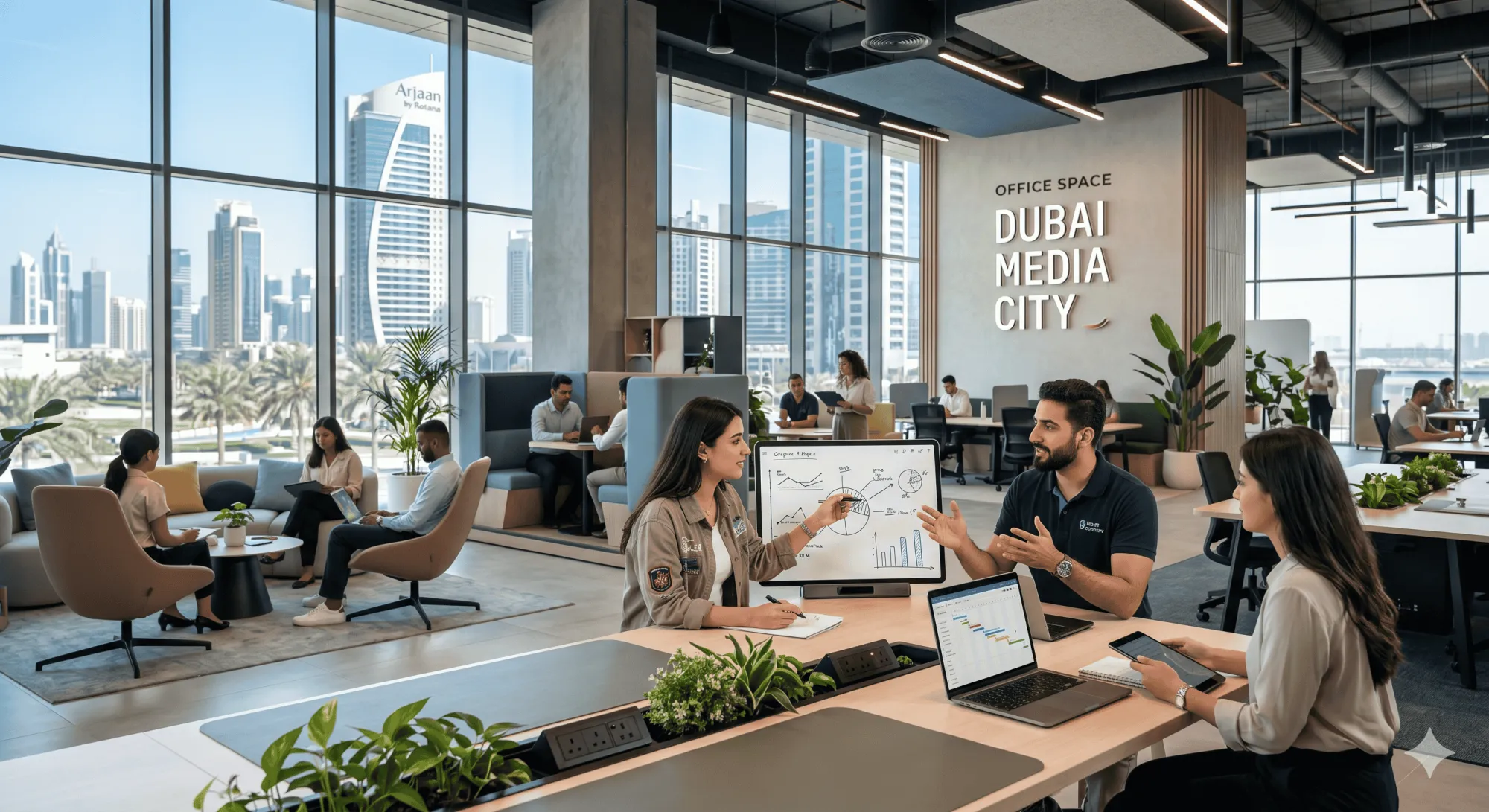
Having access to quality office space Dubai Media City during that evaluation phase matters more than it might initially appear. Dubai Media City has a specific professional reputation — media, digital, creative, and tech businesses are the natural inhabitants of the district. For businesses in those sectors, having an address in that location carries genuine credibility with the people they're trying to meet. It's not just desk space. It's a positioning signal that affects how early conversations land.
The Capital Reallocation Argument (Which Is More Compelling Than It Sounds)
This is the part of the workspace flexibility conversation that CFOs tend to respond to most directly, even if it's underplayed in most of the content written about the topic.
Capital committed to office infrastructure is capital unavailable for everything else. A significant deposit on a long-term lease, plus fit-out costs, plus the ongoing monthly commitment — this is real money that has an opportunity cost. For an early-stage or growth-stage business, that opportunity cost is particularly meaningful because the marginal value of capital invested in hiring, product development, or market entry is typically higher than the marginal value of owning a particular physical space.
Flexible workspace changes this equation by converting a capital commitment with limited exit options into an operational expense with meaningful flexibility. The monthly cost may or may not be lower depending on usage levels — it's not always cheaper in pure per-square-foot terms. But it eliminates the downside scenario where you've committed capital to space you can't productively use, which is the scenario that genuinely hurts businesses.
The question isn't just "what does this space cost." It's "what does this space cost in the scenario where our needs change significantly in the next twelve months," and that second question tends to make flexible arrangements look considerably more attractive.
What to Actually Look for When Evaluating Flexible Workspace
I want to be concrete here because "flexible workspace" covers a wide range of offerings with meaningful quality differences.
The address matters in ways that go beyond vanity. An office space Dubai Media City address places a business in a district with genuine professional identity. That's different from a flexible workspace address in a generic commercial building that means nothing in particular to the people you're meeting.
Meeting room quality matters considerably more than most people assess upfront. If you're using the workspace for client meetings — which is often the primary use case for internationally-operating businesses in a market entry phase — the quality of the environment in which those meetings happen shapes the impression you're making. A cramped or poorly maintained meeting room in an otherwise functional workspace is a problem that's hard to solve without finding a different space.
Scalability in both directions is worth understanding before you commit to anything. The workspace that can accommodate two people today needs to be able to accommodate eight or ten if things go well, without requiring you to move and re-establish yourself in a new location. Equally, if your needs reduce, you want to understand what exit options actually look like rather than discovering them in a difficult moment.
The professional services layer varies considerably across providers. Mail handling, reception, call answering, business support — the quality of these affects the professional experience your clients and partners have when they interact with your business. Worth understanding concretely rather than assuming from a brochure.
The Conclusion That Keeps Coming Back
Every conversation I have about workspace strategy for growing businesses eventually arrives at the same place: the office decision shouldn't be made in isolation from the business strategy. It should follow from it.
What's the actual use case? Who's coming in and why and how often? What's the business likely to look like in eighteen months in the optimistic scenario and in the conservative scenario? What physical presence does the business need to be taken seriously by the people it needs to take it seriously?
Answer those questions honestly and the workspace decision usually becomes clearer. For most fast-moving businesses in 2026, those answers point toward something flexible rather than something fixed — not because flexible is always cheaper, but because it's compatible with the strategic reality of how the business actually operates.
The founder counting down to the end of his lease would agree.
If you're working through a workspace decision for expansion into Dubai or the broader MENA region — whether that's evaluating office space Dubai Media City options for a market test or scaling up an existing presence — the strategic questions are usually worth settling before the operational ones.























Sign in to leave a comment.