
Every March without fail, I get some version of the same message from people in my life who know I pay attention to this stuff. The phrasing varies but the situation is identical: something that was working fine has stopped working, and they can't figure out why because they haven't changed anything.
The cleanser they've used for two years suddenly feels stripping. The moisturiser that got them through winter now feels like wearing a second face. A product that was fine in December is causing something that looks suspiciously like milia along their jawline in April.
The products haven't changed. The season has. And because most skincare advice is organised around products rather than conditions, this seasonal mismatch catches people off guard every single year.
What's Actually Happening to Your Skin Between Seasons
Skin isn't static. It's a living organ responding continuously to whatever environment it's in, and in Canada specifically — where the environmental swing between January and July is genuinely extreme — that responsiveness means the skin you're managing in February is functionally different from the skin you're managing in August.
In winter, the combination of cold outdoor air and dry heated indoor air creates low-humidity conditions on both sides of every door you open. Your skin loses water faster. The barrier works harder to compensate. It tends toward dryness, sensitivity, and that particular tightness that arrives about ten minutes after cleansing if your routine isn't quite keeping up.
Come late spring and summer, the humidity climbs. Sweat is a factor. UV intensity increases. The same barrier that was struggling to retain moisture in February now has a completely different challenge — managing heat, oil production, and external environmental load rather than compensating for dryness.
A moisturiser formulated to address the February problem will almost certainly overcorrect the August problem. That's not a product failure. It's a mismatch between a static routine and a dynamic environment, which is a different problem with a different solution.
The Part That Gets Overcomplicated
Here's where I want to push back against the direction most skincare advice goes when it encounters this topic, because the natural next step is usually "here's how to build four separate seasonal routines" and that's genuinely not what most people need.
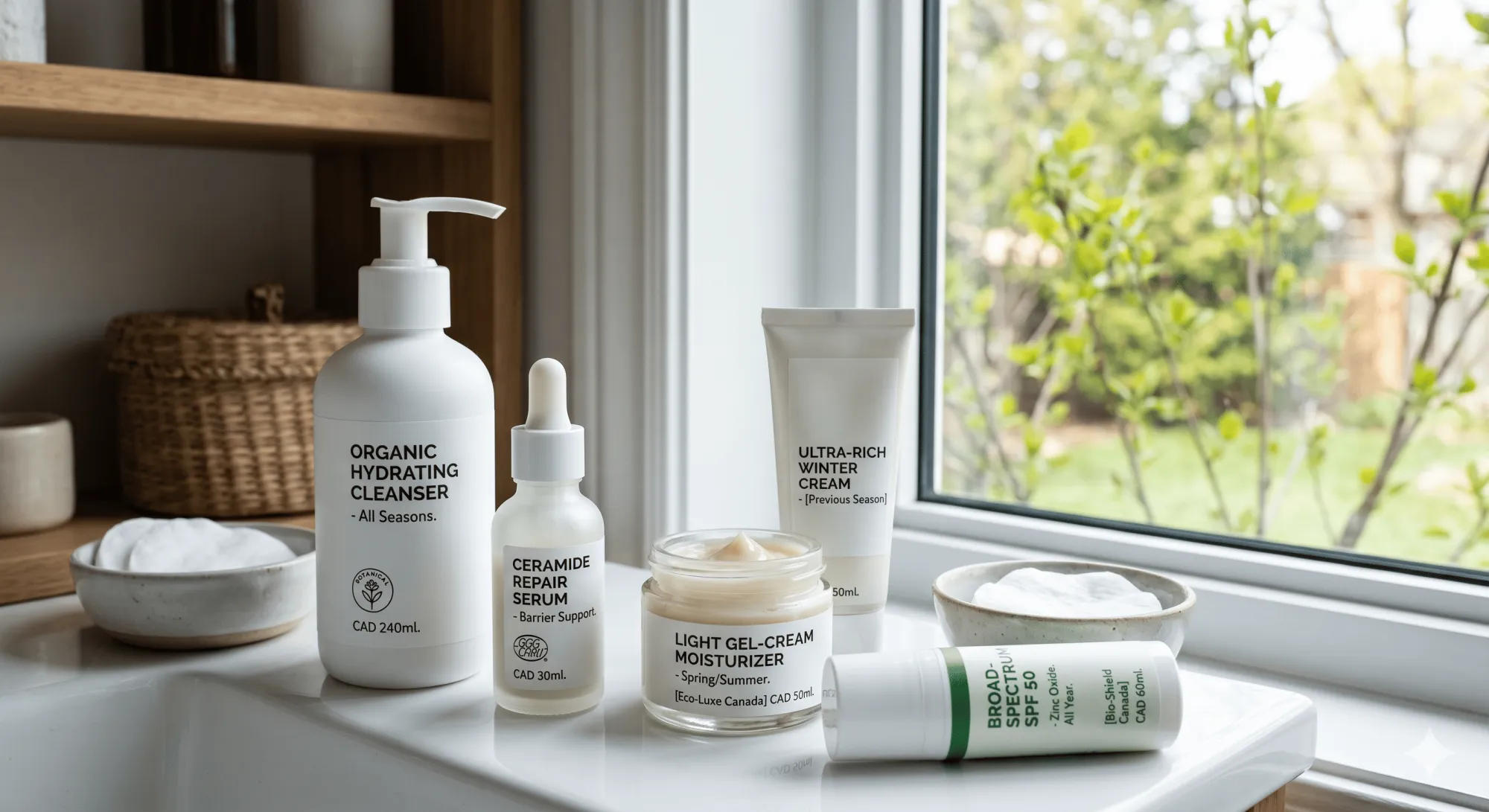
The core of a well-functioning skincare routine is surprisingly stable across seasons. A gentle cleanser that doesn't strip the barrier. A reliable broad-spectrum SPF. Some form of meaningful hydration. Basic barrier support. These things don't change based on the weather. What changes is the weight, texture, and intensity of the products filling those roles.
Most people can get most of the way there by making one or two targeted swaps rather than a full seasonal overhaul. Someone who uses a rich cream moisturiser through winter might switch to a lighter gel-cream version of roughly the same formulation in summer. Someone who exfoliates twice a week in relatively stable weather might pull back to once a week in winter when their barrier is more stressed, or push up slightly in humid summer if congestion is a seasonal problem for them.
The adjustment is real and it matters. The scale of the adjustment is usually much smaller than the seasonal routine content genre suggests.
Barrier Disruption Is Almost Always the Underlying Issue
Whenever I hear someone describe their skin as "going haywire" — suddenly sensitive to things it tolerated before, breaking out unexpectedly, feeling simultaneously dry and irritated — my first thought is barrier disruption, and seasonal transitions are one of the most common triggers.
The skin barrier is doing a complicated job under normal circumstances. When temperatures change quickly, when humidity drops suddenly, when indoor heating goes from off to full blast in October, the barrier has to recalibrate faster than it always manages to. During that recalibration window, it's more permeable and more reactive.
Products that were fine under stable conditions can cause stinging or irritation not because they've changed but because the skin's tolerance has temporarily decreased. This gets misdiagnosed constantly as product sensitivity when it's actually barrier vulnerability. The well-intentioned response — finding a "gentler" product or adding a soothing treatment — often misses the actual need, which is giving the barrier the specific things it needs to repair: occlusive protection, humectant hydration, ingredients that support rather than stimulate.
This is one of the practical reasons why genuinely thoughtful natural skin care formulations that are built around barrier support rather than active treatment earn their place in a climate-adaptive routine. Not as a seasonal trend but as a consistent presence that helps the skin stay resilient through transitions. The best organic skin care products in Canada that are worth using across seasons tend to share this characteristic — they're formulated to work with the skin's own function rather than override it, which makes them useful under a wider range of conditions.
The Social Media Season Problem
Every season generates its own skincare content cycle, and if you're paying attention to that cycle it will suggest — with considerable enthusiasm — that you're about to need a new set of products.
Summer skincare content arrives in May. It recommends lighter textures, more SPF focus, ingredients suited to humidity. This is mostly reasonable advice. But it's also delivered in a format that implicitly suggests your current routine is wrong and you need to buy things. Some of that content is genuinely informative. Some of it is just the seasonal marketing window for product launches dressed up as educational skincare advice.
The useful signal in seasonal skincare content is real: conditions change, and thoughtful routines respond to conditions. The noise is the implied urgency, the suggestion that you need to replace rather than adjust, the new ingredients presented as essential for the upcoming season that weren't mentioned last season.
Skin that's behaving reasonably well doesn't need a seasonal product haul. It might need a texture swap. It definitely needs a consistent SPF application that matches the UV conditions you're actually in. It might benefit from slightly more or slightly less exfoliation depending on how it's responding. These are small, inexpensive adjustments, not a rebuilt routine every three months.
How to Actually Read What Your Skin Is Telling You
The climate-adaptive approach at its most functional is just paying attention more deliberately at the transition points.
Late autumn is a useful time to check in. Is the routine that worked in summer still working, or is something starting to feel tight, dry, or sensitive in a way it wasn't a month ago? If yes, that's probably your cue to increase moisturiser weight or add a barrier-supportive step before winter arrives fully.
Late spring is the equivalent check-in in the other direction. Is anything feeling heavier than it needs to? Any congestion developing in areas that are usually clear? Products that are suddenly sitting on the surface rather than absorbing? These are typically signals that winter textures need to lighten up before summer conditions are in full effect.
Neither of these check-ins requires significant product knowledge or expertise. They require noticing what's actually happening rather than continuing to apply the routine on autopilot.
The irony is that people who pay a lot of attention to skincare often struggle with this more than people who pay less, because they're more likely to respond to a problem by researching and adding something rather than pausing and removing something. The reflex to intervene is strong when you've invested in a routine. Sometimes the more effective intervention is to stop intervening for a couple of weeks and let the barrier reset.
Formulation Choices That Earn Their Place Year-Round
Since we're talking about reducing rather than expanding, it's worth being specific about which kinds of products justify year-round use versus which are more seasonally conditional.
Year-round staples are the things whose function doesn't change with conditions — cleansing, SPF, basic hydration. For these, you want formulations that are stable, tolerable, and genuinely good at their job. Simplicity helps here. A gentle cleanser with a minimal ingredient list is unlikely to cause problems regardless of season. A well-formulated broad-spectrum SPF that your skin tolerates is the non-negotiable that applies through every month regardless of cloud cover.
Seasonal adjustments are the texture variables around these staples. Moisturiser weight is the big one. Exfoliation frequency is another. Whether you use a face oil or not, and which one, can shift between seasons based on how your barrier is functioning.
The best organic skin care products in Canada that are genuinely worth keeping in a year-round routine tend to be the ones built around hydration, barrier support, and botanical actives that complement the skin's own processes — because those functions are relevant regardless of season. Products that are primarily corrective or stimulating (strong actives, aggressive exfoliants, intensive treatments) are inherently more seasonal because they're working against a background of skin condition, and that condition changes.
The Practical Version of This
If you've read this far and want an actionable summary, here's what climate-adaptive skincare looks like in practice rather than in theory.
Keep your cleanser consistent year-round unless it's genuinely too stripping in winter or not removing enough in summer. Most people are using cleansers that fall in a reasonable middle ground and don't need to change them.
Have two moisturisers: a lighter one for warm and humid conditions, a richer one for cold and dry conditions. This is the most impactful single swap most people can make and it doesn't require rebuilding anything else.
Maintain SPF daily through every season — the UV levels that cause cumulative skin ageing don't pause for October. The formulation can change if needed (lighter in summer, potentially richer in winter if your skin is dry), but the habit shouldn't.
Adjust exfoliation based on how your skin is actually responding, not based on what your standard schedule is. When the barrier is stressed or the weather has changed rapidly, less is almost always the right answer.
Notice what your skin is doing at the seasonal transitions specifically — October and April are the useful checkpoints for most of Canada — and make small adjustments then rather than waiting for a problem to develop fully.
That's most of it. The complexity the internet applies to this topic is largely a function of the content economy around skincare rather than the actual requirements of human skin.
Skin that's well-supported tends to adapt well. The routines that serve people best across a full year in a genuinely variable climate like Canada's are almost always the ones that were built around that support — consistent hydration, barrier health, minimal disruption — rather than the ones optimised for peak performance in one specific set of conditions.
























Sign in to leave a comment.