

This article explains the difference between a Warehouse Management System (WMS) and an Enterprise Resource Planning (ERP) system. Many people get confused about what each system does and how they are different. This article will break down the key differences in simple terms so you can understand what each system is for and how they can help your business.
What is an ERP System?
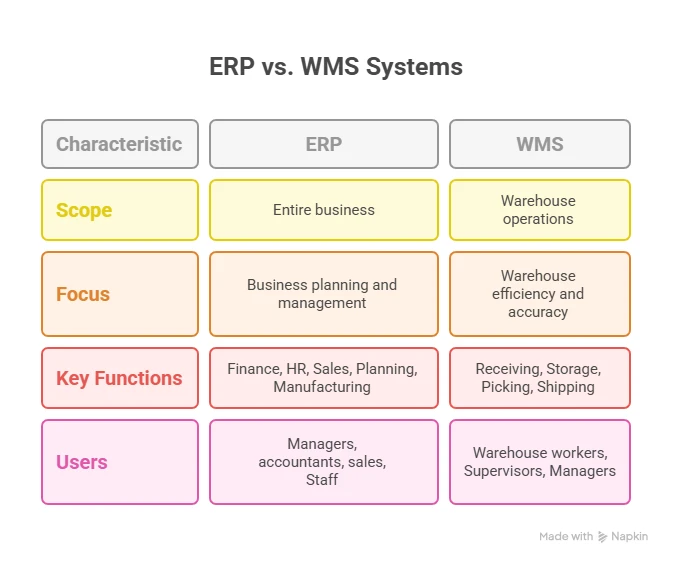
Think of an ERP system as the central computer system for your entire company. It helps manage all the important parts of your business, like:
- Money: Keeping track of income, expenses, and profits.
- Customers: Managing customer information and orders.
- Products: Planning what to make and how much.
- People: Managing employees and their work.
An ERP system brings all these different parts together into one place. This makes it easier to see how your business is doing overall and make better decisions. It's like having a control panel for your whole company.
What is a WMS System?
A WMS, or Warehouse Management System, focuses specifically on managing everything that happens inside a warehouse. This includes:
- Receiving: Getting products into the warehouse.
- Storage: Organizing and storing products in the best way.
- Picking: Finding the right products when an order comes in.
- Packing: Getting the products ready to ship.
- Shipping: Sending the products out to customers.
A WMS helps make sure that your warehouse runs smoothly and efficiently. It's like having a dedicated control panel just for your warehouse.
Key Differences Between WMS and ERP
The main difference is that an ERP system manages the entire business, while a WMS focuses only on the warehouse. Here's a table that breaks down the key differences:
Why You Might Need Both
While an ERP system can sometimes include basic warehouse features, a dedicated WMS offers much more detailed and specific tools for managing your warehouse.
- If you have a small business with a simple warehouse: You might be able to get by with just the warehouse features in your ERP system.
- If you have a larger business with a complex warehouse: You will probably need a separate WMS to manage everything effectively.
Think of it like this: your ERP system is like a general doctor, while your WMS is like a specialist for your warehouse. If you have a specific problem with your warehouse, you need the specialist.
How They Work Together
The best solution is often to have both an ERP and a WMS that work together. The WMS can send information about inventory levels and shipments to the ERP system, so everyone in the company has the most up-to-date information. The ERP system can then use this information to make better decisions about planning, sales, and customer service.
For example:
- A customer places an order through the ERP system.
- The ERP system sends the order information to the WMS.
- The WMS tells warehouse workers where to find the products in the warehouse.
- The WMS tracks the shipment and sends updates back to the ERP system.
- The ERP system updates the customer with the shipping information.
Benefits of Using a WMS
Using a WMS can bring many benefits to your warehouse:
- Improved Accuracy: Less mistakes when picking and shipping orders.
- Increased Efficiency: Faster and smoother warehouse operations.
- Reduced Costs: Lower labor costs and less wasted inventory.
- Better Inventory Management: Knowing exactly what you have in stock and where it is located.
- Happier Customers: Faster and more accurate order fulfillment.
Benefits of Using an ERP
Using an ERP system can bring many benefits to your business:
- Better Decision-Making: Access to real-time data across all departments.
- Improved Efficiency: Streamlined processes and reduced manual work.
- Reduced Costs: Lower operating costs and better resource allocation.
- Increased Collaboration: Improved communication and coordination between departments.
- Better Customer Service: Faster response times and more personalized service.
Choosing the Right System
Choosing between a WMS and an ERP system depends on the specific needs of your business.
- Consider the size and complexity of your warehouse.
- Think about your budget and the return on investment.
- Talk to different vendors and get demos of their systems.
- Make sure the system can integrate with your other software.
Conclusion
In short, an ERP system manages your entire business, while a WMS focuses specifically on your warehouse. While some ERP systems have basic warehouse features, a dedicated WMS offers more advanced tools for managing complex warehouse operations. Often, the best solution is to use both systems together to improve efficiency and accuracy across your entire business. By understanding the differences between these two systems, you can make the right choice for your business and improve your overall performance.



















Sign in to leave a comment.