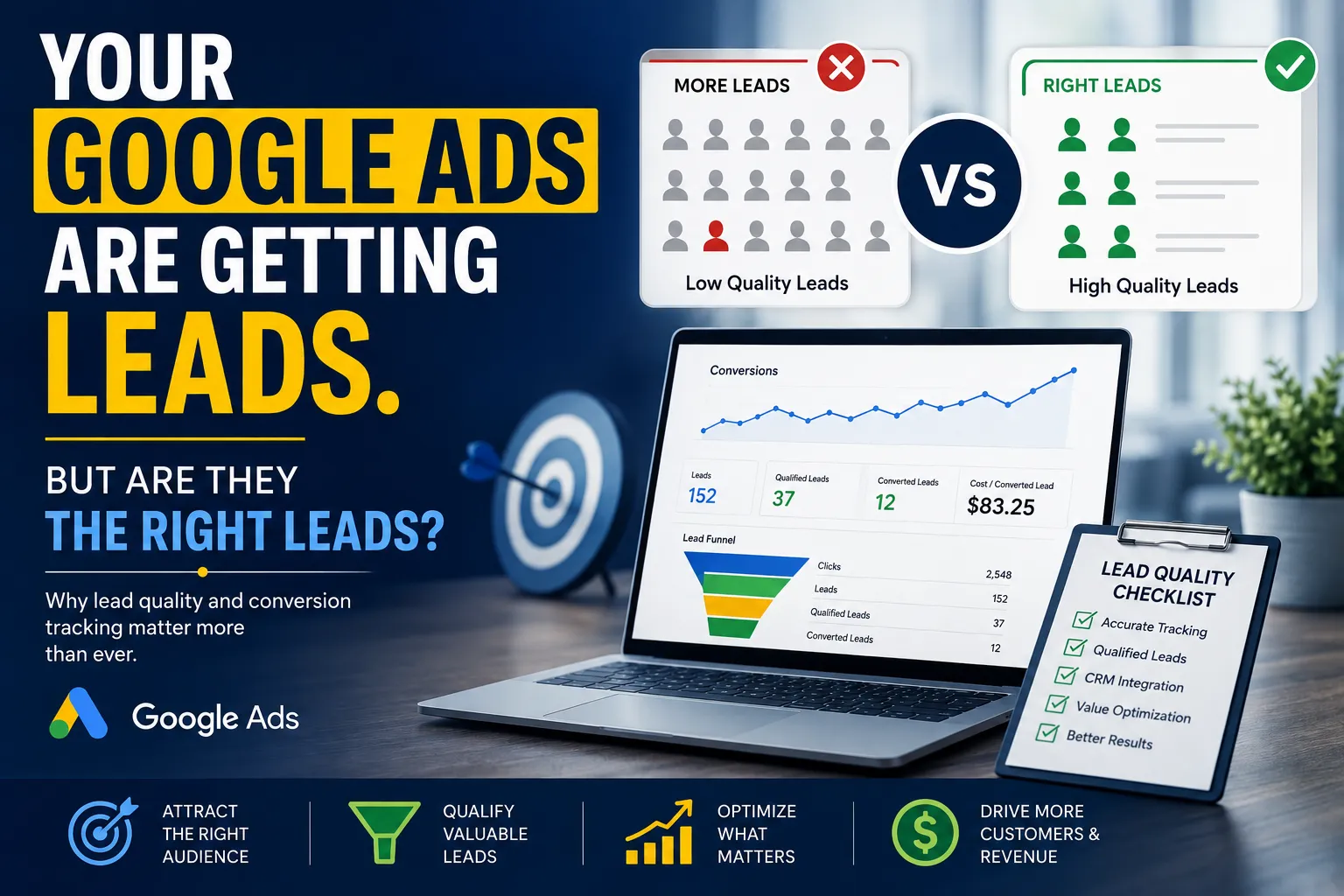

Getting more leads sounds like the obvious goal of Google Ads.
More enquiries.
More phone calls.
More forms.
More bookings.
More opportunities.
But there is a question that many businesses don't ask often enough:
Are you getting more of the right leads—or simply more leads?
That distinction is becoming increasingly important as Google Ads becomes more automated and AI plays a larger role in campaign optimisation.
Google has introduced Qualified leads and Converted leads as distinct conversion goals, allowing advertisers to measure deeper stages of the lead-to-sale journey rather than treating every initial lead as equally valuable. Google says these goals give its systems more information to optimise towards deeper funnel outcomes.
At the same time, Google is moving Search campaigns toward more AI-powered capabilities. Google has announced that remaining eligible Search campaigns using legacy Dynamic Search Ads settings will begin automatically upgrading to AI Max from September 2026, with the transition expected to conclude by the end of September.
That makes accurate conversion data more important—not less.
Because when more of the optimisation is automated, the quality of the signals you provide becomes increasingly important.
A Lead Is Not Necessarily a Customer
Imagine a business receives 100 enquiries from Google Ads.
That sounds impressive.
But what if:
- 40 are outside the service area
- 20 are looking for a service the business doesn't provide
- 15 are price shoppers with no realistic buying intent
- 10 are duplicates
- 5 are spam
- 5 never respond
- Only 5 are genuinely qualified prospects
The campaign generated 100 leads.
But the business generated only 5 meaningful opportunities.
This is why cost per lead can be a misleading metric when viewed by itself.
A campaign generating leads at $30 each may look better than one generating leads at $60 each.
But what happens if the $30 leads rarely become customers while the $60 leads regularly do?
The cheaper campaign may actually be the more expensive campaign.
Cheap leads aren't necessarily valuable leads.
1. Google Ads Is Moving Beyond the Basic “Lead” Conversion
This is one of the most important current changes advertisers should understand.
Google Ads has replaced the older Imported leads conversion goal with two more specific goal types:
Qualified leads
and
Converted leads
Google defines a qualified lead as a Google-generated lead that has subsequently been qualified offline—for example, in a CRM or internal lead-management system.
A converted lead represents a lead that has completed a defined later stage in the sales process, such as a sale or another meaningful business outcome.
This is a major conceptual improvement.
Instead of seeing the journey as:
Click → Lead
businesses can start thinking about:
Click → Lead → Qualified Lead → Converted Lead
That is much closer to how many real businesses actually operate.
A customer doesn't normally go from clicking an advertisement directly to becoming revenue.
There is usually a process in between.
2. Why This Matters More as Google Uses More AI
Google's current direction is increasingly focused on using AI to help advertisers find and optimise towards valuable opportunities.
Google's 2026 materials describe AI Max for Search campaigns as a combination of AI-powered capabilities including search-term matching, text customisation and Final URL Expansion.
Google is also explicitly positioning qualified and converted lead goals as a way to help advertisers make better use of Google AI and automated bidding.
This creates an important principle:
Automation does not remove the need for good data. It increases its importance.
If your account tells Google:
“Every form submission is valuable.”
then the system has less information about which leads actually matter.
If your measurement can distinguish:
Lead → Qualified Lead → Customer
you provide a much richer picture of business value.
The objective isn't to give Google more data simply for the sake of having more data.
It's to give the system better signals about what success actually means.
3. The Lead Funnel Is Bigger Than the Conversion Column
A Google Ads dashboard might show:
50 conversions
But a business owner might know:
50 leads → 18 qualified → 7 proposals → 3 customers
Those are very different stories.
Google's current lead-funnel reporting is designed to show conversion volumes across stages including interactions, leads, qualified leads and converted leads.
That gives businesses an opportunity to stop looking at the advertising funnel as a single number.
Instead:
Interactions
↓
Leads
↓
Qualified Leads
↓
Converted Leads
↓
Revenue
The further down the funnel you can measure accurately, the more meaningful your advertising analysis becomes.
4. Your CRM Can Tell Google What Your Website Cannot
A website can tell you that someone submitted a form.
It cannot necessarily tell you whether that person:
- Had the right budget
- Needed the service
- Was in the target location
- Was genuinely interested
- Became a sales opportunity
- Signed a contract
- Purchased the service
That information often exists somewhere else.
It might be in:
- A CRM
- Sales software
- Booking software
- An internal lead-management system
- A spreadsheet
- A phone system
- An invoicing platform
This is where offline conversion measurement becomes valuable.
Google explains that enhanced conversions for leads can use first-party customer information, such as email addresses, alongside other identifiers to improve measurement of leads that continue beyond the initial online interaction.
For businesses where sales happen offline or through a longer sales process, connecting those outcomes back to advertising can provide a much clearer picture of performance.
5. Google Has Also Changed the Technology Behind Offline Conversion Imports
There is an important 2026 technical update that advertisers and developers should know about.
Starting 15 June 2026, Google says offline conversion imports and enhanced-conversion-for-leads uploads are being migrated to the Data Manager API, with legacy uploads through the Google Ads API being blocked for those use cases. Google recommends using Data Manager for current and future offline conversion and enhanced-conversion-for-leads uploads.
This isn't simply a technical change for developers.
It matters to marketers because conversion measurement infrastructure is becoming an increasingly important part of Google Ads strategy.
If your advertising depends on offline lead outcomes, your tracking setup should not be treated as something that was configured once and forgotten.
It needs to remain compatible with Google's current measurement infrastructure.
6. “Form Submitted” Shouldn't Automatically Mean “Successful Lead”
Consider a business that sells a service for $5,000.
Someone submits:
“How much does this cost?”
That might be a lead.
But it doesn't necessarily mean they are a qualified opportunity.
Another person submits:
“We need this service for our business next month. Can you provide a quote?”
That is a very different signal.
Both might appear as:
1 conversion
inside a basic Google Ads report.
But their business value can be completely different.
That's why businesses should define what qualified actually means.
For example:
A qualified lead might:
- Be located in the target service area
- Require a service the business actually provides
- Meet minimum project requirements
- Have genuine purchase intent
- Be contactable
- Meet a relevant budget or commercial threshold
The exact definition depends on the business.
There is no universal qualification formula.
The important thing is to define it clearly.
7. Not Every Conversion Should Be a Primary Optimisation Signal
Another common problem is treating every tracked action as equally important.
A website may track:
- Contact form submission
- Phone click
- Email click
- Brochure download
- Page view
- Appointment booking
- Quote request
- Purchase
These actions don't necessarily have equal business value.
A brochure download may be useful.
A phone call may be much more valuable.
A completed sale may be more valuable still.
Google's conversion system allows advertisers to identify which conversion actions should be used for optimisation. Google also recommends choosing appropriate goals when setting up qualified and converted lead measurement.
The goal is not to eliminate useful measurement.
It is to make sure the actions used for automated optimisation actually represent the business outcome you want to improve.
8. Lead Quality Should Influence How You Judge Cost
Consider two campaigns.
Campaign A
- Spend: $3,000
- Leads: 100
- Cost per lead: $30
- Qualified leads: 10
- Customers: 3
Campaign B
- Spend: $3,000
- Leads: 50
- Cost per lead: $60
- Qualified leads: 20
- Customers: 8
Campaign A looks better if you only measure cost per lead.
Campaign B looks much stronger if you measure qualified opportunities and customers.
This is why businesses should consider metrics such as:
Cost per qualified lead
Cost per converted lead
Customer acquisition cost
Revenue per lead
Revenue per customer
Return on ad spend
Return on advertising investment
The right metric depends on the business model.
But the principle remains:
Don't optimise the metric that is easiest to count. Optimise the outcome that matters to the business.
9. Google Is Making Full-Funnel Measurement More Explicit
Google's current Lead Journey Mapping capability allows advertisers to define and organise stages in their lead funnel.
Google describes it as a way to map the journey from initial interaction through leads, qualified leads and converted leads, helping businesses identify drop-offs and important conversion points.
This is particularly relevant for businesses with longer sales cycles.
For example:
Google Ad
↓
Website enquiry
↓
Sales call
↓
Qualified opportunity
↓
Proposal
↓
Customer
A business that only measures the first step is effectively judging its marketing using incomplete information.
The deeper stages tell you what happened after the click.
10. Your Sales Team Is Part of Your Google Ads Measurement System
This is often overlooked.
Marketing may generate the lead.
Sales determines what happens next.
If sales teams aren't recording lead outcomes consistently, marketing cannot accurately understand lead quality.
Imagine three sales representatives receive 30 leads each.
One records:
Qualified
Not qualified
Converted
The second records only:
Contacted
The third records nothing.
Now the marketing team has incomplete information.
The problem isn't necessarily the Google Ads campaign.
It may be the measurement process after the lead arrives.
For businesses investing heavily in lead generation, marketing, sales and CRM processes should therefore work together.
11. AI Max Makes This Even More Relevant
Google has announced that eligible legacy Search campaigns will begin automatically upgrading to AI Max from September 2026. The company says the upgrades will preserve relevant legacy controls while enabling AI Max features according to the campaign type.
That means businesses should use the period before and during the transition to examine their measurement foundations.
Ask:
What does Google currently count as a conversion?
Which conversions are primary?
Which leads become qualified?
Which leads become customers?
Can those outcomes be imported or connected back to Google Ads?
Are conversion values meaningful?
Are duplicate conversions being avoided?
Does the CRM contain reliable lead-stage information?
These questions may matter more than simply adding another keyword.
12. Conversion Values Can Make the Data More Useful
Not every lead has the same economic value.
A $200 service enquiry and a $20,000 project enquiry should not necessarily be treated as identical business outcomes.
Google's current guidance supports using conversion values for offline qualified or closed leads and recommends enhanced conversions for leads when measuring qualified or closed offline outcomes.
For example, a business might assign different values based on:
- Service type
- Customer type
- Expected revenue
- Estimated profit
- Lead quality
- Sales stage
The exact approach should reflect the business's economics.
The key is to avoid pretending that every conversion is worth exactly the same amount when it clearly isn't.
13. Phone Calls Need Measurement Too
For many Australian service businesses, the most valuable conversion isn't a form.
It's a phone call.
A plumber.
Electrician.
Chiropractor.
Law firm.
Accountant.
Tradie.
Medical practice.
Professional service business.
For these businesses, a person may click an advertisement, visit the website and immediately call.
If that call isn't measured correctly, the business may underestimate the value of its advertising.
Google provides phone-call conversion tracking to help advertisers understand how effectively ads lead to calls from a website.
But simply counting every call isn't enough.
A 20-second spam call shouldn't necessarily have the same business value as a 10-minute conversation with a genuine prospective customer.
Where technically and legally appropriate, businesses should consider whether their call measurement can distinguish meaningful outcomes from low-value interactions.
14. Don't Confuse More Data With Better Data
It can be tempting to track everything.
Every click.
Every button.
Every page.
Every interaction.
Every scroll.
Every form.
Every call.
Every event.
But more tracking doesn't automatically create better decision-making.
The real question is:
Which signals help us understand whether Google Ads is creating business value?
For a local service company, that might be:
Qualified phone calls + qualified enquiries + booked jobs
For an ecommerce company:
Purchases + revenue + profit
For a B2B company:
Qualified opportunities + closed deals + revenue
Measurement should reflect the business model.
15. What Businesses Should Audit Before the Next Google Ads Optimisation
Before changing keywords, increasing budgets or enabling more automation, review the measurement foundation.
Conversion Audit
1. List every conversion action.
What exactly is Google counting?
2. Separate micro and macro conversions.
Which actions indicate interest, and which represent genuine business value?
3. Define a qualified lead.
What makes a lead worth pursuing?
4. Define a converted lead.
What event represents a successful business outcome?
5. Check primary conversion settings.
Are the right actions being used for optimisation?
6. Check for duplicate conversions.
Could the same lead be counted more than once?
7. Connect CRM outcomes where appropriate.
Can qualified and converted leads be sent back to Google Ads?
8. Review conversion values.
Do values reflect differences between lead types?
9. Check phone-call tracking.
Are valuable calls being measured?
10. Review the full funnel.
Can you see:
Lead → Qualified → Converted → Revenue?
If you cannot, you may be optimising with incomplete information.
16. What This Means for Small Australian Businesses
You don't necessarily need an expensive enterprise CRM to start improving lead quality.
A small business can begin with a simple process.
For example:
New Lead
↓
Contacted
↓
Qualified
↓
Quote/Proposal
↓
Won/Lost
Even a well-maintained system can be more useful than simply counting every form submission as a success.
The important thing is consistency.
If the business defines “qualified” one way on Monday and another way on Friday, the resulting data becomes much less useful.
Start simple.
Then improve the system as the business grows.
17. The Future of Google Ads Is Not “More Leads”
Google's current product direction tells us something important.
The company isn't only talking about clicks and impressions.
Its 2026 lead-generation guidance increasingly focuses on:
- First-party data
- Conversion measurement
- Qualified leads
- Converted leads
- Lead-funnel reporting
- AI-powered optimisation
- Full-funnel outcomes
Google's own guidance says selecting qualified or converted lead goals can give Google AI more information for optimisation, while Lead Journey Mapping is designed to connect advertising activity with deeper stages of the sales process.
That points toward a more mature advertising model:
Don't just ask Google to find people who convert.
Give it better information about which conversions actually matter.
Google Ads is increasingly becoming an AI-powered system, making campaign strategy, conversion measurement and ongoing optimisation more important. Businesses that need help managing this process can explore Google Ads management as part of a broader lead-generation strategy.
What Should You Do Now?
If your business is currently running Google Ads, start with five questions:
1. How many leads are we actually generating?
Not estimated leads.
Not enquiries someone remembers.
Actual tracked leads.
2. How many are qualified?
How many genuinely meet your criteria?
3. How many become customers?
This is where marketing performance meets business performance.
4. Can Google Ads see those deeper outcomes?
If not, investigate whether enhanced conversions for leads, offline conversion measurement or CRM integration is appropriate for your business. Google's current documentation recommends enhanced conversions for leads as an upgrade path from legacy offline conversion imports.
5. Are you ready for increasing automation?
With eligible legacy Search campaigns beginning their transition to AI Max from September 2026, now is a sensible time to review conversion goals, lead quality and measurement rather than waiting for the campaign structure to change first.
Final Thought
Getting a lead is only the beginning.
The real value appears later.
When the lead is contacted.
When the lead is qualified.
When a proposal is accepted.
When a booking is made.
When a sale happens.
When revenue is generated.
Google Ads can help businesses find opportunities.
Increasingly, Google is also giving advertisers tools to help its systems understand which opportunities are valuable.
But the business still has to define success.
Don't ask, “How many leads did Google Ads generate?”
Ask:
“How many valuable customers did Google Ads help us acquire?”
That is a much better measure of advertising performance.
And as Google Ads becomes increasingly AI-powered, better measurement may become one of the most important competitive advantages an advertiser can build.























Sign in to leave a comment.