

If you’re currently living the intern pharmacist life in Australia, you already know how busy and overwhelming it can feel.
Long shifts. ITP tasks. Constant revision. And somewhere in between all of that.
There’s one final step left before you become a fully registered pharmacist:
The intern pharmacist's written exam.
I’ve seen so many interns feel stressed about this stage. And honestly, that’s completely normal. This exam is not just another test. It’s the final check to make sure you’re ready to practise safely in Australia.
So let’s make this simple.
This guide will walk you through everything from pharmacy intern written exam dates to exam format or preparation tips and what to expect on the big day.
What is the Intern Pharmacist Written Exam?
The intern pharmacist written exam is conducted by the Australian Pharmacy Council (APC).
Its main goal is to check one thing: Can you apply your knowledge in real-life pharmacy situations?
This is not like your university exams.
You’re not just memorising.
You’re thinking like a pharmacist.
You’ll be tested on things like:
- Identifying unsafe prescriptions
- Managing drug interactions
- Giving proper patient advice
- Making safe clinical decisions
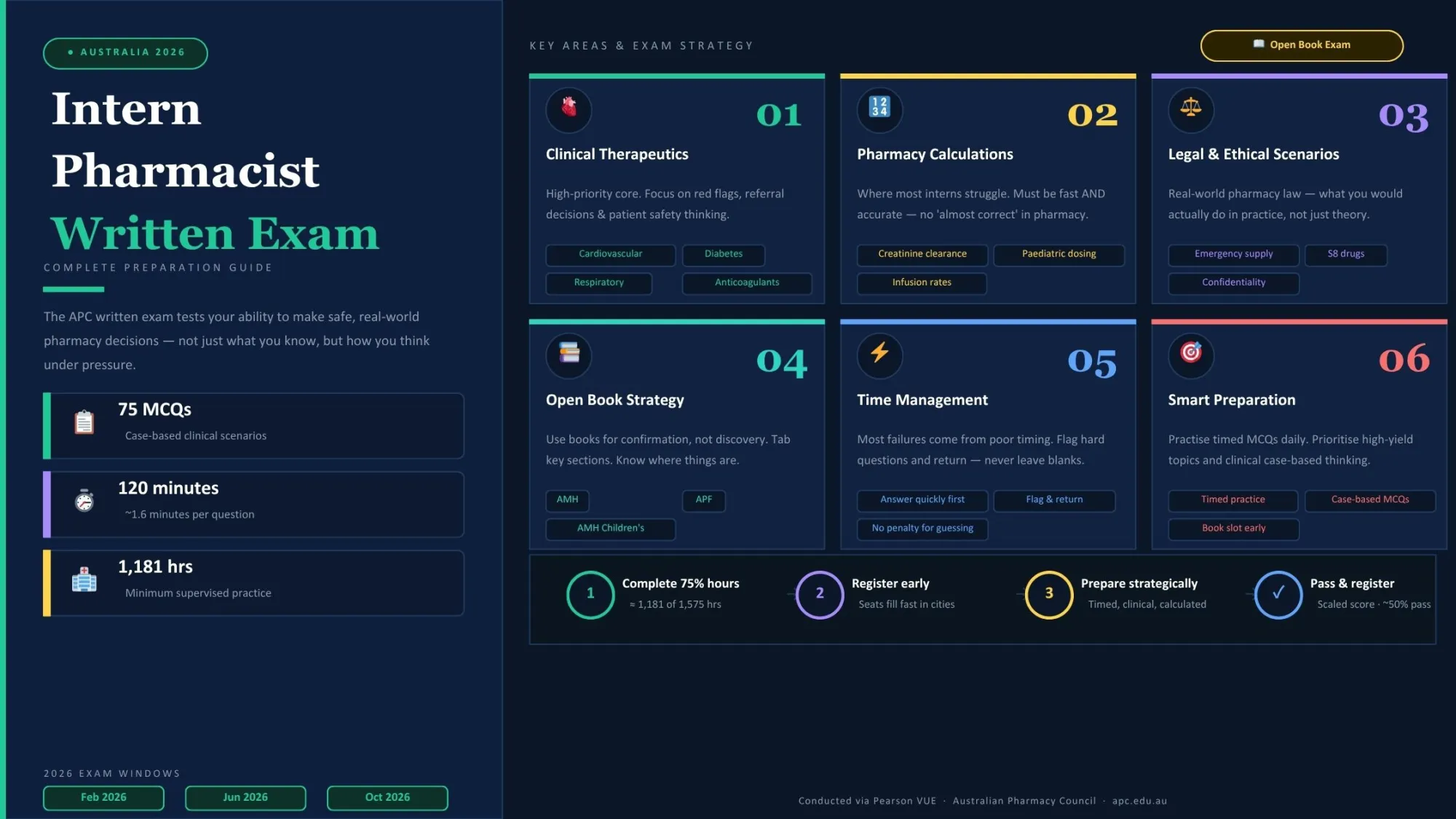
Australian Pharmacy Intern Written Exam Format (2026)
Let’s keep it simple:
- 75 Multiple Choice Questions (MCQs)
- 2 hours (120 minutes)
- Computer-based exam
- Conducted at Pearson VUE test centres
- Questions are case-based and practical
That gives you around 1.6 minutes per question.
So, time management matters a lot.
Pharmacy Intern Written Exam Dates 2026
The exam usually happens three times a year.
Here’s a simple breakdown of expected intern written exam dates:
- February 2026
- June 2026
- October 2026
Each exam has a strict registration window.
If you miss it, you’ll have to wait for the next cycle.
Simple advice: Book early. Don’t wait till the last week.
Eligibility: Can You Sit the Exam?
Before booking the pharmacist written exam, you must complete:
75% of your supervised practice hours
For most interns:
- Total hours = 1,575
- Required before exam ≈ 1,180 hours
Also:
- Your hours must be logged and approved
- Everything should be updated in your APC portal
No approval = no exam booking.
Is the Exam Really Open Book?
Yes, it is.
But here’s the truth most people don’t tell you:
If you depend on books for every answer, you will run out of time.
What you can bring:
- Australian Medicines Handbook (AMH)
- Australian Pharmaceutical Formulary (APF)
- BNF (optional)
What you should do:
- Study concepts properly
- Use books only to confirm answers quickly
- Practice using tabs for fast navigation
What Should You Study?
The exam covers everything, but some areas are more important.
1. Calculations (Very Important)
This is where many interns struggle.
Focus on:
- Dosing calculations
- Creatinine clearance (CrCl)
- Infusion rates
- Paediatric doses
Practice regularly. Don’t ignore this.
2. Clinical Scenarios
You’ll get patient cases and questions like:
- Is this prescription safe?
- Should you change the dose?
- Should you refer the patient?
You need to think practically, not just remember facts.
3. Legal & Ethical Topics
Make sure you understand:
- Medicine schedules
- Labelling rules
- Pharmacist responsibilities
These are usually easy marks if you prepare well.
Mock Exams: Don’t Skip This
Mock exams make a big difference.
They help you:
- Improve speed
- Understand question patterns
- Build confidence
Try to complete at least 5–7 mock tests
This will make the real exam feel much easier.
Time Management Strategy
Time is limited, so use it wisely.
Simple strategy:
- Start with easy questions
- Skip difficult ones
- Come back later
- Review at the end
Don’t get stuck on one question.
Common Mistakes to Avoid
Many interns lose marks due to simple mistakes:
- Not practicing enough
- Ignoring calculations
- Poor time management
- Depending too much on books
Avoid these, and you’re already ahead.
Exam Day: What to Expect
On the exam day, things are very structured.
Here’s what you need to know:
- Arrive 30 minutes early
- Bring your passport (mandatory)
- Store all belongings in a locker
- You’ll get a short tutorial before the exam
Use that tutorial time to get comfortable with the system.
After the Exam: What Happens Next?
If You Pass:
- Move to the oral exam
- Complete internship
- Apply for registration
If You Don’t Pass:
- Reattempt in the next exam cycle
- Focus on weak areas
- Improve your strategy
Failing once is not the end. Many pharmacists succeed after a second attempt.
Career Options After Passing
Once you pass the intern pharmacist written exam, many doors open.
You can work in:
- Community pharmacy
- Hospital pharmacy
- Clinical roles
- Research
- Academia
Later, you can specialise in:
- Oncology
- Aged care
- Infectious diseases
- Medication reviews
Final Checklist Before Exam Day
Before your exam, make sure:
- Eligibility completed
- Exam booked
- Resources ready
- Mock exams done
- Calculations practiced
Final Thoughts
The intern pharmacist written exam is your final academic step before becoming a registered pharmacist in Australia.
Yes, it can feel stressful.
But it is absolutely achievable.
Just stay consistent.
Practice regularly.
Trust your preparation.
You’ve already come this far.
Now it’s time to take that final step.
You’re closer than you think.




























Sign in to leave a comment.