Should You Sit ZDTE Now? A Six-Question Decision Tree for the Zscaler Digital Transformation Engineer Exam

By VMExam Editorial Team (VCP-DCV, VCAP) · Last updated 25 November 2026
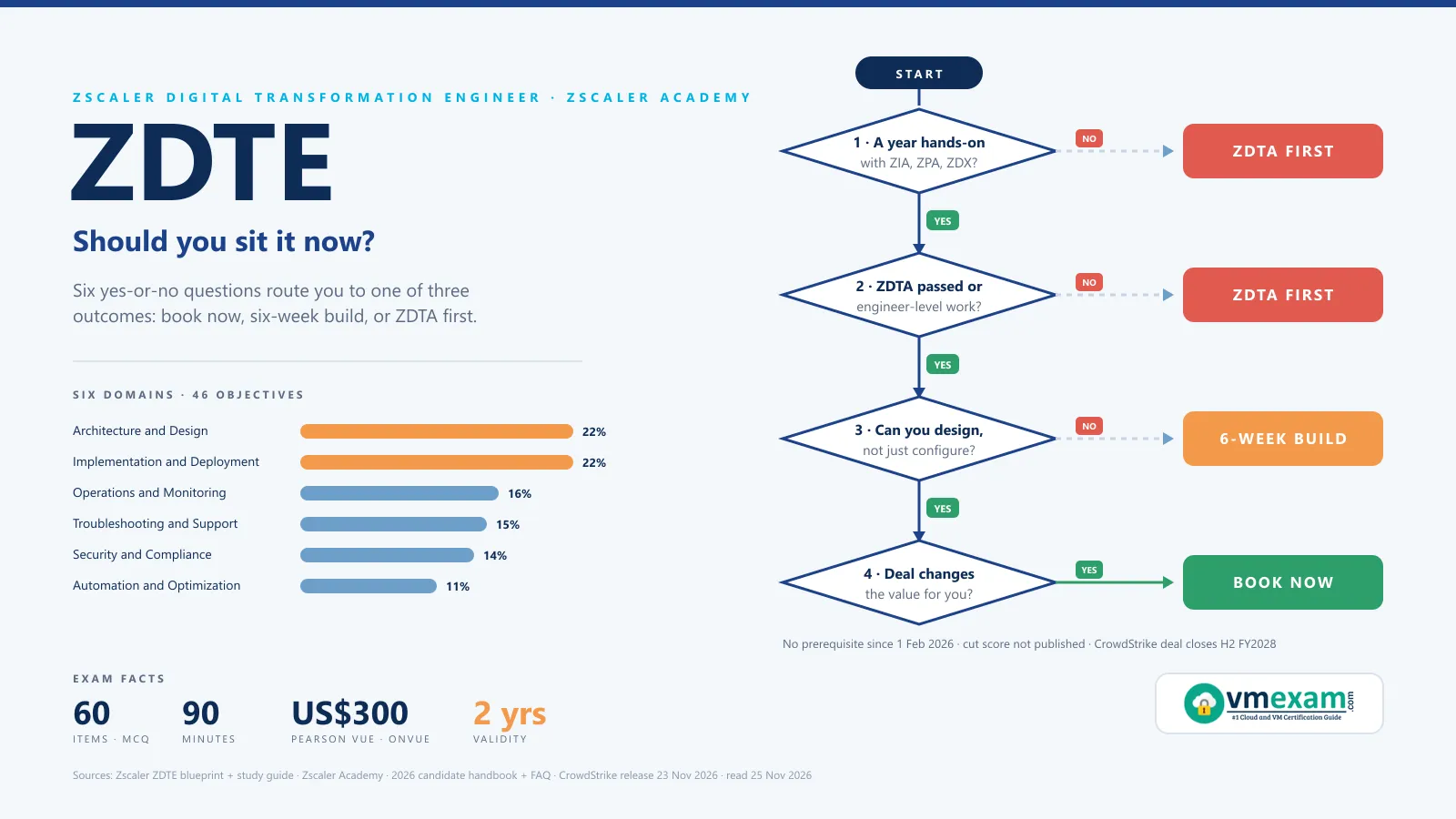
Two things happened to the Zscaler Digital Transformation Engineer exam in 2026 that change the decision to sit it. On 1 February, Zscaler stopped requiring customers and partners to finish its eLearning and labs before booking. On 23 November, Zscaler agreed to be acquired by CrowdStrike. Neither makes the exam easier or harder. Both change when and why you would take it. Below is a decision tree: six yes-or-no questions, each with the evidence behind it, each routing you to one of three outcomes. Start at the top and follow your answers.
The three outcomes: Path A, book within two weeks and spend the gap on timed practice. Path B, a six-week build on the two design-heavy domains before you book. Path C, sit the administrator-level ZDTA first, or get a year of hands-on work, and come back to this tree.
Question 1: Do you have at least a year of hands-on work with ZIA, ZPA and ZDX?
If yes, go to Question 2. If no, you are on Path C: Zscaler's own study guide says the exam is for people with a minimum of one year on the platform and five years in networks and security, and the blueprint is written for that person.
Zscaler's ZDTE study guide, a 394-page document published on zscaler.com, defines the audience as "cybersecurity and network professionals who have hands-on experience with core networking and security concepts, including routing and switching, firewalls, VPN technologies, DNS, proxies, operating systems, and common network protocols," with "practical working knowledge of Zscaler Internet Access (ZIA), Zscaler Private Access (ZPA), and Zscaler Digital Experience (ZDX)." It then sets two numbers: "Minimum of 5 years working in both IT networks and cybersecurity" and "Minimum of 1 year experience with the Zscaler platform."
These are recommendations, not registration gates, so you can book without them. The reason to treat them as a real fork is the shape of the questions. Forty-six objectives on the blueprint, and nearly every one begins "Given a scenario." A scenario about App Connector sizing from the Help Doc chart, or about which log fields to stream to a SIEM through the Nanolog Streaming Service, is not something you reason out from first principles in 90 seconds. You have either done it or you have not.
If you answered no, Path C is not a detour; it is the exam's own recommended route. The handbook's Zscaler for Users - Engineer course (EDU-202) and lab exist for this, and the administrator-level ZDTA exam covers the same three products at the configuration level. Come back to this tree in six to twelve months.
Question 2: Have you passed ZDTA, or do you need to?
If you have ZDTA or do engineering-level Zscaler work daily, go to Question 3. If you have neither, take ZDTA first (Path C). ZDTE has no prerequisite, but the two exams cost the same and ZDTA is the cheaper way to find out whether your platform knowledge is deep enough.
The blueprint states it plainly: "Prerequisites | None. Zscaler for Users - Engineer (EDU-202) Course & Lab are strongly recommended." Zscaler's 2026 Certification Candidate Handbook adds the February change: "As of February 1, 2026, customers, partners, and Zscaler employees are no longer required to complete eLearning modules and Labs as mandatory prerequisites to schedule and take the ZDTA, ZDTE, and ZDXA exams." So nothing stops a first-time Zscaler candidate from booking ZDTE directly.
The argument for ZDTA first is economic and diagnostic, not procedural. The handbook sets the standard price for every Zscaler certification exam at "$300 per attempt," so a failed ZDTE costs exactly what a passed ZDTA does. ZDTA tests configuration and administration of the same ZIA, ZPA and ZDX services; ZDTE tests, in the handbook's words, "advanced deployment and complex strategy skills" and is "targeted at experienced engineers and consultants." If you are not sure which of those two descriptions fits you, that uncertainty is the answer.
If you already hold ZDTA, or your job title has "engineer" or "architect" in it and your week is spent designing forwarding, segmentation and policy rather than operating it, skip ZDTA and go to Question 3.
Question 3: Can you make design decisions, not just configure the result?
If yes, go to Question 4. If no, you are on Path B: Architecture and Design (22%) plus Implementation and Deployment (22%) are 44% of the exam and 29 of its 46 objectives, and the first of those domains is written as judgement calls rather than setup tasks.
The blueprint's six domains and weights are: Architecture and Design 22%, Implementation and Deployment 22%, Operations and Monitoring 16%, Troubleshooting and Support 15%, Security and Compliance 14%, Automation and Optimization 11%. The study guide describes the first domain as the point where "the ZDTE blueprint shifts from feature familiarity to engineering judgment," with objectives "framed less as setup tasks and more as scenario decisions: choosing connectivity models, defining segmentation boundaries, applying least privilege, and using evidence to explain outcomes."
Test yourself on three of its twelve objectives before you answer:
- Given user groups in several geographies, can you assign GRE, IPsec, PAC or Zscaler Client Connector to each and explain why?
- Given a user's location and bandwidth and the sizing chart, can you choose an App Connector configuration that is both correctly sized and highly available?
- Given a user on a known network, can you say when private-application traffic should bypass the Zero Trust Exchange, and what that does to policy and visibility?
If you hesitated on two of the three, take Path B: three weeks in Parts 1 and 2 of the study guide (Architecture and Design runs from page 9 to page 90; Implementation and Deployment from 91 to 216), then three weeks on the remaining four domains and timed practice. The arithmetic favours this. The three smallest domains, Troubleshooting, Security and Compliance, and Automation, together carry 40% of the marks on only seven objectives, so each of those objectives is worth roughly four times a single Deployment objective. You cannot afford to spend all six weeks on design, but you cannot pass without it either.
Question 4: Can you get into EDU-202 and a lab, or will you self-build?
Either answer continues to Question 5; this question decides how you prepare, not whether. Customers, partners and public-sector staff can enrol through Zscaler Academy's sign-in; everyone else builds from the free blueprint, the free study guide and practice questions.
Zscaler Academy's ZDTE page describes the certification as the "final step in the Zscaler for Users - Engineer (EDU-202) learning path" and offers "Get Certified" through separate Customer, Partner and Public Sector sign-ins. The exam itself is scheduled through Pearson VUE, either at a test centre or online through OnVUE, with a government-issued photo ID at check-in.
If you have Academy access, EDU-202's hands-on lab is the shortest route to the scenario fluency Question 1 asked about. If you do not, the free material is unusually complete for a vendor exam: a three-page blueprint listing all 46 objectives, a 394-page study guide organised domain by domain, and a certification FAQ. Add a lab of your own, even a trial tenant or a partner sandbox, because the blueprint's "Given a scenario and graphic of a ZIA dashboard" objectives assume you have looked at those dashboards.
Whichever way you prepare, one figure is not available to you. Zscaler's FAQ says, "We do not reveal specific cut scores or the exact number of correct items needed to pass as content changes and exam maintenance can impact scoring." Third-party pages that quote a percentage are estimating. Passers receive a "Passing status" only; non-passers receive a score breakdown by blueprint area, which is the one piece of diagnostic data the exam gives you, and only after a fail.
Question 5: Does the CrowdStrike acquisition change whether ZDTE is worth holding?
If you work in a Zscaler environment or sell into one, the answer is no, it does not reduce the value, and you continue to Question 6. If you were choosing between vendor certifications on the strength of the vendor's independence, the deal is the one new fact to weigh.
On 23 November 2026, CrowdStrike and Zscaler announced a definitive agreement under which CrowdStrike will acquire Zscaler in an all-stock transaction: 1.135 CrowdStrike shares for each Zscaler share, an implied value of about US$260.41 per share and an enterprise value of about US$43.9 billion at CrowdStrike's 20 November closing price. The companies expect the deal to close "in the second half of CrowdStrike's fiscal year 2028," subject to Zscaler shareholder and regulatory approval, and state that "until closing, both companies will continue to operate independently." Jay Chaudhry will continue to lead the Zscaler business and join CrowdStrike's board after close.
The announcement also sets out why the platform you are certifying on is not going anywhere. Zscaler's Zero Trust Exchange "processes more than 750 billion transactions per day," the company protects 50 percent of the Fortune 500, and its annual recurring revenue was US$3.9 billion at the end of its most recent quarter. CrowdStrike counts about 8,000 Zscaler customers who are not yet CrowdStrike customers and more than 2,000 shared customers across 16 existing integrations. George Kurtz, CEO and founder of CrowdStrike, framed the deal in one sentence: "Security used to be about keeping the adversary out. Today, safety is required to let AI in." Chaudhry, Zscaler's CEO, chairman and founder, said, "Zscaler and CrowdStrike are complementary and this is the natural evolution of our longstanding partnership."
For a candidate, the timing matters more than the strategy. A ZDTE certification earned in December 2026 is valid for two years, to December 2028, which spans the expected close and the first year of the combined company. Zscaler's own figures from its 23 November quarterly report, revenue up 20% to US$949.3 million and annual recurring revenue up 21% to US$3.88 billion, describe a product line growing into the acquisition, not shrinking out of it. The skills on the blueprint, forwarding design, segmentation, least privilege, PAC logic, log streaming to a SIEM, are the skills the acquirer paid US$43.9 billion to add. If anything, a credential that proves them is worth more in a market where two large customer bases are about to be cross-sold.
Question 6: Should you book this quarter or wait for a new version?
Book within the next quarter if you reached this question on yes answers. The blueprint warns that its guidelines "may change at any time without notice," the current study guide is the version in force, and waiting for a post-acquisition exam means waiting past the expected close in 2027 or 2028.
Two practical details support booking sooner. First, the handbook notes that discounted exams "are often offered at our premiere customer onsite event of the year, Zenith Live," so if your employer sends people, the US$300 fee can fall; if not, the standard price applies whenever you sit. Second, recertification works by passing the current version of the exam, and you become eligible 90 days before expiry. Sitting now starts a two-year clock you control; waiting for a hypothetical revised blueprint gives you nothing you can study for today.
The exam format you are booking: 60 multiple-choice items, a 90-minute seat time, delivered online proctored, in English or Japanese according to the study guide, at the Professional level of Zscaler's Digital Transformation series. Pearson VUE lets you flag questions for review and return to them before you submit.
What does each path through the tree look like?
Three paths, three timelines: Path A books inside two weeks, Path B books after a six-week build, Path C sits ZDTA or gains a year of experience first.
- Path A, book now. You answered yes to Questions 1, 2, 3 and 5. Spend two weeks on timed 60-question sets at 90 minutes, read the Troubleshooting, Security and Automation chapters of the study guide once more because those seven objectives carry 40% of the marks, and book a date before the end of the quarter.
- Path B, six-week build. You have the experience but hesitated on the design objectives. Weeks 1 to 3: study guide Parts 1 and 2, with a lab exercise per objective group (forwarding, PAC, AppSegments and connectors, access policies, probes and alerts, log streaming). Weeks 4 and 5: Parts 3 to 6, dashboards, troubleshooting traces, containment and PAC optimisation. Week 6: timed sets, then book.
- Path C, ZDTA first or more time. You lack a year on the platform, or ZDTA would tell you something ZDTE's pass-or-fail result will not. Take EDU-202 if you have Academy access, sit ZDTA, and run this tree again in six to twelve months.

Video: How to Prepare for Zscaler Digital Transformation Engineer Certification? (VMExam on YouTube): https://www.youtube.com/watch?v=KQKAOORiFIQ
Which ZDTE exam facts should you confirm before booking?
Six: 60 items in 90 minutes, multiple choice, online proctored through Pearson VUE, US$300 per attempt, no published cut score, and a two-year validity with recertification by re-passing the current exam.
- Format: 60 multiple-choice items, 90-minute seat time, Professional level, English and Japanese, per the study guide's exam format table.
- Delivery: Pearson VUE test centre or OnVUE online proctoring; government-issued photo ID required; no-shows forfeit the fee, per the 2026 handbook.
- Price: US$300 per attempt, listed on Zscaler Academy's ZDTE page as "US$300 (1 credit) per attempt."
- Prerequisites: none since 1 February 2026; EDU-202 strongly recommended; one year on the platform recommended.
- Scoring: cut score not revealed; passers see "Passing status"; non-passers see a breakdown by blueprint area.
- Validity: two years from the date earned; recertify by passing the current exam version, eligible from 90 days before expiry; Credly badge re-issued.
Quick answers: ZDTE FAQ
How many questions are on the ZDTE exam?
60 multiple-choice items in a 90-minute seat time, according to Zscaler's ZDTE study guide and exam blueprint.
How much does the ZDTE exam cost?
US$300 per attempt, per Zscaler Academy's ZDTE page and the 2026 Certification Candidate Handbook. Discounts are sometimes offered at Zenith Live.
Does ZDTE have prerequisites?
No. The blueprint lists none, and since 1 February 2026 the eLearning and labs are no longer mandatory before scheduling. The EDU-202 course and lab are strongly recommended.
What is the ZDTE passing score?
Zscaler does not publish it. Its certification FAQ says cut scores and the number of correct items needed are not revealed because exam maintenance affects scoring.
What topics does ZDTE cover?
Six domains: Architecture and Design 22%, Implementation and Deployment 22%, Operations and Monitoring 16%, Troubleshooting and Support 15%, Security and Compliance 14%, Automation and Optimization 11%, across 46 objectives.
What is the difference between ZDTA and ZDTE?
ZDTA is the administrator-level exam on configuring ZIA, ZPA and ZDX; ZDTE is the engineer-level exam on designing, deploying and optimising them. Both cost US$300 and neither requires the other.
How long is ZDTE valid?
Two years from the date earned. Recertification means passing the current version of the exam, which you can do from 90 days before expiry.
Does the CrowdStrike acquisition affect the ZDTE certification?
Not before closing. The companies say they will operate independently until the deal closes, expected in the second half of CrowdStrike's fiscal 2028, and a certification earned now is valid for two years through that period.
Is ZDTE worth it in 2026?
If you engineer Zscaler deployments, yes. The platform handles more than 750 billion transactions a day for half the Fortune 500, and the acquisition adds a second large customer base that will need the same skills.
Before you book
Write down your six answers. If they are all yes, you are two weeks from a booking; VMExam's ZDTE practice exam and syllabus breakdown follows the same six domains and weights as the blueprint, so a timed set tells you which domain to revisit before you pay the fee. If a no sent you to Path B or C, come back to the tree after the build and check whether the answer changed. Confirm the price and delivery options on Zscaler Academy's ZDTE page when you register; this article reflects Zscaler's blueprint, study guide, 2026 handbook and FAQ, and the CrowdStrike announcement, as read on 25 November 2026.
Zscaler, ZIA, ZPA, ZDX, Zero Trust Exchange and Zenith Live are trademarks of Zscaler, Inc. CrowdStrike and Falcon are trademarks of CrowdStrike, Inc. This article is independent exam-preparation guidance and is not affiliated with or endorsed by Zscaler or CrowdStrike.








Sign in to leave a comment.