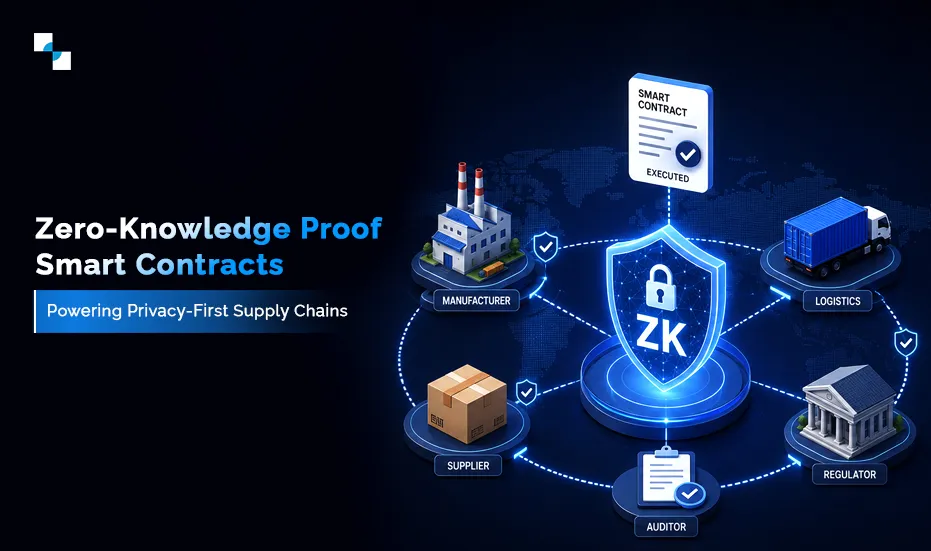

Your supply chain has a confidentiality problem that first-generation blockchain was never designed to solve. Every time supply chain data moves to a shared ledger without a privacy layer, supplier contracts, pricing terms, and logistics routes become shared intelligence visible to competitors, regulators, and counterparties on the same network. The same immutability that makes blockchain trustworthy makes full-transparency architectures commercially dangerous.
According to the World Economic Forum’s Global Cybersecurity Outlook 2026, 65% of large enterprises now cite third-party and supply chain vulnerabilities as their single greatest challenge, up from 54% in 2025. That risk does not decrease when supply chain data moves on-chain without a privacy layer. It compounds.
In this blog, we break down exactly how zero knowledge proof smart contracts resolve the privacy-transparency conflict and what it means for how blockchain supply chain development gets architected in 2027.
What Is a Zero Knowledge Proof Smart Contract?
A zero knowledge proof smart contract is a blockchain-based program that verifies whether a statement is true without revealing the underlying data. It uses cryptographic proofs to automate compliance, verification, and business processes while keeping sensitive information private.
In supply chain environments, this allows organizations to prove product origin, regulatory compliance, shipment conditions, or supplier certifications without exposing confidential business information to other participants on the network.
Why Blockchain Supply Chain Development Without Privacy Is a Competitive Liability
The core problem with first-generation blockchain supply chains: transparency that was designed to build trust ends up leaking competitive intelligence.
When supply chain data sits on a shared ledger with no cryptographic privacy controls, it does not just create visibility; it creates a shared intelligence layer. Every consortium participant can read supplier identities. Rivals on the same network can see pricing agreements. Anyone with node access can map your logistics routing. A pharmaceutical manufacturer, revealing its active ingredient supplier on-chain, is conducting its competitors’ sourcing research for free. A defence contractor publishing procurement routes on a shared ledger is handing adversaries a structural map of supply dependencies.
According to PwC’s 2026 Digital Trends in Operations Survey of 767 operations and supply chain leaders, organizations continue to face significant challenges in extracting value from digital transformation initiatives, with data quality, integration complexity, and operational silos emerging as persistent barriers. As enterprises expand blockchain-based supply chain systems, privacy-preserving architectures become increasingly important for balancing transparency, compliance, and commercial confidentiality.
The solution is not to abandon blockchain supply chain development. The solution is to separate what supply chains must prove from what they cannot afford to reveal. That separation is what zero knowledge proof smart contracts were architected to deliver.
Inside a Zero Knowledge Proof Smart Contract Workflow
Traditional smart contracts require access to data before they can verify a condition and execute an action. In supply chain environments, that creates a challenge: organizations often need to validate compliance, product quality, sourcing standards, or contractual obligations without exposing commercially sensitive information to every participant on the network.
Zero knowledge proof smart contracts solve this challenge by separating verification from disclosure. Instead of sharing raw business data, participants generate cryptographic proofs that confirm a specific claim is true. The smart contract verifies the proof and automatically executes the predefined logic without accessing the underlying records.
In practice, this enables a supplier to prove a shipment remained within a required temperature range without revealing logistics data, a manufacturer to verify sourcing compliance without exposing supplier relationships, or an auditor to confirm regulatory adherence without publishing confidential reports.
The process typically follows three steps:
Proof Generation: A participant generates a cryptographic proof based on internal business data while keeping the underlying information private.
Proof Verification: The proof is submitted to the blockchain, where the smart contract validates its authenticity and integrity.
Automated Execution: Once the proof is verified, the contract automatically triggers the required business action, such as releasing payments, issuing certifications, approving shipments, or recording compliance status.
As zero knowledge proving systems continue to improve in speed and scalability, enterprises are increasingly adopting them to build supply chain networks that combine transparency, automation, and privacy within a single compliance framework.
Did You Know?
“According to MarketsandMarkets, the global blockchain supply chain market is projected to reach $3.27 billion reflecting accelerating enterprise demand for privacy-preserving, verifiable supply chain infrastructure.”
The Compliance Collision Making Blockchain App Development Services Non-Negotiable
Regulatory compliance is becoming a key driver of zero knowledge proof adoption in enterprise supply chains. As organizations seek greater transparency and stronger data privacy, blockchain app development services are increasingly focused on building architectures that balance regulatory verification with commercial confidentiality.
- Transparency mandates: The EU’s MiCA regulation, Corporate Sustainability Reporting Directive (CSRD), and Deforestation-Free Products Regulation (EUDR) all require enterprises to make supply chain data verifiable, auditable, and provable to regulators on demand.
- Privacy obligations: GDPR prohibits storing personal or sensitive business data on immutable public ledgers. CCPA in the US, DPDP in India, and China’s national data protection framework impose similar constraints.
These requirements do not overlap. They conflict. A first-generation blockchain that puts supply chain data on-chain satisfies the transparency mandate and violates the privacy obligation simultaneously. The only architecture that resolves both requirements is a privacy-preserving blockchain model powered by zero knowledge proofs.
Blockchain app development services teams that do not build ZK compliance requirements into the architecture from day one are delivering systems that will require expensive redesigns at the next audit cycle. By 2027, any enterprise supply chain protocol deployed without privacy-preserving smart contracts is not a technology gap; it is a documented compliance liability.
The Regulatory Stack Driving ZK Adoption in 2027
- GDPR (EU): Prohibits personal/sensitive data on immutable public ledgers; ZK keeps data off-chain
- MiCA (EU): Requires verifiable on-chain compliance for digital asset supply chains; ZK enables proof without disclosure
- EUDR (EU): Mandates deforestation-free sourcing proof for food/agriculture imports; ZK proves origin without revealing supplier contracts
- CSRD (EU): Requires auditable ESG supply chain reporting; ZK enables third-party-verifiable sustainability claims
- CCPA / DPDP / China DSL: National data protection laws globally; ZK architecture satisfies all without architectural rewrites
Trying to satisfy GDPR, MiCA, or EUDR compliance requirements without exposing your supplier data on-chain? Antier’s blockchain app development services team architects ZK-enabled supply chain systems that satisfy regulators and your legal team – ZK circuit design to compliant production deployment.
Looking for Privacy-First Supply Chain Infrastructure?
Talk to our Experts
How Zero Knowledge Proof Smart Contracts Improve Supply Chain Compliance
Supply chain compliance has become significantly more complex as organizations navigate evolving regulations, cross-border trade requirements, ESG mandates, and data privacy laws. Traditional compliance systems often force enterprises to choose between transparency and confidentiality. Zero knowledge proof smart contracts eliminate this trade-off by enabling verifiable compliance without exposing sensitive business information.
Supplier Verification Without Data Exposure
Organizations can verify supplier certifications, sourcing credentials, and contractual obligations through cryptographic proofs rather than document sharing. This reduces manual verification efforts while protecting proprietary supplier relationships.
ESG and Sustainability Reporting
As frameworks such as CSRD and EUDR increase reporting requirements, enterprises must prove sustainability claims with greater accuracy. Zero knowledge proof smart contracts allow companies to validate sourcing practices, environmental standards, and ESG commitments without revealing confidential operational data.
Product Traceability and Provenance
Manufacturers can prove product origin, production history, and chain-of-custody records while maintaining commercial confidentiality. This improves trust among regulators, partners, and consumers without exposing sensitive supplier networks.
Audit-Ready Compliance Records
Every proof verified by a smart contract creates a tamper-resistant record that can be reviewed by auditors and regulators. This reduces paperwork, accelerates compliance checks, and strengthens accountability across the supply chain.
Customs and Cross-Border Trade Verification
Importers and exporters can demonstrate compliance with customs, trade, and sourcing regulations through cryptographic verification. Regulatory authorities receive the proof they need while businesses retain control over confidential commercial information.
As blockchain supply chain development continues to evolve, zero knowledge proof smart contracts are becoming a foundational technology for building compliance frameworks that are verifiable, automated, and privacy-preserving by design.
How Zero Knowledge Proof Smart Contracts Rebuild Supply Chain Architecture
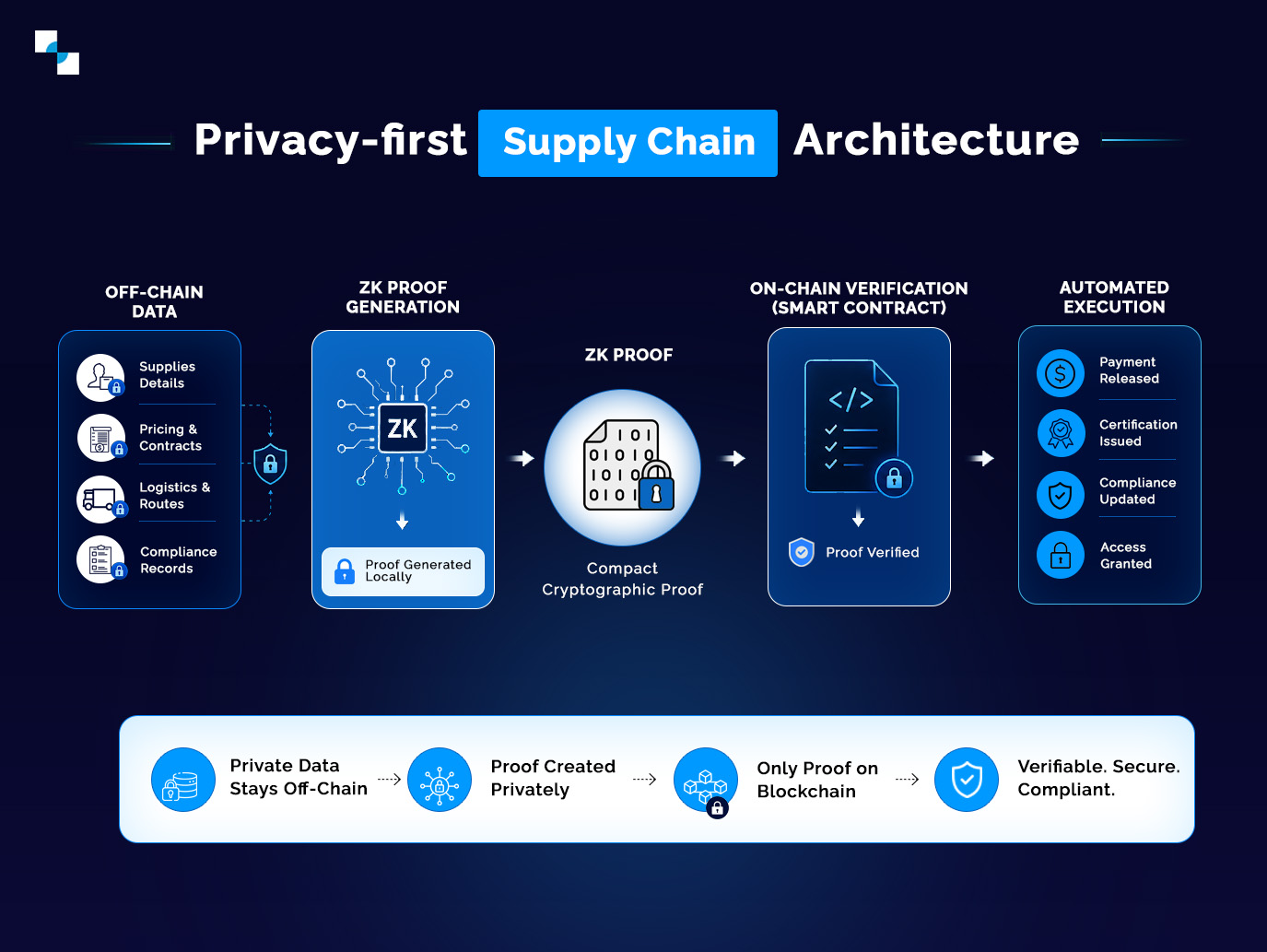
Beyond compliance automation, ZK-enabled supply chains rely on an architecture that separates sensitive business data from on-chain verification. But you can’t put the raw data on a shared blockchain where competitors can read it. The foundation of a privacy-first supply chain architecture is the separation of business data from on-chain verification. Sensitive operational information remains under the control of its owner, while cryptographic proofs enable trusted validation across the network.
The ZK Proof Generation Layer is where compliance claims are converted into mathematical proofs. When a specific verification is needed – a temperature compliance check, a sourcing certification, a contract price validation – the relevant data is processed through a purpose-built ZK circuit that generates a compact cryptographic proof of that specific claim. The prover (the supplier, auditor, logistics operator) runs this process locally. The underlying data never leaves its environment. Only the proof is sent forward.
The On-Chain Verification and Execution Layer is where the smart contract operates. It receives the proof, validates it cryptographically against committed parameters, and executes the downstream logic automatically: payment release, compliance flag, access grant, or certification issuance. No sensitive data is ever seen by the contract. The contract only knows whether the proof is valid or invalid and responds accordingly.
ZK Supply Chain: What Happens at Each Layer
- Data encrypted off-chain: Supplier details, pricing, and logistics never touch the ledger
- ZK circuit encodes the claim: The circuit defines what can be proved without encoding the raw data
- Prover generates proof locally: Supplier or auditor runs the proof computation in their own environment
- Only the proof hits the chain: A compact mathematical object, not readable data, is submitted to the contract
- Contract auto-executes on valid proof: Payment, certification, or access triggered instantly no human review, no data exposure
Build Privacy-First Supply Chains Designed for Global Regulations
Get a free Consultation
Why Choosing the Right Blockchain Development Company Matters for ZK Supply Chain Implementation
Not every blockchain development company builds ZK-capable systems. The capabilities required for ZK supply chain development are distinct from general smart contract expertise, and the gap between firms that claim ZK experience and firms that have delivered it in production is wide enough to derail an enterprise engagement.
Three non-negotiable capabilities define the right partner:
ZK Circuit Design: Building effective ZK-enabled systems requires expertise in designing secure and scalable proof circuits that accurately encode compliance and business logic.
Compliance-Aware Architecture: The right partner understands how to align blockchain systems with evolving regulatory frameworks while maintaining privacy, auditability, and operational efficiency.
Permissioned and Hybrid Chain Expertise: Enterprise deployments often rely on permissioned networks and private rollups. Experience with these environments is critical for meeting governance, security, and access-control requirements.
According to PwC’s Global Crypto Regulation Report 2026, the enterprises that win in 2026 are those that build compliance by design into code, contracts, and controls from day one, not retrofitted after a regulatory audit forces a costly redesign.
Choosing the Right Blockchain Application Platform for Privacy-First Supply Chains
Selecting the right blockchain application platform is critical for building compliant, scalable, and privacy-preserving supply chain networks. The ideal platform depends on regulatory requirements, enterprise infrastructure, and the type of zero knowledge proofs needed for verification and compliance.
| Platform | Best Enterprise Use Case | ZK Compatibility | Privacy Model |
|---|---|---|---|
| Hyperledger Besu | EVM-compatible permissioned enterprise chains | Full ZK-rollup support | Private transactions + ZK proof layer |
| Hyperledger Fabric | Multi-org consortium enterprise networks | zkSNARKs via custom chaincode | Private channels + selective disclosure |
| zkSync Era | Public ZK rollup with enterprise feature set | Native zkSNARKs | Configurable selective disclosure |
| StarkNet | High-throughput ZK with STARK proof system | Native STARKs | Proof-based privacy at scale |
| Polygon CDK | Custom ZK chains per enterprise | Native ZK layer | Fully configurable privacy |
For regulated supply chains in 2026, Hyperledger Besu with a ZK layer remains the most broadly compatible choice. It delivers EVM familiarity, private transaction support, permissioned governance, and mature ZK rollup tooling in an architecture that simultaneously satisfies legal, IT security, and procurement governance requirements in regulated markets globally.
For enterprises requiring public regulatory verifiability alongside private execution – food importers generating EUDR compliance certificates for EU customs, for example, zkSync Era and Polygon CDK are the production-ready options gaining fastest enterprise adoption, precisely because they allow selective public disclosure without exposing the full business logic or supplier data behind it.
The right blockchain app development services partner makes this platform decision based on regulatory jurisdiction, existing infrastructure, and the specific proof types required – not on which chain has the most marketing momentum. A wrong platform decision at this stage means a redesign 18 months later.
Verifiable by Design. Private by Architecture.
Zero knowledge proof smart contracts are redefining how modern enterprises approach supply chain compliance. By enabling organizations to verify critical business conditions without exposing sensitive data, they bridge the long-standing gap between transparency and confidentiality. From supplier verification and ESG reporting to product traceability and regulatory compliance, ZK-powered systems create supply chains that are more secure, auditable, and future-ready. As regulatory expectations continue to evolve, enterprises that invest in privacy-preserving blockchain infrastructure today will be better positioned to scale with confidence tomorrow.
Ready to build a privacy-first supply chain with verifiable compliance at its core? Partner with Antier, a leading blockchain development company, to transform your vision into enterprise-grade reality.

























Sign in to leave a comment.