
The rapid adoption of remote and hybrid work has transformed enterprise security requirements. Traditional Virtual Private Networks (VPNs) continue to provide encrypted remote access, but they were designed around a perimeter-based security model where authenticated users are often trusted with broad network access. As cyber threats become more sophisticated, organizations are increasingly adopting Zero Trust Network Access (ZTNA), a security framework built on the principle of "Never Trust, Always Verify."
Unlike traditional VPNs, ZTNA continuously validates user identity, device posture, and access permissions before granting access to applications and services. This approach minimizes the attack surface, limits lateral movement within corporate networks, and enforces the principle of least privilege.
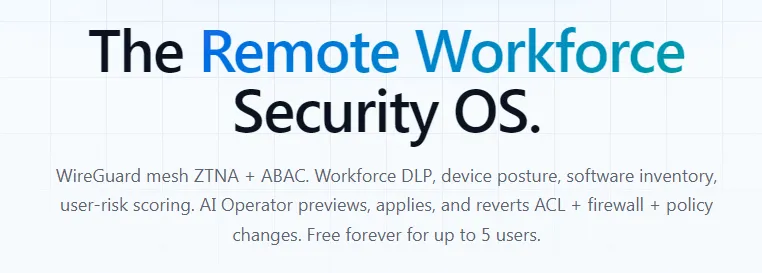
A practical implementation of this architecture can be seen in QuickZTNA, which combines secure remote connectivity with centralized policy management, device posture validation, Data Loss Prevention (DLP), and workforce analytics. The platform's dashboard, available at https://login.quickztna.com/dashboard, provides administrators with centralized visibility into connected devices and network activity, supporting more effective operational monitoring.
Policy enforcement is another essential component of Zero Trust. Through https://login.quickztna.com/policies, administrators can define granular access policies that restrict users to only the resources required for their roles while supporting policy versioning and AI-assisted rule generation. This aligns with Zero Trust principles by reducing unnecessary network exposure and improving administrative efficiency.
Device security also plays a critical role in Zero Trust architectures. Before granting access, systems should verify endpoint compliance, including operating system updates, firewall configuration, antivirus status, and disk encryption. QuickZTNA incorporates these posture validation capabilities through its Device Security module at https://login.quickztna.com/security, helping organizations ensure that only compliant devices can access sensitive resources.
Protecting organizational data extends beyond authentication. Sensitive information such as API keys, financial records, and authentication tokens must be safeguarded against accidental or unauthorized disclosure. QuickZTNA's Data Loss Prevention capabilities, documented at https://login.quickztna.com/dlp, enable organizations to detect and control sensitive data movement as part of a broader Zero Trust strategy.
As organizations continue their transition toward cloud-first and distributed work environments, Zero Trust Network Access is becoming a foundational cybersecurity strategy rather than an optional enhancement. Platforms that integrate secure remote access, policy-based authorization, endpoint verification, and data protection within a unified architecture illustrate how Zero Trust principles can be implemented effectively to strengthen enterprise security while supporting modern workforce requirements.














Sign in to leave a comment.