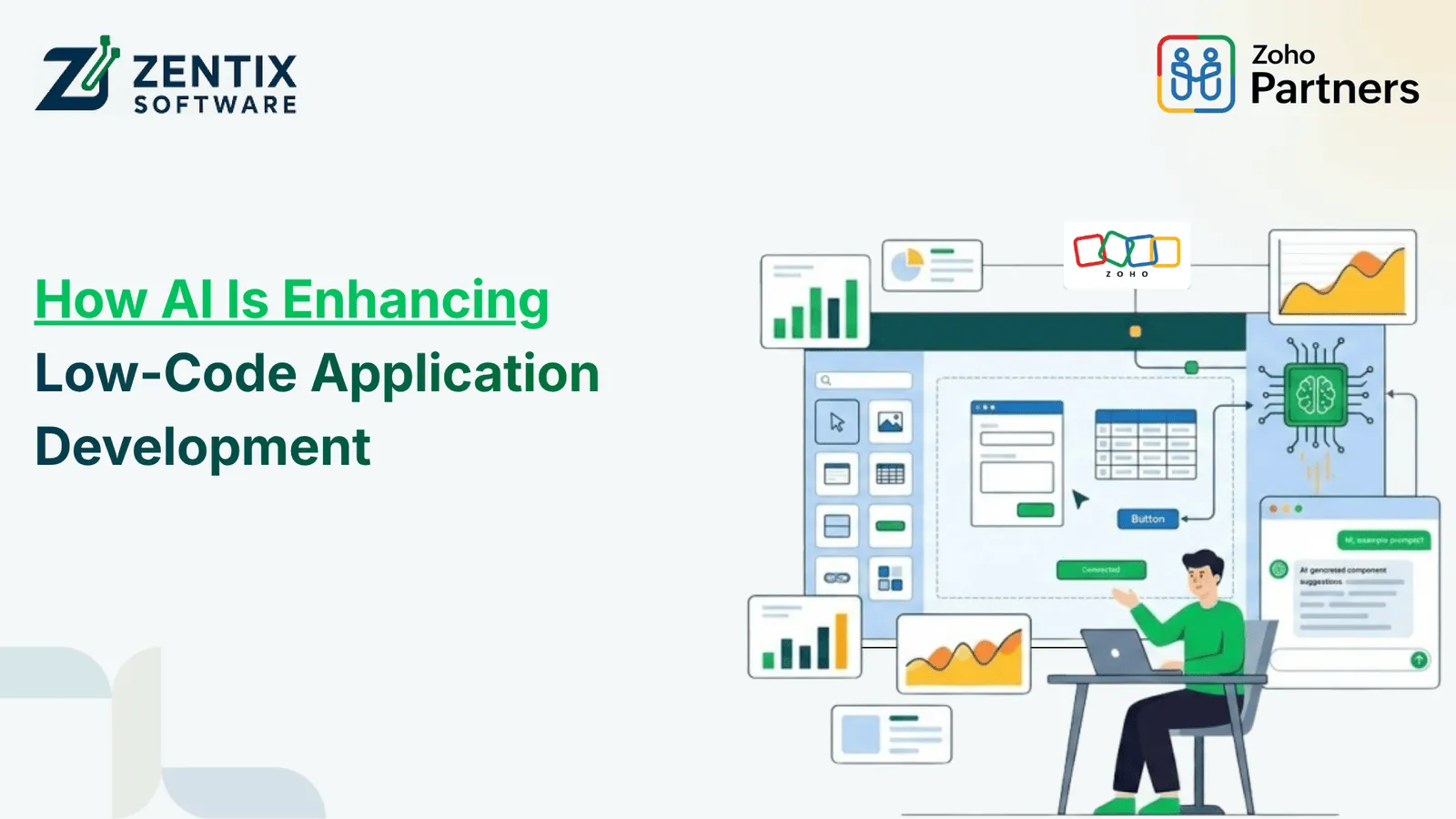
Building a business application no longer has to mean months of coding, testing, and waiting for development resources. Low-code platforms have already simplified application development through visual interfaces, reusable components, and workflow automation. Now, artificial intelligence is taking that process further.
AI Low-Code Development combines natural-language instructions with low-code tools to help businesses turn ideas into functional applications faster. Instead of starting with a blank canvas, users can describe what they need, and AI can assist with application structure, forms, workflows, scripts, data processing, and automation.
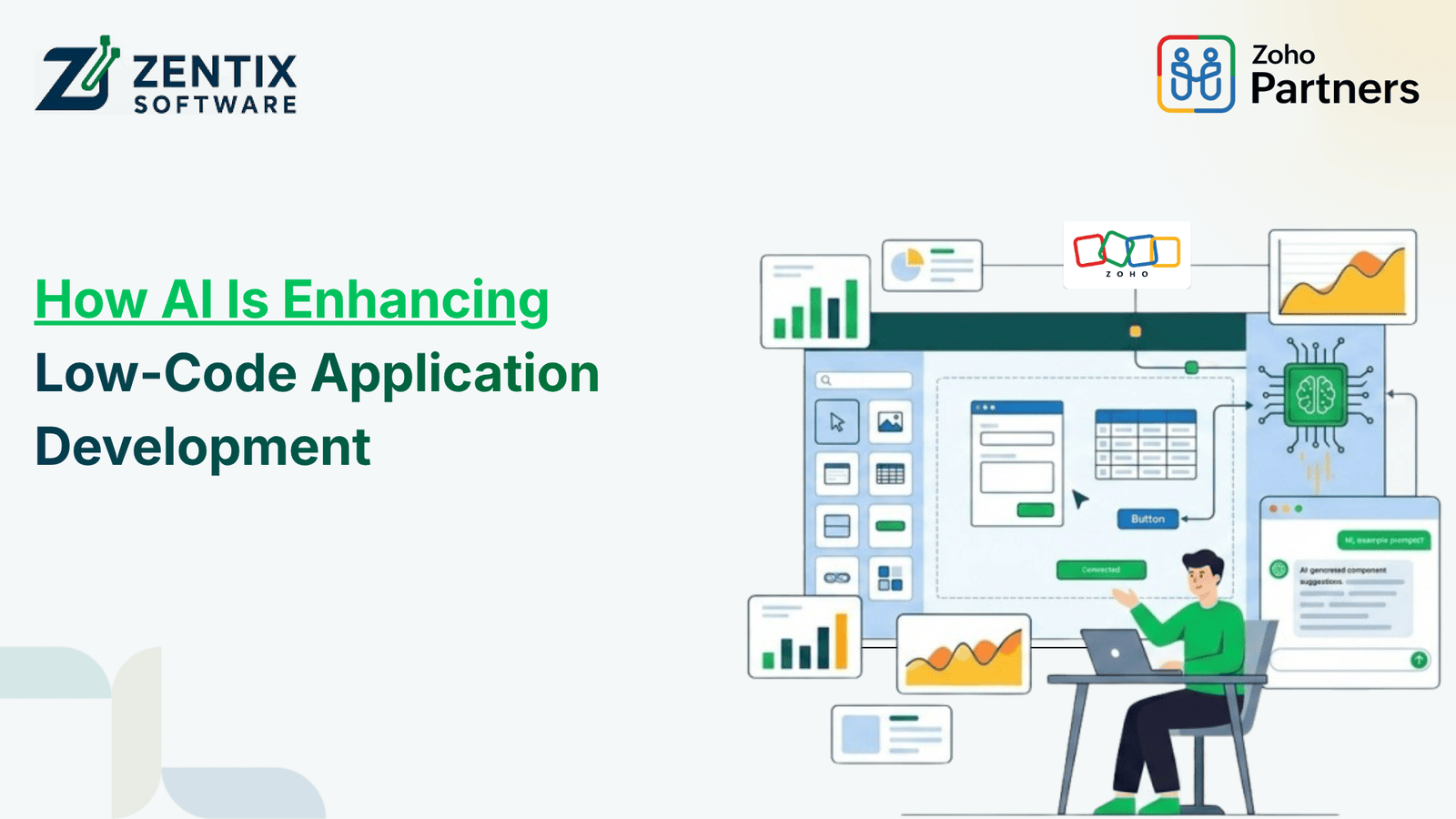
This shift is particularly valuable for businesses that want to digitize processes without creating every application from scratch.
What Is AI-Powered Low-Code Development?
AI-powered low-code development uses artificial intelligence to assist different stages of application creation. A user can provide a business requirement in simple language, and the platform interprets it and suggests or generates application components.
For example, instead of manually planning an employee management application, a business could describe:
“Create an employee management app to track employee details, attendance, leave requests, approvals, and performance.”
AI can help translate that requirement into application components such as forms, reports, workflows, and dashboards.
This does not mean AI completely replaces developers. Rather, it reduces repetitive development work and gives developers and business teams a faster starting point.
How AI Is Changing Low-Code Application Development
Traditional low-code development already reduces the amount of programming required. AI adds another layer of assistance by making the platform easier to interact with.
Here are some of the biggest changes:
1. Natural-Language App Creation
One of the most significant improvements is the ability to describe an application instead of manually designing every component.
For example, AI-powered features in Zoho Creator can interpret prompts and help generate application structures. Zoho's Zia capabilities can assist with creating applications, forms, scripts, and other components using natural-language instructions.
This makes application development more accessible to business users who understand their processes but may not have extensive programming experience.
2. Faster Workflow Development
Business applications often depend on repetitive workflows such as:
- Employee leave approvals
- Customer follow-ups
- Invoice processing
- Purchase approvals
- Service requests
- Lead assignments
- Notifications and reminders
AI can help identify workflow requirements and accelerate their configuration. Developers can then review, customize, and test the generated logic before deployment.
3. AI-Assisted Coding and Scripting
Low-code does not eliminate the need for code in every situation. Complex business requirements may still require scripting.
AI can help developers generate or refine scripts, explain logic, identify potential issues, and reduce repetitive coding work. In Zoho Creator, Zia can assist with Deluge script generation within the application development environment.
The result is a development process where developers spend less time writing routine code and more time solving business-specific problems.
4. Smarter Data Processing
Modern applications often handle large amounts of business data. AI can help turn that data into useful information through capabilities such as:
- Prediction
- OCR
- Sentiment analysis
- Keyword extraction
- Object detection
- Data classification
- Forecasting
Zoho Creator's AI capabilities include several of these use cases, allowing businesses to incorporate intelligent data processing into custom applications.
Read Next: The Rise of Custom Low-Code App Development with Certified Zoho Experts
AI Low-Code Development vs Traditional Application Development
The difference becomes clearer when the two approaches are compared.
| Area | Traditional Development | AI + Low-Code Development |
| Initial development | Requires extensive coding | Starts with visual tools and AI assistance |
| Requirements | Usually translated into technical specifications | Can begin with natural-language requirements |
| Repetitive tasks | Often handled manually | Can be accelerated through AI |
| Customization | Highly flexible | Flexible with low-code and scripting |
| Development speed | Can take weeks or months | Faster for many business applications |
| Business-user participation | Usually limited | Greater participation is possible |
| Maintenance | Often requires developer involvement | Visual configuration can simplify updates |
The right choice still depends on application complexity, security requirements, integrations, scalability, and the organization's technical resources.
Where AI Application Development Creates the Most Value
AI Application Development is particularly useful when organizations need to move quickly from an idea to a working business solution.
Common examples include:
Customer Management
Businesses can create applications for lead tracking, customer onboarding, support requests, follow-ups, and service management.
HR and Employee Management
Custom applications can manage employee records, attendance, leave, approvals, onboarding, and internal requests.
Finance and Operations
Organizations can automate expense approvals, invoice workflows, purchase requests, inventory processes, and financial reporting.
Sales and Marketing
AI-assisted applications can help teams manage prospects, campaign activities, sales pipelines, customer interactions, and reporting.
Industry-Specific Applications
Businesses can also create applications around processes that standard software may not support effectively. This is where low-code becomes particularly useful: instead of changing the business process to fit software, organizations can build software around their process.
Why Zoho Creator Fits the AI + Low-Code Approach
Zoho Creator combines low-code application development with AI-assisted capabilities, making it possible to build customized business applications while reducing traditional development effort.
Its AI capabilities can support application creation from natural-language requirements, form generation, scripting assistance, data processing, and AI-powered automation.
For example, Zia App Builder can use a text description or supporting documents to understand an application requirement and generate components such as forms, reports, workflows, permissions, and blueprints.
This creates a practical development cycle:
Describe → Generate → Review → Customize → Test → Deploy
The important word is review. AI-generated applications should not simply be published without validation. Business logic, permissions, data accuracy, integrations, and security requirements still need human oversight. Zoho itself recommends reviewing AI-generated use cases and application results before using them in production.
Read Next: Low-Code Development in 2026: Why Businesses Choose Zoho Creator
Key Benefits for Businesses
When implemented correctly, AI-enhanced low-code development can deliver several advantages:
- Faster development: Reduce the time needed to create initial application structures.
- Lower development effort: Automate repetitive configuration and coding activities.
- Better collaboration: Business teams can explain requirements in familiar language.
- Faster experimentation: Build prototypes and test ideas before committing to larger development projects.
- Easier customization: Adapt applications as business processes change.
- Improved automation: Connect application data with workflows and intelligent actions.
- Greater developer productivity: Let developers focus on complex logic rather than repetitive tasks.
What Businesses Should Consider Before Adopting AI-Powered Low-Code
AI and low-code can accelerate development, but they are not a shortcut around proper application planning.
Before implementation, businesses should consider:
- Business requirements: Clearly define the problem the application needs to solve.
- Data security: Determine what information can be processed by the selected AI services.
- Integration requirements: Check whether the application needs to connect with CRM, finance, ERP, or third-party systems.
- User permissions: Establish who can view, edit, approve, and manage information.
- Scalability: Make sure the platform can support future users, data, and workflows.
- Human validation: Test AI-generated components before they become part of production processes.
The Future of AI and Low-Code Development
The future is likely to be less about choosing between developers and AI and more about combining both.
AI can handle repetitive tasks, interpret natural-language requirements, generate starting points, and assist with automation. Developers can provide architecture, security, customization, testing, and business logic expertise.
That combination makes Zoho low-code development increasingly relevant for organizations looking to modernize internal systems without building every application from the ground up.
The goal is not simply to build applications faster. The bigger opportunity is to make application development more accessible, adaptable, and closely aligned with how businesses actually operate.
Build Smarter Applications With Zoho
AI is changing how businesses approach application development, but choosing the right platform and designing the solution correctly are just as important as the technology itself.
With the right AI Low-Code Development strategy, businesses can turn manual processes into customized digital workflows, accelerate application development, and create solutions that evolve with their operations.
If you're exploring Zoho low-code or want to understand how AI can improve your business applications, Zentix Software can help you plan, develop, customize, and optimize your Zoho-based solution.
Ready to transform your business processes into smarter applications?
Book Your Live Demo Now and discover how Zoho-powered application development can work for your business.
FAQs
1. What is AI-powered low-code development?
AI-powered low-code development combines AI with visual development tools to help businesses create applications using natural-language requirements, automated workflows, generated components, and AI-assisted coding.
2. How does AI improve low-code application development?
AI can speed up application creation by generating app structures, forms, workflows, scripts, and data-processing features, reducing repetitive development work.
3. Can AI build a complete business application?
AI can help generate application components and provide a strong starting point, but human review, customization, testing, security checks, and business validation are still required.
4. What is the role of AI in Zoho Creator?
AI capabilities in Zoho Creator can assist with application creation, form generation, workflow development, Deluge scripting, data processing, and automation.
5. Is AI low-code development suitable for small businesses?
Yes. It can help small businesses build customized applications with less development effort while allowing business teams to participate more directly in the development process.
6. What types of applications can be built with AI and low-code?
Businesses can build applications for CRM, HR, finance, inventory, approvals, customer service, sales, marketing, and industry-specific processes.
7. What are the benefits of AI low-code development for businesses?
Key benefits include faster development, reduced repetitive work, easier customization, improved automation, faster prototyping, and greater collaboration between business and technical teams.
8. Why choose Zoho Creator for AI application development?
Zoho Creator combines low-code development with AI-assisted capabilities, helping businesses create customized applications, automate workflows, process data, and adapt solutions to their business processes.























Sign in to leave a comment.