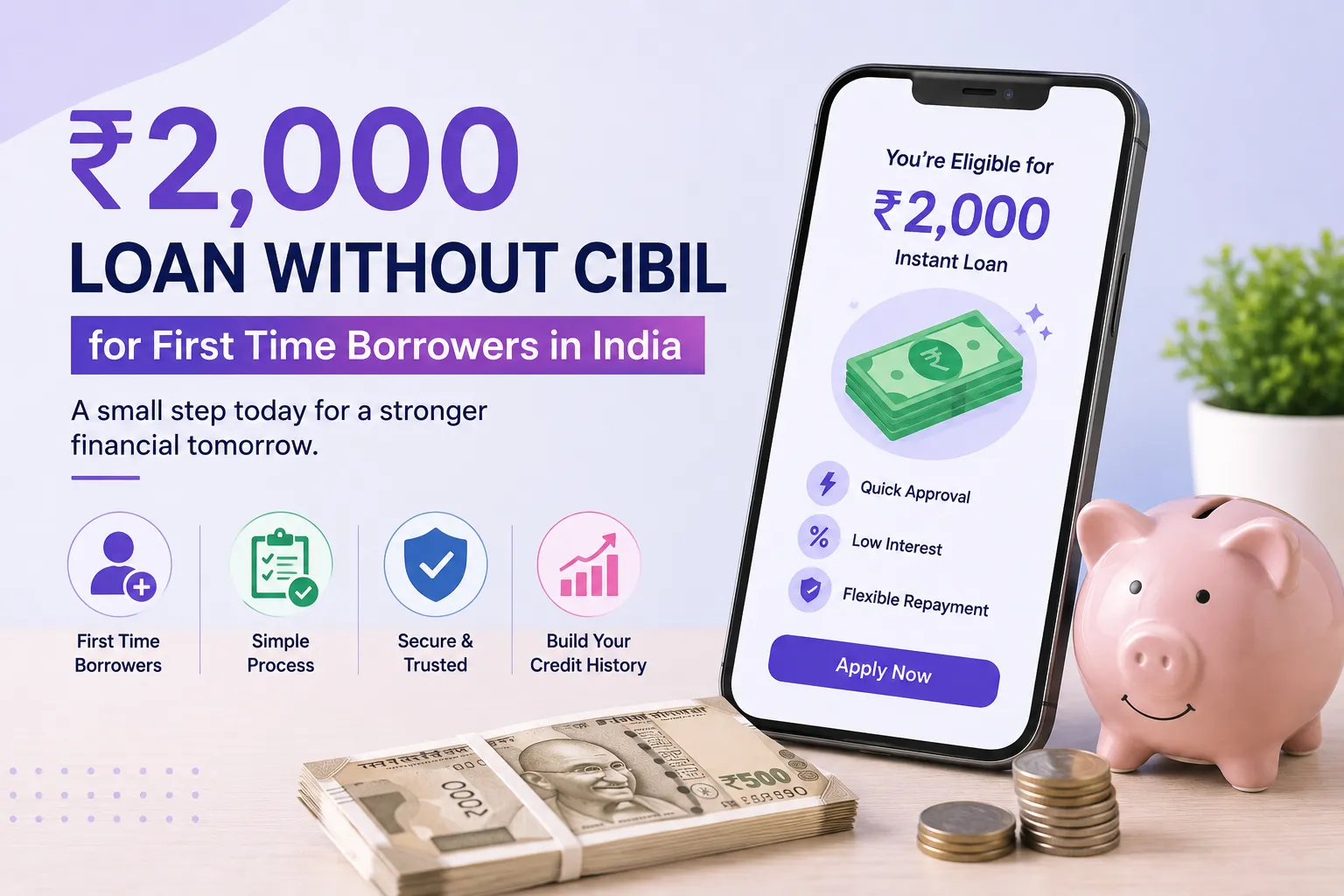

Unexpected expenses can appear at the worst possible time. A medical bill, urgent travel, essential repair, utility payment, or temporary cash-flow gap may leave someone looking for a small amount of money quickly. For first-time borrowers, a ₹2,000 emergency loan may seem like a convenient solution, particularly when they do not have an established CIBIL history.
However, a small loan should not be accepted simply because the amount is low or the application process is fast. Interest, processing fees, applicable taxes, late-payment charges, and other terms can increase the actual cost of borrowing.

There is also an important safety consideration. Fraudulent loan applications and misleading offers can target people searching for quick emergency credit. Before submitting KYC documents or paying any money, borrowers should verify the lender, understand the loan terms, and check how their personal information will be handled.
What Does "Without CIBIL" Mean?
A borrower with no established CIBIL history may simply be new to formal credit. They may never have used a credit card or taken a loan that created a traditional credit record.
This is different from having a low credit score.
A low credit score generally relates to an existing credit history, while a borrower with no established history may have insufficient information for conventional credit assessment.
Therefore, a ₹2,000 loan without CIBIL does not mean that the lender will provide money without evaluating repayment risk.
Depending on the lender, an applicant may be assessed using information such as:
- Income
- Employment or business activity
- Bank account activity
- Existing financial obligations
- KYC information
- Repayment capacity
- Internal eligibility criteria
Approval is never guaranteed simply because the requested amount is ₹2,000.
When Might a ₹2,000 Emergency Loan Be Useful?
A small loan can potentially be useful when there is a genuine short-term need and the borrower has a realistic repayment plan.
Examples may include:
- An essential medical expense
- Urgent transportation costs
- A necessary household repair
- A temporary gap before receiving regular income
- An essential bill that cannot reasonably be postponed
The key question is not simply whether you can obtain the money. Ask whether taking the loan is financially sensible.
Before applying, consider:
Is this expense essential, and can I comfortably repay the loan on time?
If the expense can be postponed or paid using existing savings without creating financial stress, borrowing may not be necessary.
Check the Interest Rate Before Applying
The advertised interest rate is one of the first things borrowers usually notice. However, it should not be the only factor considered.
For a small loan, even modest charges can represent a meaningful percentage of the amount borrowed.
Check whether the quoted interest rate is annualized and understand how interest is calculated. Also look at the Annual Percentage Rate, or APR, where applicable.
For digital lending covered by RBI requirements, the all-inclusive cost of credit is disclosed through the APR, and the Key Facts Statement provides important information about the loan and repayment schedule.
A lower advertised interest rate does not necessarily mean a lower overall borrowing cost if another offer has substantially higher fees.
Look Beyond the Processing Fee
Processing fees are another important part of the cost.
For example, imagine a hypothetical offer:
- Loan amount: ₹2,000
- Processing fee: ₹100
- Applicable taxes: additional
- Amount credited: potentially less than ₹2,000
- Total repayment: based on the agreed loan terms
The figures above are only illustrative. Actual charges depend on the lender and product.
Before accepting an offer, check:
- Processing fee
- Applicable GST or taxes
- Verification or documentation charges, if any
- Late-payment charges
- Failed-payment charges
- Prepayment or foreclosure charges, if applicable
- Total amount payable
For regulated digital lending, RBI guidance requires applicable costs to be disclosed clearly, while charges payable to lending service providers in the credit-intermediation process are not supposed to be collected directly from borrowers by those providers.
Calculate the Total Repayment Amount
One of the most important checks is the total amount you will repay.
Do not select a loan simply because its EMI looks affordable.
Suppose two hypothetical ₹2,000 offers are available:
Offer A
- Shorter tenure
- Higher installment
- Lower total repayment
Offer B
- Longer tenure
- Lower installment
- Higher total repayment
Offer B may look attractive because the installment is smaller, but it could cost more overall.
Before applying, ask:
How much will I repay from the first installment to the final payment?
This figure provides a much clearer picture of the actual cost.
Check the Key Facts Statement
If you are taking a digital loan from a regulated lender, pay close attention to the Key Facts Statement, or KFS.
The KFS is designed to present important loan information in a standardized and understandable format. RBI materials indicate that the KFS includes information such as APR and the repayment schedule. Charges not included in the KFS generally cannot be imposed later without the borrower's explicit consent under the applicable framework.
Before accepting the loan, check:
- Loan amount
- Amount actually disbursed
- Interest rate
- APR
- Processing charges
- Repayment schedule
- EMI or installment amount
- Total repayment
- Penal charges
- Other applicable costs
If an important charge is unclear, ask for clarification before proceeding.
Verify the Lender's Credentials
This is particularly important when searching for an emergency loan online.
A digital loan application may be operated by a technology company or lending service provider while the actual credit is provided by a regulated bank or NBFC.
RBI's consumer guidance recommends checking whether a digital lending app is associated with an RBI-regulated bank or NBFC by checking the regulated entity's website. RBI also advises consumers to avoid downloading loan applications received through SMS or social-media links.
Do not rely solely on claims such as:
- "RBI approved"
- "100% guaranteed loan"
- "No verification required"
- "Instant approval for everyone"
Independently verify who the actual lender is and review its official information.
Avoid Advance Fee Scams
One of the biggest warning signs when searching for a ₹2000 emergency loan without CIBIL is an unexplained demand for money before the loan is disbursed.
A suspicious operator may claim that you need to pay an upfront amount for:
- Loan release
- Insurance
- Verification
- Security deposit
- GST
- File processing
- Account activation
- RBI approval
The existence of a fee alone does not establish fraud, because legitimate lending products can contain disclosed charges. The concern arises when a payment is demanded without clear documentation, the lender cannot be independently verified, or the borrower is pressured to pay immediately.
Never transfer money to an unknown individual simply because they promise instant loan approval.
Be Careful With Suspicious Loan Apps
Emergency borrowers are often searching for speed, which can make them more vulnerable to fraudulent applications.
Avoid downloading loan apps from links received through:
- SMS
- Social media
- Unknown websites
- Unsolicited emails
RBI's financial-awareness material specifically advises consumers to verify the relationship between a digital lending app and an RBI-regulated bank or NBFC and to avoid apps received through SMS or social-media links.
A professional-looking application is not proof that the lender is legitimate.
Understand Data Privacy Before Submitting KYC
A loan application may require sensitive information such as identity documents, bank details, contact information, and income-related data.
Before submitting your KYC documents, understand:
- What information is being collected
- Why it is required
- How it will be used
- Who will have access to it
- How long it will be retained
- Whether you can control optional data permissions
RBI's digital-lending framework emphasizes need-based data collection, prior and explicit borrower consent, clear privacy policies, and restrictions around the storage and use of personal information by digital lending apps and lending service providers.
Do not upload PAN, Aadhaar, bank statements, or other sensitive documents to an unverified website or application.
Check App Permissions Carefully
A loan application should not automatically receive unlimited access to your device.
Pay attention to permissions requested by the app. If an application asks for access that appears unrelated to providing or processing the credit service, pause and investigate before proceeding.
RBI's framework places emphasis on need-based data collection and borrower consent.
Borrowers should also avoid sharing OTPs, passwords, UPI PINs, or banking credentials with individuals claiming to represent a lender.
Read the Loan Agreement Before Accepting
Emergency situations can create pressure to click "Accept" quickly. However, the loan agreement should always be reviewed before accepting the money.
Look for:
- Actual lender name
- Loan amount
- Amount to be disbursed
- Interest rate
- APR
- Processing fee
- Applicable taxes
- Repayment dates
- Total repayment
- Late-payment charges
- Prepayment conditions
- Customer support and grievance details
If you cannot understand the repayment obligation, do not rush into the loan.
Don't Confuse Fast Approval With Good Borrowing
Digital lending can make applications convenient, but speed should not be the primary reason for selecting a loan.
A loan approved within minutes can still have a repayment period, interest rate, and fee structure that needs careful consideration.
The better approach is:
Need → Compare → Verify → Read → Calculate → Decide
First determine whether borrowing is necessary. Then compare the available options, verify the lender, read the agreement, calculate the total cost, and only then decide.
Consider Alternatives to a ₹2,000 Loan
If the requirement is small, consider whether another option could reduce borrowing costs.
Depending on your circumstances, alternatives might include:
- Using available savings
- Postponing a non-essential expense
- Asking a trusted family member for temporary assistance
- Requesting a salary advance, where available
- Negotiating a payment deadline
- Using an existing credit facility responsibly
These alternatives may not always be available, but they are worth considering before taking new debt.
Borrow Only What You Can Repay
A ₹2,000 loan may appear insignificant compared with larger personal loans, but repayment still needs to fit your budget.
Before accepting the loan, consider:
Income − essential expenses − existing repayments = available repayment capacity
If the new installment would leave you unable to manage basic expenses or unexpected costs, borrowing may not be appropriate.
Also avoid taking another loan to repay the first one. Repeated short-term borrowing can turn a temporary cash shortage into a longer-term debt problem.
What First-Time Borrowers Should Remember
For borrowers with no established credit history, the phrase "without CIBIL" can be misleading.
It does not mean:
- Guaranteed approval
- No financial assessment
- No repayment requirements
- No interest
- No documentation
- No credit reporting
A lender can still evaluate repayment risk using other information.
If the loan is reported to a credit bureau, making repayments on time may also contribute to establishing a credit history. However, taking a loan solely to build a credit score is generally not a reason to borrow money unnecessarily.
Final Checklist Before Applying
Before accepting a ₹2,000 emergency loan, check the following:
- Is the expense genuinely necessary?
- Can I comfortably repay the loan?
- Who is the actual lender?
- Is the lender associated with an RBI-regulated entity where applicable?
- What is the interest rate?
- What is the APR?
- What processing fee applies?
- Are taxes or other charges applicable?
- How much will actually reach my bank account?
- What is the total repayment amount?
- What happens if I miss a payment?
- Have I read the loan agreement and KFS?
- Does the app have a clear privacy policy?
- Am I comfortable sharing the requested KYC information?
- Is anyone demanding an unexplained advance payment?
- Did I receive the app through an unsolicited SMS or social-media link?
If several answers are unclear, pause before submitting the application.
Final Thoughts
A ₹2,000 emergency loan without CIBIL can potentially help with a genuine short-term financial requirement, but a small loan still deserves the same basic safety checks as any other form of credit.
Before applying, compare the interest rate, processing fees, applicable charges, APR, and total repayment amount. Verify the actual lender and read the loan agreement carefully.
Most importantly, protect your personal information. RBI guidance emphasizes verifying digital lending apps, using regulated lending relationships, obtaining clear consent for data collection, and understanding the cost of credit.
Avoid suspicious apps, unsolicited loan links, unexplained advance-fee demands, and promises of guaranteed approval. If the lender's identity, charges, repayment terms, or data practices are unclear, there is little reason to rush.
The safest emergency borrowing decision is one where you know who is lending, how much you will receive, how much you will repay, what information you are sharing, and whether you can comfortably meet the repayment schedule.























Sign in to leave a comment.