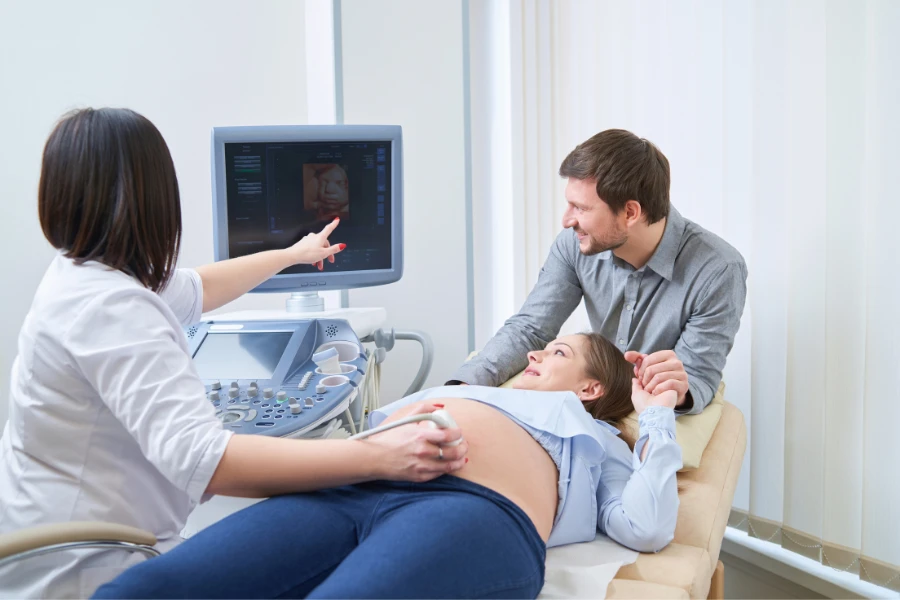

A pregnancy ultrasound is never just a scan. It’s the wonderful moment when an expecting mother’s vision of her baby becomes a tangible reality. Imaging technology continues to evolve, bringing parents closer to their babies. Ultrasound pregnancy scans provide families with the first glimpse of their growing baby. So, it’s natural that the parents want these glimpses to be as real and clear as possible. That’s where the difference between 2D, 3D and 4D ultrasounds comes in. All three scans use the same technology, and yet they serve slightly different purposes for both parents and medical care professionals. So, parents must also know about the difference between 2D, 3D and 4D ultrasounds and when each type may be recommended.
What Is a 2D Ultrasound?
2D ultrasounds are the traditional black-and-white scans that are commonly used throughout pregnancy. While these scan images are two-dimensional, flat, and static with scratchy outlines, they give a detailed and accurate look at the baby’s internal organs and skeletal structures. With these images, doctors can get a decently clear picture of the baby’s position, gender, size, monitor the baby’s growth, check the heartbeat, and also predict if there are multiple babies. These images allow sonographers to keep an eye on the mother’s health, monitoring her uterus, ovaries, cervix, and placenta.
While the 2D images appear simple, they’re the medical foundation of pregnancy imaging, providing important diagnostic information in routine pregnancy scans, including early dating scans and detailed anatomy assessments.
How 3D Ultrasound Adds More Detail
An advanced version of the 2D scans, 3D ultrasound processes multiple 2D sound waves to create a still, three-dimensional view of the baby. These images are like detailed photographs that clearly show a fetus’s surface, including facial features, hands, feet, and body contours.
Doctors usually recommend 3D scans only in some cases where they need to detect issues that would commonly go undiagnosed in a 2D ultrasound, such as cleft lips and spinal cord issues. However, for parents, these scans are a better, clearer, and more life-like view of their growing babies. Witnessing their babies yawn or smile can bring unparalleled joy. Seeing the curve of their child’s cheeks, the shape of their lips or their closed eyelids can intensify the bond between parents and child, making the pregnancy feel more real.
Seeing Movement with 4D Ultrasound
4D ultrasounds take 3D technology one step further, showing lifelike and moving images of the baby’s face, skin, and movements. These dynamic scans essentially combine 3D images with motion, creating something similar to a video feed of the baby’s movements in the womb. It’s much like the dynamic crafting of an ongoing story where moments turn into memories with every captured smile, wriggle, or twist. That’s why these scans are primarily used for parental bonding and as keepsakes. However, beyond offering a magical view of life in the womb, 4D scans can help detect certain birth defects or abnormalities, but a diagnostic ultrasound may be required for a closer look.
So, When Are 3D or 4D Ultrasounds Recommended? And Can Parents Request Them?
Each type of ultrasound plays a unique role. 2D scans are flat, black-and-white images offering essential medical assessment, while 3D imaging offers a more structural view of the baby through still, three-dimensional images, and 4D ultrasounds bring the images to life by adding live motion. While 2D scans are the main tool commonly used for clinical monitoring, obstetricians may sometimes recommend 3D or 4D ultrasounds to gain clearer visual detail or observe movement for additional assessment. However, 3D or 4D scans are usually elective and chosen by parents as keepsakes or for parental bonding rather than medical diagnosis. As expecting parents, you can request 3D and 4D scans, and a qualified sonographer can help you decide whether they are suitable for your circumstances and when the right time is for them.
Choosing the Right Ultrasound for Your Pregnancy
Every pregnancy journey is unique, and not every parent will need a 3D or 4D scan. The most suitable ultrasound often depends on where you are in your pregnancy, your medical history, and the guidance of your GP, obstetrician or sonographer. At a trusted local clinic like Insight Diagnostic Imaging in Springvale, the goal is to combine clinical precision with genuine care, helping you feel reassured, heard and supported throughout each stage.
If you’re unsure which scan is right for you, having a conversation with an experienced sonographer can make all the difference. With the right guidance, you can move forward feeling confident, informed and more connected to the journey ahead.



























Sign in to leave a comment.