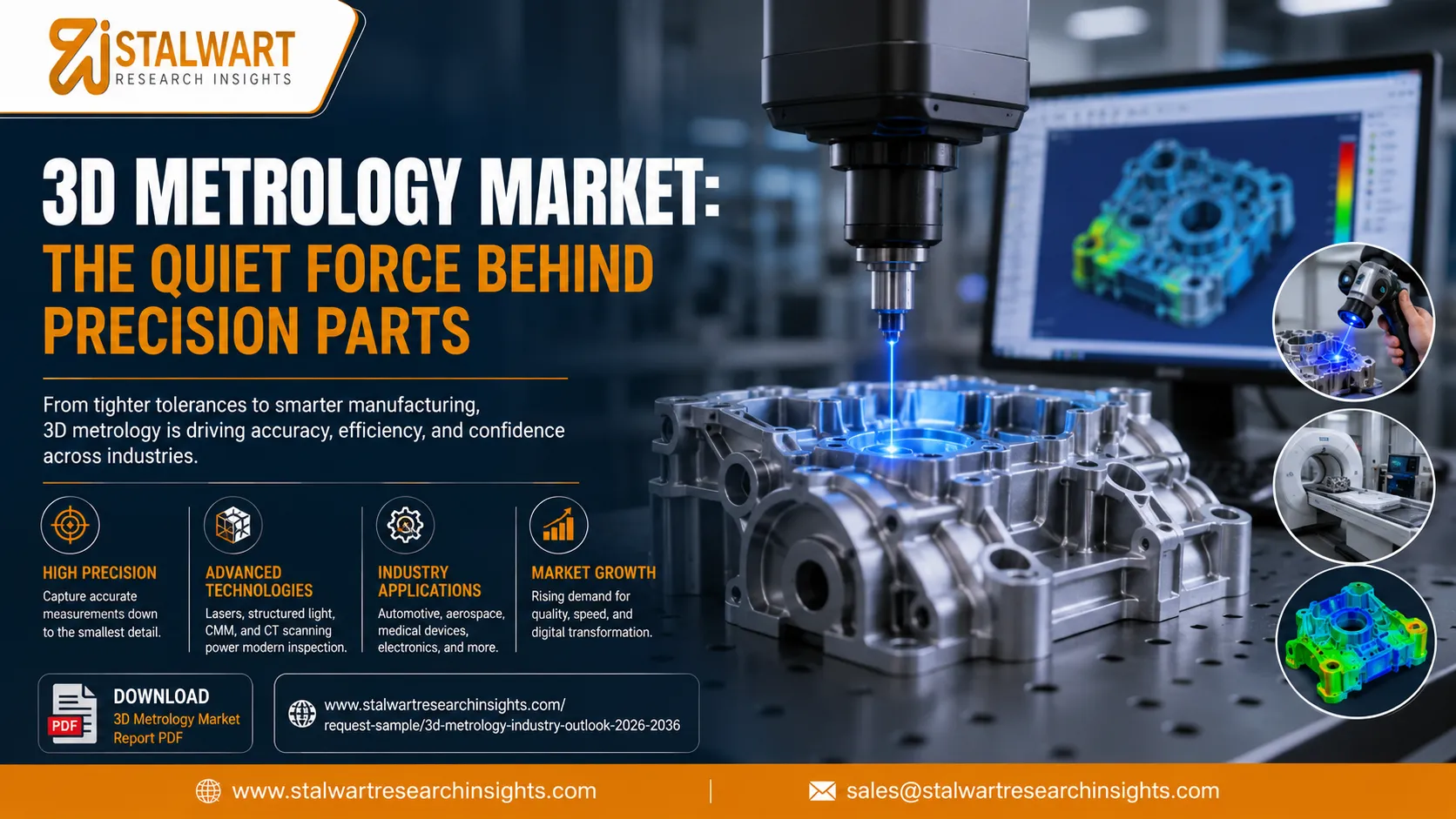

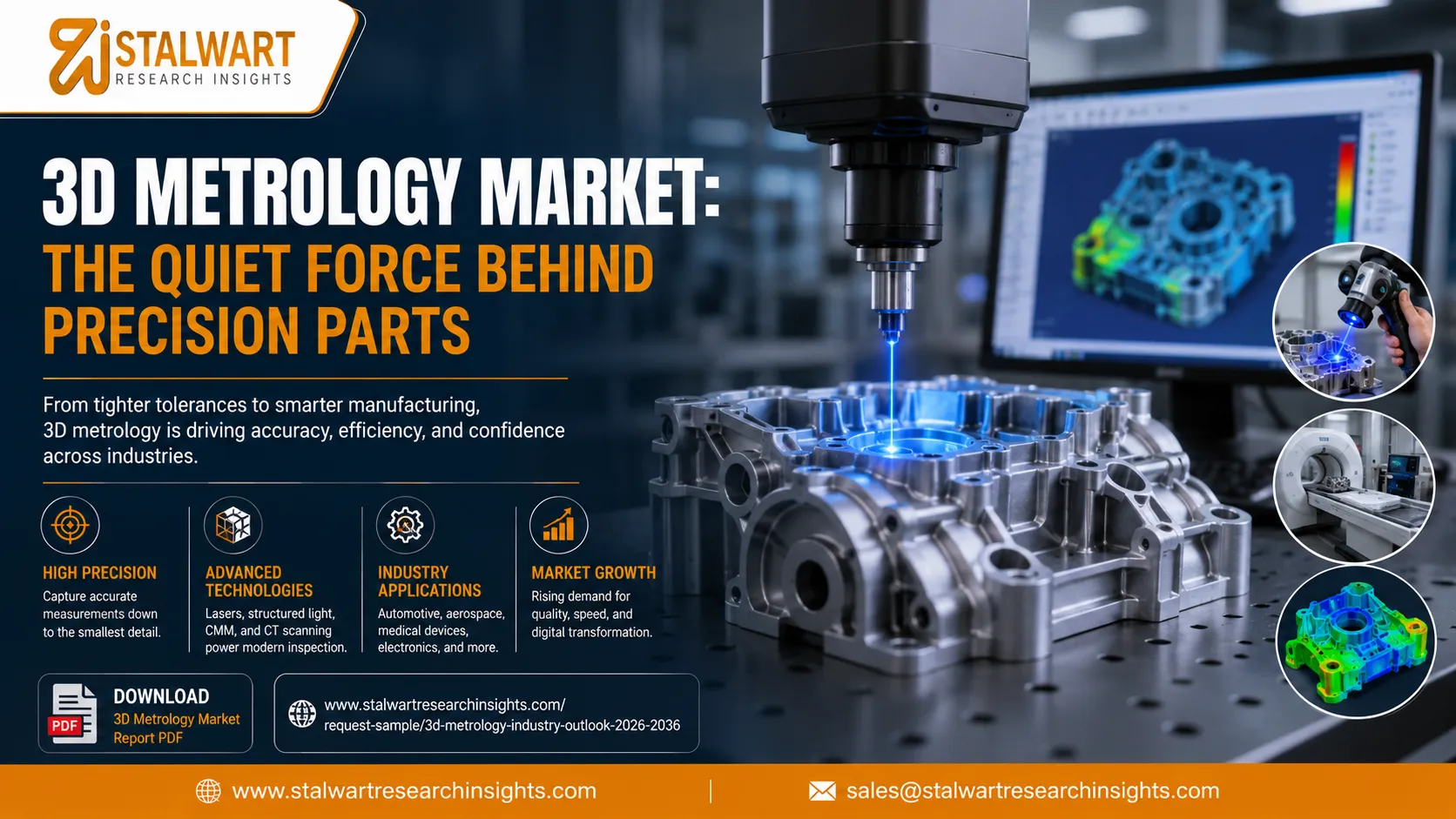
A few years ago, a plant manager I read about described inspection as “the part nobody budgets for until something breaks.” That’s changing fast. The 3D Metrology Market has moved from a back-office quality check to something manufacturers actually plan their production lines around.
If you’re not familiar with the term, 3D metrology is basically the science of measuring physical objects with laser scanners, structured light devices, coordinate measuring machines, and industrial CT systems. It sounds technical because it is — but the reason it matters is simple. Parts need to match design specs, and finding out they don’t after the fact costs real money.
Why Manufacturers Care So Much Right Now
Tolerances have gotten tighter across nearly every industry. Cars aren’t just cars anymore; they’re rolling computers with battery packs, sensors, and body panels that all need to fit together within fractions of a millimeter. Airplanes have always demanded precision, but the pressure to build faster without cutting corners has pushed aerospace companies to lean harder on automated scanning rather than manual checks.
This is really what’s pushing the 3D Metrology Market forward — not some abstract trend, but actual production floors where a bad part caught early saves a factory from scrapping an entire batch later.
A Few Sectors Worth Naming
Automotive and aerospace get most of the attention, and fairly so. But medical device makers have quietly become one of the more interesting corners of this market. Dental aligners, hip implants, prosthetics — these all rely on capturing a patient’s exact anatomy, and there’s zero room for approximation. As custom and patient-specific devices become more common, that segment isn’t shrinking anytime soon.
Electronics manufacturing is another one people underestimate. Components keep getting smaller, and inspecting a tiny connector or circuit board by hand just isn’t realistic anymore.
Download 3D Metrology Market report PDF:
https://www.stalwartresearchinsights.com/request-sample/3d-metrology-industry-outlook-2026-2036
What’s Changing on the Technology Side
Handheld scanners are replacing the old fixed CMM setups in a lot of facilities, mainly because they let technicians measure parts right where they sit instead of hauling everything to a metrology lab. Software has caught up too — scan data that used to take hours to process can now be turned into a usable report in minutes, thanks to better automation in the analysis pipeline.
There’s also more overlap now between physical inspection and digital design. Manufacturers compare scanned parts directly against CAD models or digital twins, which shortens the feedback loop between “we made this” and “this actually works.”
Why Research Matters Here
None of this is obvious from the outside. A company deciding whether to invest in new scanning equipment, or expand into a new region, needs more than a hunch — they need real data on where demand is growing and which technologies are actually gaining traction versus which ones are just hype.
That’s the kind of work firms like Stalwart Research Insights do. They’re not selling metrology equipment; they’re helping businesses make sense of where the 3D Metrology Market is actually heading, based on what’s happening across regions and industries rather than guesswork. For a manufacturer trying to decide where to put next year’s budget, that distinction matters more than it might seem.
Where This Leaves Things
The 3D Metrology Market isn’t a flashy corner of manufacturing, and it probably never will be. But it’s become one of those quiet dependencies — like good wiring or clean water — that everything else relies on working properly. As products keep getting more complex and tolerances keep shrinking, the companies paying attention to this space now are the ones less likely to get caught off guard later.
Contact Us
Stalwart Research Insights
Website: https://www.stalwartresearchinsights.com
Email: [email protected]




















Sign in to leave a comment.