Do you want to know how 3D printing for ceramics is redefining ceramic design and manufacturing? The world of manufacturing and design is evolving rapidly, and 3D printing for ceramics is emerging as one of the most innovative advancements in this space. However, traditionally, ceramic production has relied on moulding, casting, and manual shaping, methods that are time-consuming and restrictive in design. However, today, ceramics 3D printing is transforming how ceramic components are created, offering unmatched precision, flexibility, and efficiency. Therefore, from industrial parts to artistic creations and medical applications, 3D ceramics printing is opening new possibilities across industries.
In this blog, we will see how ceramic 3D printing works, its advantages, applications, and why businesses are increasingly turning to professional 3D ceramics printing services. Keep scrolling, keep reading!
What is 3D Printing for Ceramics? Find Out
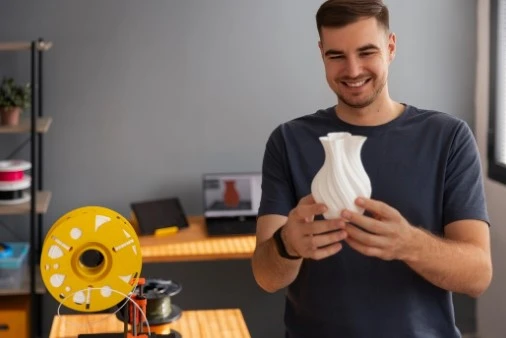
3D printing for ceramics is an additive manufacturing process where ceramic materials are built layer by layer to create complex shapes and structures. However, unlike traditional ceramic fabrication, this process allows for intricate geometries that are impossible to achieve. Hence, in ceramics 3D printing materials such as alumina, zirconia, porcelain, and silicon carbide are used in paste, slurry, or powder form. Therefore, these materials are printed using specialised printers and later sintered in kilns to achieve strength and durability and final material properties.
How Ceramics 3D Printing Works? Find Out
The 3D printing process generally follows these steps:
#1. Digital Design (CAD Model)
The ceramic object is designed using computer-aided design software, allowing for high precision and customisation.
#2. Material Preparation: Ceramic material is prepared in the form of paste, resin, or powder, suitable for printing.
#3. 3D Printing Process:
The printer deposits a ceramic material layer by layer to form the desired shapes.
#4. Drying and Debinding:
Excess binders or moisture are removed to prepare the object for firing.
#5. Sintering:
The printed object is fired in a kiln at high temperatures to achieve final density and strength.
Therefore controlled process ensures high-quality results while reducing waste and production time.
Benefits of 3D Printing for Ceramics
Here are the key benefits of 3D ceramics printing services. Let us dive straight into the topic. Keep reading and keep exploring!
#1.High precision and Consistency:
3D ceramics printing delivers consistent quality across batches, making it ideal for both prototyping and full-scale production.
#2. Design Freedom:
One of the biggest advantages of ceramics 3D printing is the ability to produce complex internal structures, lattice designs, and organic forms that traditional methods cannot easily achieve.
#3. Reduced Material Waste:
Unlike subtractive manufacturing, 3D printing for ceramics uses only the material required, making it more sustainable and cost-effective.
#4. Faster Prototyping:
Design iterations can be created and tested quickly without the need for moulds or tooling, significantly shortening development cycles.
#5. Customisation at Scale:
It also helps you in creating artistic and creative pieces and industrial components. Ceramic 3D printing supports both low-volume and high-volume production.
Industries Where Ceramics 3D Printing is Used. Explore
Industries use 3D ceramics printing to produce heat- resistant parts, electrical insulators and chemically stable components for aerospace, automotive, and electronics applications. Here are the industries where ceramics 3D Printing is used. Let’s check out!
#1. Medical and dental uses:
Ceramic materials such as zirconia are widely used in implants, dental crowns, and prosthetics. However, ceramics 3D printing allows for patient-specific designs with exceptional accuracy.
#2. Art and Creative Industries.
Artists and designers use ceramic 3D printing to experiment with complex shapes, textures, and forms that push creative boundaries.
Therefore, businesses can hire experienced 3D ceramics printing services and focus on innovation while ensuring consistent quality and compliance with industry standards.
Wrapping Up!
3D printing for ceramics is no longer a niche technology. It is a powerful manufacturing solution redefining what’s possible with ceramic materials. However, from industrial innovation to artistic expression, ceramics 3D printing offers precision, flexibility, and efficiency like never before. Hence, whether you are prototyping a complex component or producing high-quality ceramic parts at scale, partnering with an expert 3D ceramics printing services can help you unlock the full potential of this groundbreaking technology.
























Sign in to leave a comment.