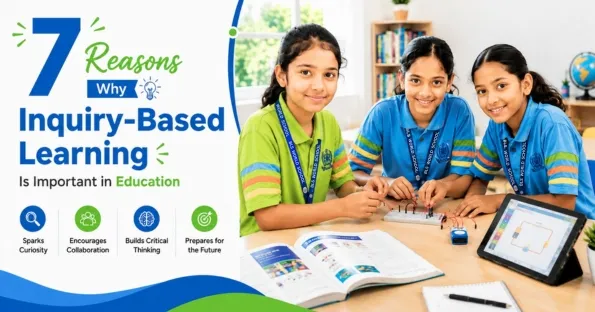

For decades, a "good student" meant someone who could sit still, listen carefully, and repeat back exactly what the teacher said. That definition is quietly disappearing. In its place is a classroom where children ask questions, chase their own curiosity, and build understanding through discovery rather than repetition. This shift has a name: inquiry-based learning (IBL).
Inquiry-based learning is a student-centered teaching approach in which children learn by asking questions, exploring concepts, and finding answers through research and discussion—rather than memorizing information handed to them. It builds critical thinking, creativity, collaboration, and problem-solving, turning learners into independent thinkers rather than passive note-takers.
Why Question-Based Learning Fits the World We Live In
Think about how different today's world is from the one most parents were educated in. Information isn't scarce anymore — it's overwhelming. Careers that didn't exist ten years ago are now common, and industries reinvent themselves faster than any school curriculum can be rewritten. In this environment, the ability to ask a sharp, well-formed question is often more valuable than knowing a single "correct" answer.
Traditional teaching—a teacher delivering facts, students absorbing them—was designed for a world that changed slowly. It doesn't map well onto one that changes by the month. Student-centered learning offers a different model: instead of telling children what to think, educators guide them to discover it themselves through curiosity, exploration, and evidence. The result is learners who are more adaptable, more genuinely engaged, and far better prepared for problems they've never encountered before.
This isn't a passing educational trend, either. It traces back to the discovery learning movement of the 1960s, when classrooms began moving away from rote memorization toward active, question-driven exploration grounded in constructivist theory — including the influential work of Jean Piaget.
7 Ways Inquiry-Based Learning Changes How Children Think
1. Critical thinking
When students are pushed to question rather than accept, they naturally start analyzing, comparing, and evaluating ideas — a habit that outlasts any single school year. This isn't just a nice theory: a study published through the U.S. National Library of Medicine found that inquiry-based learning meaningfully strengthened students' critical and analytical thinking, moving them beyond memorized facts toward applied understanding.
2. Problem-solving becomes second nature
Inquiry classrooms replace neat textbook answers with messy, open-ended challenges. Students learn to break down complicated situations, test possible solutions, and adjust course when a first attempt doesn't work—the exact muscle memory needed for real-world problem-solving.
3. Boosts Student Engagement
Curiosity is a natural motivator. A lesson that opens with a genuine question, instead of a fact to memorize, turns students into active participants rather than passive listeners. That's the difference between a lesson students tolerate and one they actually enjoy.
4. Independence Learning
Responsibility for learning shifts from teacher to student. Children practice seeking out information, judging sources, and drawing their own conclusions—skills that become non-negotiable in senior grades, college, and careers.
5. Communication and teamwork improve
Most inquiry work happens in groups—discussing, debating, and presenting findings to peers. That builds the ability to express ideas clearly and listen to different viewpoints in a way lectures alone never manage to teach.
6. Creativity
Without one single correct answer to chase, students feel freer to explore unconventional ideas. This concept-based approach helps them connect ideas across subjects in ways rigid, answer-driven teaching rarely allows.
7. Real-world readiness improves
Future careers will reward adaptability, judgment, and comfort with uncertainty far more than memorized procedure. Students who've practiced questioning and exploring simply handle unfamiliar situations better.
Watching Inquiry Grow Up Alongside a Child
Inquiry-based learning doesn't look the same at every age—it matures as children do.
Between ages 3 and 7, inquiry is small and sensory: simple "why" and "how" questions, guided exploration, a toddler sorting shapes or wondering aloud why the sky is blue. Teachers act mostly as facilitators, shaping natural curiosity into structured discovery.
By ages 8 to 11, children begin forming actual hypotheses and testing them—simple science experiments, nature observation journals, and self-chosen mini research projects. This is where independent thinking habits first take shape.
In middle school (ages 12–14), inquiry becomes structured and cross-disciplinary: group investigations, debates, and design-based projects that require real research, evidence, and reasoned argument, often supported by dedicated STEM and science labs.
By senior school (ages 15–18), inquiry closely mirrors real-world and career-oriented thinking—data analysis, Model United Nations-style debate, and independent research projects that resemble how problems are actually solved in college and the workplace.
What This Actually Looks Like in a Classroom
- Science experiments where students form a hypothesis and run the experiment themselves, instead of being told what will happen—turning abstract concepts into memorable, hands-on discovery.
- Field trips to museums, farms, or historical sites, where spontaneous questions connect textbook theory to the real world in a way no classroom lecture can replicate.
- Classroom debates, including structured formats like Model UN, that require researching both sides of an issue and building confident, evidence-based arguments.
- STEM and AI-based projects — coding a program, building a working model, designing a solution in an AI/STEM lab — that push students to plan, troubleshoot, and present their work.
- Group collaboration, where open discussion lets students test their understanding against their peers' perspectives, refining their thinking through dialogue instead of isolated study.
Inquiry in Action at BLS World School
True to its motto, "Education for Life," BLS World School—a CBSE school in Greater Noida West—treats curiosity as part of the everyday classroom experience, not an occasional add-on.
Dedicated discovery, science, mathematics, and social science labs, alongside a full AI/STEM lab for middle and senior school, give students real spaces to question, experiment, and build understanding hands-on. In the Discovery Lab, younger learners run guided experiments and sensory-based investigations; in the AI/STEM Lab, senior students design and code real projects instead of simply reading about technology.
Programmes like Battle of Wits (quizzing) and inter-house debates build confident public speaking and reasoning skills, while project-based learning weeks push students to research, create, and present their own ideas—nurturing creativity alongside academic understanding. An experienced faculty, trained to act as facilitators rather than lecturers, guides students to explore ideas rather than simply memorize them, keeping academic excellence and genuine understanding firmly connected at every grade.
Questions Parents Often Ask
What is inquiry-based learning, in simple terms?
It's a teaching method where students learn by asking questions, investigating, and discovering answers themselves—rather than being told information directly by a teacher.
How can parents encourage this style of learning at home?
Ask open-ended questions—"What do you think will happen?"—instead of giving the answer directly. It reinforces the same curiosity-driven thinking children practice at school.
Does this work for very young children?
Yes. Even toddlers and young learners benefit from age-appropriate inquiry activities like simple experiments and guided questions, which build curiosity from an early age.
Does BLS World School follow this approach?
Yes, BLS World School integrates inquiry-based and experiential learning techniques across its CBSE curriculum to build critical thinking and problem-solving abilities.
The Classroom Your Child Deserves
Inquiry-based learning is more than a teaching technique — it's a philosophy that turns students into lifelong learners, innovators, and leaders. At BLS World School, recognized as one of the best school in Greater Noida West, this approach runs through every stage of a child's education, from early years exploration to senior-school research.
If you're looking for a school built around student-centered learning, genuine curiosity, and strong problem-solving foundations, your child's journey can start here. Book a campus visit to see the hands-on discovery labs in action, or call the admissions team today to secure a seat before spots fill up.
Address: HS 03, Sector 16, Panchsheel Greens 2, Greater Noida West
Admissions: 099974 43666


























Sign in to leave a comment.