

If you have spent hours highlighting a thick monthly current affairs magazine only to freeze when facing a 15-marker Mains question on federalism or multilateralism, you are not alone. Most civil services aspirants treat General Studies Paper 2 as a pure memorization test. They memorize constitutional articles, list out a few Supreme Court judgments, brush up on international summits, and hope that is enough.
Then the exam hall hits.
UPSC rarely asks straightforward static questions in GS 2 anymore. Instead, it tests how effectively you can connect static constitutional provisions with real-world governance issues, policy debates, and geopolitical shifts. A single question might touch upon constitutional law, administrative friction, and recent judicial observations.
Developing a reliable upsc mains gs paper 2 strategy isn't about reading three newspapers a day or piling up endless PDF compilations. It is about building a system that turns daily current developments into structured, high-yield answer material.

Here is a practical, ground-tested breakdown of how to master current affairs and sharpen your overall gs paper 2 strategy for upsc mains.
Understanding the Syllabus Beyond the Headings
Before jumping into current events, you need to understand what GS Paper 2 actually evaluates. The syllabus is broadly split into four main pillars:
- Polity & Constitution: Functions and responsibilities of the Union and States, separation of powers, dispute redressal, constitutional/statutory bodies, and electoral dynamics.
- Governance: Public policy, e-governance, transparency, accountability, role of civil services, and citizen charters.
- Social Justice: Welfare schemes for vulnerable sections, health, education, human resources, and issues relating to poverty and hunger.
- International Relations (IR): India’s neighborhood, global groupings, bilateral agreements, and the Indian diaspora.
Notice how every single pillar is inherently dynamic. A static textbook like Laxmikanth gives you the foundation, but without contemporary context, your answers will feel dry and academic.
The Static-Dynamic Integration Formula
The biggest mistake aspirants make when building their upsc gs 2 preparation strategy is treating static study and current affairs as two separate subjects. In GS 2, static content provides the structure, while current affairs provides the life.
Static Concept (Articles/Doctrine) + Current Context (Issue/Event) + Analytical Layer (SC Judgment/Committee) = High-Scoring Answer
1. Indian Polity & Constitution: Bridging Text and Context
When reading news about parliamentary disruptions, state-center friction over financial grants, or gubernatorial powers, do not just read it as political gossip. Immediately anchor it to the Constitution.
- The Static Anchor: Articles 200 (Governor’s assent), 246 (Legislative powers), or 279A (GST Council).
- The Current Context: Tussles between state governments and Governors over pending bills.
- The Value Addition: Cite recommendations from the Sarkaria Commission or Punchhi Commission, along with landmark rulings like Shamsher Singh (1974) or Nabam Rebia (2016).
2. Governance & Social Justice: Focus on Outcome over Output
Questions in this segment evaluate whether policies are actually delivering results on the ground. Instead of simply listing welfare schemes, focus on implementation gaps, technological integration, and rights-based frameworks.
- Use Concrete Data: Quote verified figures from NITI Aayog reports, NFHS-5, or international indices (like the Global Hunger Index or UNDP Human Development Index).
- Reference Mechanisms: Mention specific e-governance tools (such as direct benefit transfers, DigiLocker, or Jan Samarth portal) when answering questions on administrative efficiency.
3. International Relations: Thinking Geopolitically
Current affairs in IR can quickly become an overwhelming sea of daily developments. To keep your upsc mains gs 2 strategy efficient, organize IR topics by strategic interest rather than individual daily headlines:
- Geographic Clusters: Neighborhood First, Indo-Pacific, West Asia, Africa.
- Institutional Alliances: Quad, BRICS, SCO, G20, UN Security Council reforms.
- Core Themes: Supply chain resilience, global south advocacy, diaspora diplomacy, and technology transfer.
How to Filter Current Affairs for GS 2 Without Burning Out
You do not need to note down every news item. To keep your current affairs preparation manageable, pass every article through this simple filter before taking notes:
Filter 1: Does this touch a specific topic listed in the GS 2 syllabus? Filter 2: Does it involve a law, judicial ruling, constitutional body, policy decision, or global treaty? Filter 3: Can I use this as an example, quote, or case study in a 150-250 word answer?
If a news item fails these three checks, move on.
Recommended Daily & Monthly Workflow
- Newspaper (45–60 mins daily): Focus strictly on the Editorial and Explained pages of a reputed national daily (like The Hindu or The Indian Express). Highlight constitutional debates, policy critiques, and official statements.
- Monthly Compilations: Use monthly compilations primarily for consolidation and revision, not as your primary learning source. Use them to fill gaps in data, committee names, and scheme details.
Answer Writing for GS 2: Value Additions That Boost Marks
Two candidates can write the exact same core points, yet one secures a 4.5/10 while the other gets 7/10. What makes the difference? Value additions.
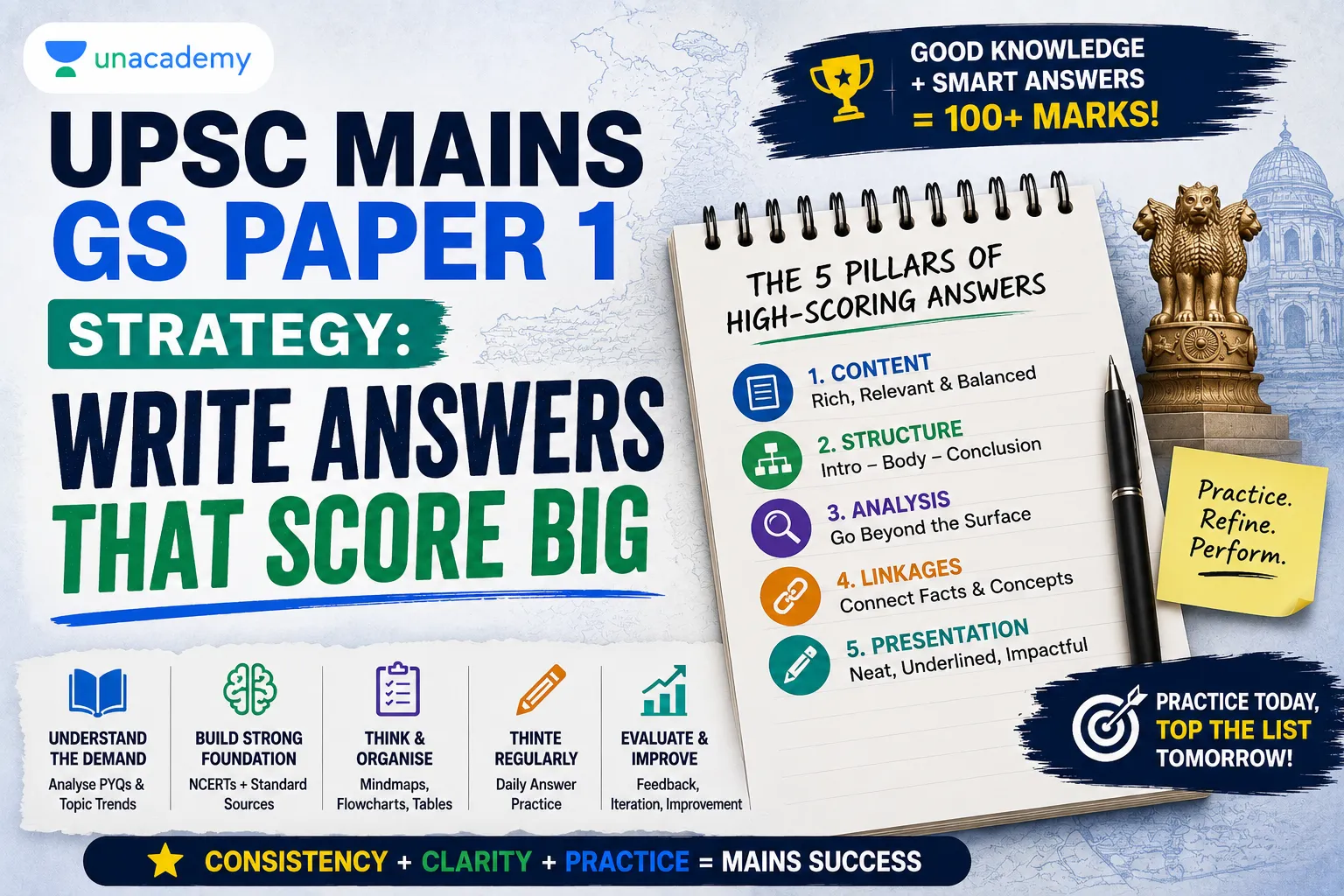
A well-rounded upsc mains gs paper 2 strategy incorporates three key elements directly into answer structures:
| Element | Purpose | Practical Example |
|---|---|---|
| Constitutional Articles & Doctrines | Establishes legal authority | Citing Article 21 (Right to Life) or the Basic Structure Doctrine. |
| Committees & Commissions | Shows analytical depth | Referencing 2nd ARC recommendations on ethics or administrative reforms. |
| Judicial Precedents | Demonstrates contemporary awareness | Citing KS Puttaswamy for privacy or SR Bommai for President's Rule. |
Sample Answer Structuring Framework
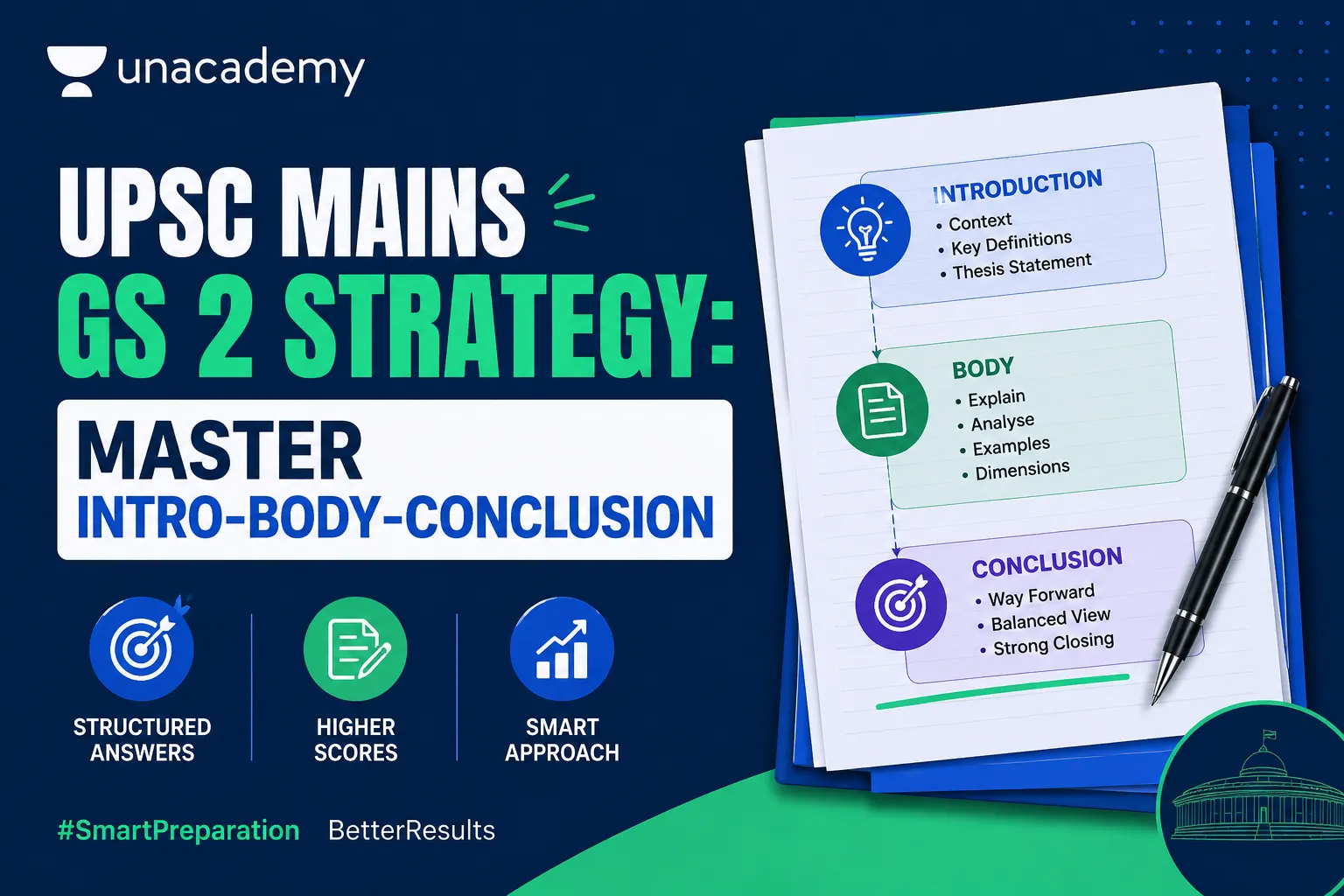
- Introduction (20–30 words): Start directly with a relevant definition, constitutional article, or recent context/data point.
- Body Section 1 (70–90 words): Address the core question using bullet points with bold subheadings. Insert a relevant committee recommendation or court ruling.
- Body Section 2 (70–90 words): Analyze challenges, opposing viewpoints, or structural bottlenecks.
- Way Forward & Conclusion (20–30 words): Offer constructive, forward-looking suggestions based on official report findings or constitutional ideals.
Common Mistakes to Avoid in GS Paper 2
- Over-relying on Laxmikanth for Mains: Laxmikanth is indispensable for Prelims, but for Mains, you need analytical depth on issues, reforms, and working of the Constitution.
- Ignoring Governance and Social Justice: Candidates often spend 70% of their prep time on Polity and IR, leaving Governance and Social Justice unprepared. In practice, Governance and Social Justice account for a massive chunk of GS 2 marks.
- Writing Generic Conclusions: Avoid vague endings like "Government should take necessary steps to fix this." Instead, propose specific policy tweaks, legal reforms, or institutional mechanisms.
- Neglecting PYQs (Previous Year Questions): UPSC frequently repeats themes such as statutory bodies, parliamentary decline, federalism issues, and welfare delivery bottlenecks. Analyzing the last 10 years of PYQs is essential.
Aspirant Experiences: What Worked on Exam Day
Aarav S. (Rank 142, CSE 2023):
"In my first two attempts, my gs paper 2 strategy for upsc mains was completely static-driven. I wrote generic theoretical answers for Polity. In my third attempt, I explicitly made micro-notes for Supreme Court judgments, committee names, and NITI Aayog recommendations. Injecting these into every answer bumped my GS 2 score from 84 to 112."
Priya Nair (Mains Qualifier):
"I used to get overwhelmed by IR current affairs. My breakthrough came when I stopped tracking daily leader visits and started mapping issues under thematic heads like 'India-Pacific Security' or 'WTO Disputes'. Suddenly, my upsc gs 2 preparation strategy felt manageable, and I could structure 15-mark answers in 9 minutes flat."
Frequently Asked Questions (FAQs)
1. How many months of current affairs should I cover for UPSC Mains GS Paper 2?
Focus on current affairs from the past 12 to 15 months leading up to the Mains exam. For major constitutional debates, landmark judgments, and key foreign policy shifts, a 2-year horizon is helpful.
2. Is static study enough for the Polity section in GS Paper 2?
No. Static study gives you the foundational framework, but UPSC evaluates how well you understand the practical application of constitutional provisions in light of recent events, legislative bills, and judicial rulings.
3. How do I memorize Supreme Court judgments and committee recommendations for answer writing?
Do not try to memorize hundreds of cases. Maintain a cheat sheet of 30–40 landmark and recent Supreme Court judgments grouped by syllabus themes (e.g., Free Speech, Privacy, Federalism, Electoral Reforms). Revise them weekly so you can naturally weave them into your answers.
4. What is the best way to handle the Governance section in GS 2?
Focus on core themes like e-governance, Citizen’s Charters, RTI, civil service reforms, and accountability mechanisms. Prepare 1-2 page notes per topic containing key definitions, constitutional/statutory backing, major bottlenecks, 2nd ARC recommendations, and successful state-level case studies.
5. How much time should I dedicate daily to current affairs during Mains preparation?
Limit your active newspaper reading to 45–60 minutes daily. Spend another 30 to 45 minutes integrating key points into your static syllabus topics or writing answers. Quality of analysis matters much more than quantity of news consumed.
Final Thoughts
Mastering current affairs for GS Paper 2 is not about becoming a walking encyclopedia of daily news. It is about building an analytical mindset that connects contemporary events to fundamental constitutional principles, administrative challenges, and global realities.
Focus on syllabus micro-topics, build thematic notes, consistently integrate law and committee recommendations, and practice writing structured answers under time constraints. With a systematic upsc mains gs 2 strategy, GS Paper 2 can transform from an unpredictable hurdle into one of your most dependable scoring papers.





























Sign in to leave a comment.