

The Trap of Endlessly Reading GS 1
You sit down at 8:00 AM, open a heavy volume on Indian art and culture, and by lunch, you have covered exactly six pages. Your head hurts, your highlighter is running dry, and a familiar sense of panic starts to set in. You are working ten hours a day, yet the sheer volume of General Studies Paper 1 feels completely untamed.
This is the silent crisis of UPSC preparation. Aspirants do not fail GS Paper 1 because they lack discipline; they fail because they treat it like a university history degree instead of a competitive civil services exam.
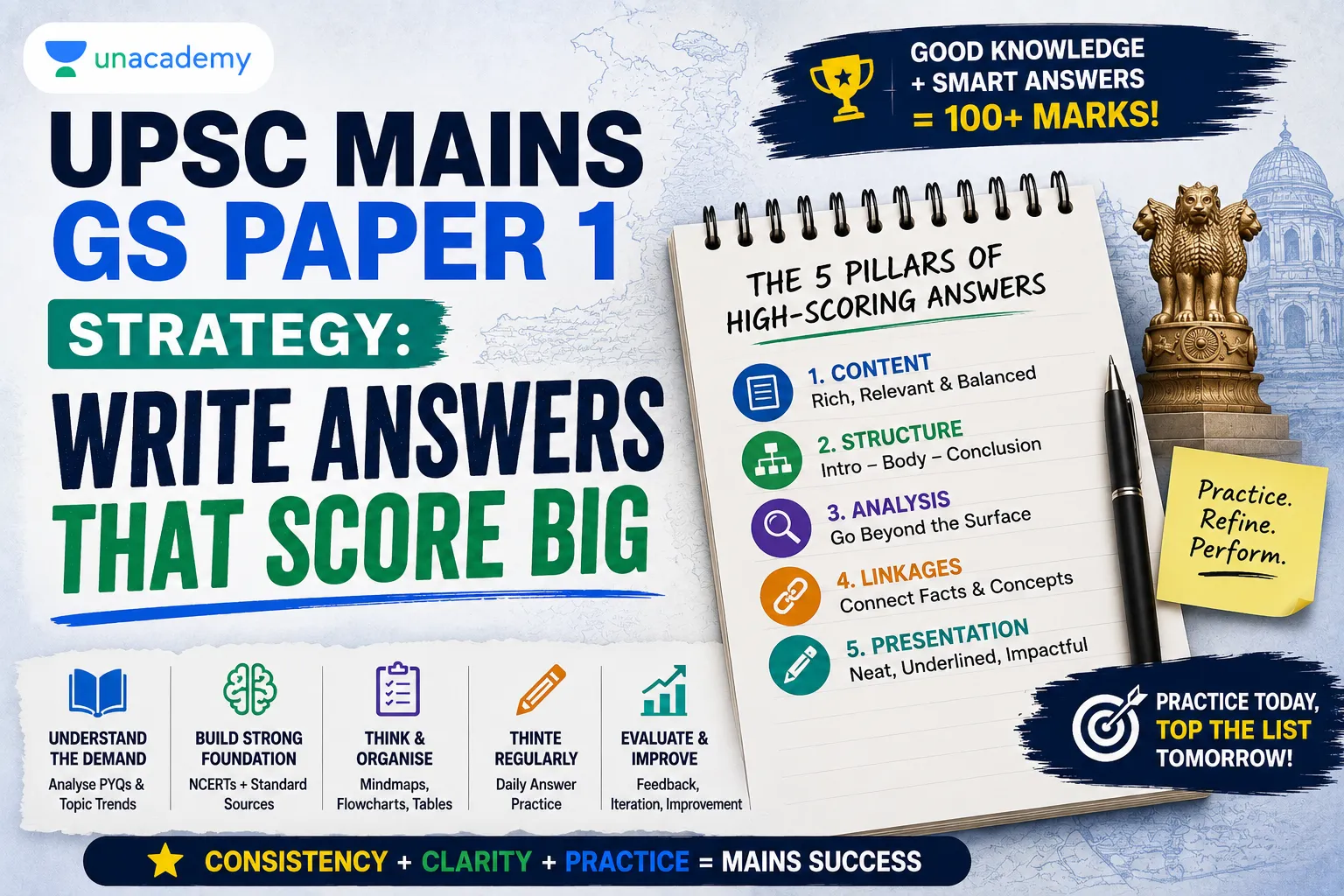
The syllabus for GS 1 spanning History, Art & Culture, Society, and Geography is vast, but it is not infinite. The problem is that most candidates spend endless hours reading static textbooks cover-to-cover without understanding what the examiner is actually testing. If you want to break out of this cycle, you need an actionable UPSC Mains GS Paper 1 strategy that prioritizes high-yield topics, strict syllabus mapping, and structured answer writing over sheer reading volume.
Let us fix your approach so every hour you spend at your desk actually converts into marks on exam day.

Why GS Paper 1 Feels So Unforgiving
GS Paper 1 is unique. Unlike GS Paper 2 (Governance & Polity) or GS Paper 3 (Economy & Environment), where current affairs dominate, GS 1 is heavily anchored in static subjects.
| Subject Category | Estimated Weightage |
|---|---|
| History, Art & Culture | ~75–85 Marks |
| Indian Society | ~75–85 Marks |
| Physical & Human Geography | ~80–90 Marks |
Because these subjects feel familiar from school, aspirants fall into three major traps:
- The Over-Sourcing Trap: Buying three different books for Modern History or four standard references for Geography.
- The Reading Delusion: Mistaking re-reading notes for active learning and retention.
- Neglecting Society: Treating Society as "easy general knowledge" and leaving it for the last fortnight before Mains, only to struggle when writing structured, sociological answers.
Executing an effective GS Paper 1 strategy for UPSC Mains requires recognizing that the paper tests your analytical linking ability, not your memory capacity.
Deconstructing the Syllabus: Subject-Wise Precision
To stop wasting hours, you must approach each segment of GS 1 with a distinct tactical mindset.
1. History, Art, and Culture: Focus on Transitions
Stop memorizing every dynasty, king, and architectural detail. UPSC rarely asks pure factual memory questions in Mains. Instead, focus on themes, social impacts, and historical transitions.
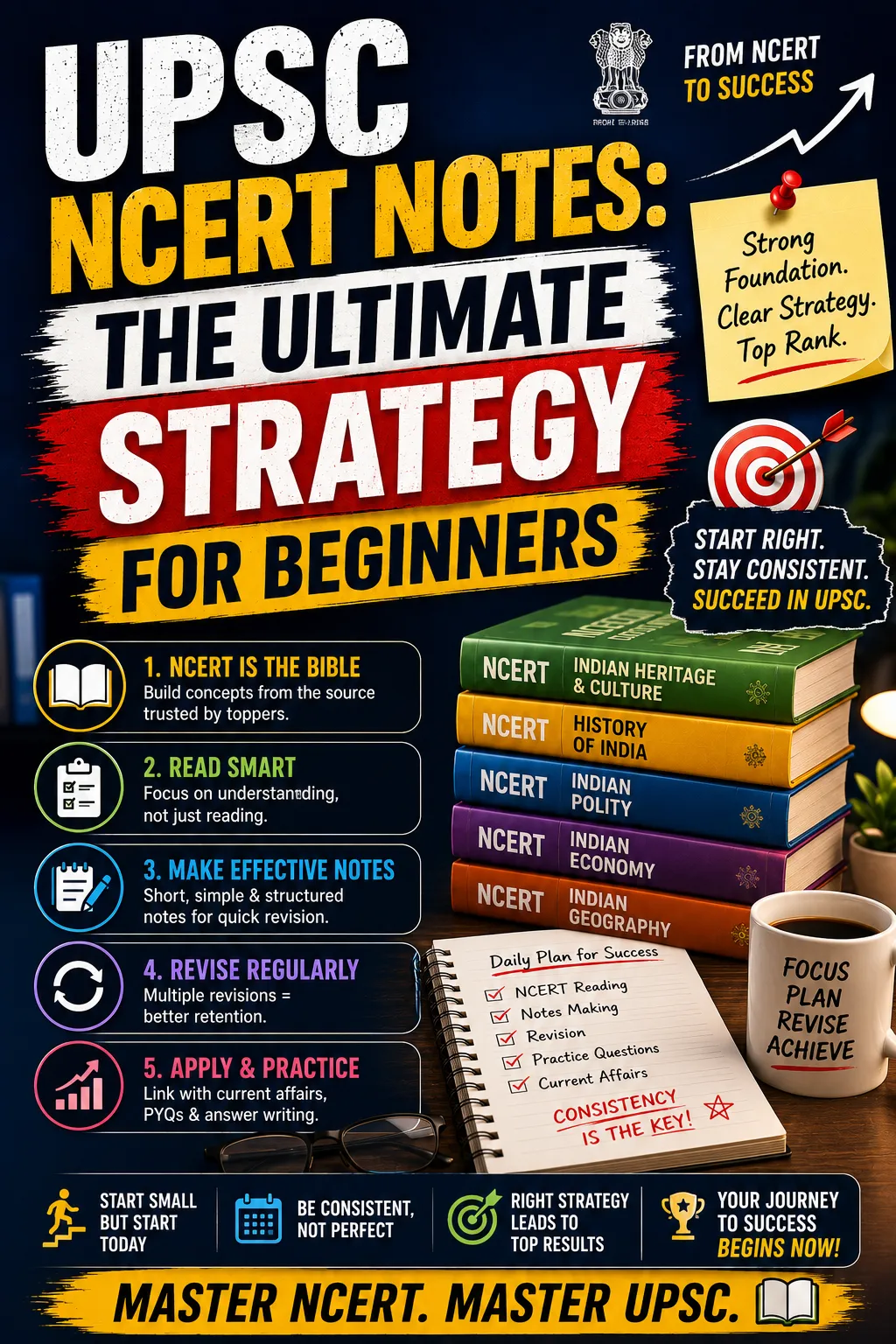
- Art & Culture: Connect cultural manifestations to their socio-economic background. Instead of just studying the architecture of the Vijayanagara Empire, understand why their temple architecture reflected royal power and urbanization. Keep your notes consolidated using basic sources like NCERTs and Nitin Singhania selectively.
- Modern History: Focus on the underlying causes, ideological shifts, and social movements between 1750 and 1947. Pay close attention to regional movements, tribal uprisings, and the contributions of lesser-known personalities.
- World History & Post-Independence: These two areas carry unpredictable weight (sometimes 10–20 marks, sometimes zero). Do not spend months on them. Limit your material to concise class notes or a single consolidated summary, focusing primarily on major world events (Industrial Revolution, World Wars, Decolonization) and key post-independence themes (Linguistic reorganization, Emergency, Land reforms).
2. Geography: Master the Spatial Approach
Geography is the most scoring section of GS 1 because it is systematic and objective. A solid UPSC GS 1 preparation strategy leverages Geography to pull up your overall paper score.
- Physical Geography: Ensure your conceptual clarity on plate tectonics, climatology, oceanography, and geomorphology is absolute. When answering, always frame responses around processes (cause > process > landform/impact).
- Resource Distribution & Industrial Location: Prepare micro-notes on the location of key industries (iron, cotton, petroleum, technology) across the world and India. Focus on factor inputs: raw materials, power, labor, markets, and policy shifts.
- Visuals are Mandatory: An answer on ocean currents or cyclone formation without a clean, quick diagram will rarely hit the top score band.
3. Indian Society: The Secret High-Yield Segment
Society accounts for nearly 75 to 85 marks in GS 1, yet it receives a fraction of the preparation time spent on History.
- Syllabus Micro-Topics: Map topics like Secularism, Communalism, Regionalism, Globalization, Population, and Women's Empowerment directly to specific definitions, key dimensions, and relevant data.
- Contemporary Relevance: Integrate recent social issues, sociological concepts, demographic trends, and landmark government reports into your answers.
- Avoid Generic Prose: Write like an informed policy analyst rather than expressing casual personal opinions. Use sociological frameworks (e.g., structural factors, cultural shifts, economic drivers).
Building a Lean Micro-Note System
If your notes are as thick as the original textbook, you will fail to revise them during the frantic 3-day gap during Mains week. Modern UPSC Mains GS 1 strategy relies on hyper-condensed micro-notes.
Aim for 1–2 pages per sub-topic of the syllabus. When you complete a topic, you should be able to answer three questions immediately:
- What is the core issue or definition?
- What are the 3-4 primary drivers or impacts?
- What is the way forward, supported by a real-world example, committee, or map?
Answer Writing for GS 1: Moving From Knowledge to Marks
Knowing the content is only half the battle; displaying it under severe time pressure is what earns marks.
1. Direct Contextual Introductions
Avoid long, poetic intros. If the question asks about the impact of the Industrial Revolution on Indian cottage industries, define the timeline and state the core economic impact in 2–3 lines.
2. Multi-Dimensional Body Structure
Organize your body paragraphs using explicit, sub-heading-driven frameworks. For historical questions, use temporal or thematic breakdowns (Socio-Cultural, Economic, Political, Administrative). For Geography and Society, use spatial, institutional, or demographic dimensions.
3. Integrate Value Addition Early
- History: Cite specific contemporary texts, historians' perspectives, or archaeological sites.
- Geography: Include clear, labeled maps, flowcharts of processes, and spatial layouts.
- Society: Quote recent survey statistics, constitutional provisions, or committee recommendations.
Common Mistakes to Avoid in GS Paper 1
Even dedicated candidates lose marks by falling into predictable habits:
- Treating History as Pure Chronology: Focusing on what happened without analyzing why it happened or its long-term socio-economic implications.
- Ignoring Diagrams in Non-Geography Answers: Diagrams, timelines, and structural maps work just as well in History and Society questions to break up dense blocks of text.
- Over-Investing in World History: Spending 50 hours studying the French and Russian Revolutions for a single potential 10-mark question.
- Writing Emotionally on Social Issues: Losing objectivity on topics like caste, secularism, or gender dynamics instead of maintaining a balanced, evidence-backed analytical perspective.
Aspirant Experiences: Real Shift, Real Results
"In my first two attempts, I spent 70% of my GS 1 time reading Art & Culture and History books repeatedly. I scored 78 marks. In my third attempt, I capped my history reading, built micro-notes for Society and Geography, and practiced drawing quick regional maps. My score jumped to 106. The difference wasn't how much I knew it was how I allocated my time."
— Ananya S., Rank 142 (UPSC CSE)
"I used to write essay-style answers for GS 1 Society questions. I realized quickly that without data, specific terminology, and structured headings, you sound like a casual commentator. Once I started treating Society with the same technical precision as Geography, my answer quality transformed completely."
— Rahul V., Appeared in 3rd Mains Interviews
Frequently Asked Questions (FAQs)
1. How many months should I dedicate to preparing GS Paper 1 for Mains?
If your Prelims foundation is decent, dedicate 6 to 8 weeks of focused, topic-wise preparation for GS 1 between Prelims and Mains. Integrate answer writing and micro-note generation directly into this study window.
2. Is standard NCERT enough for Geography in GS Paper 1?
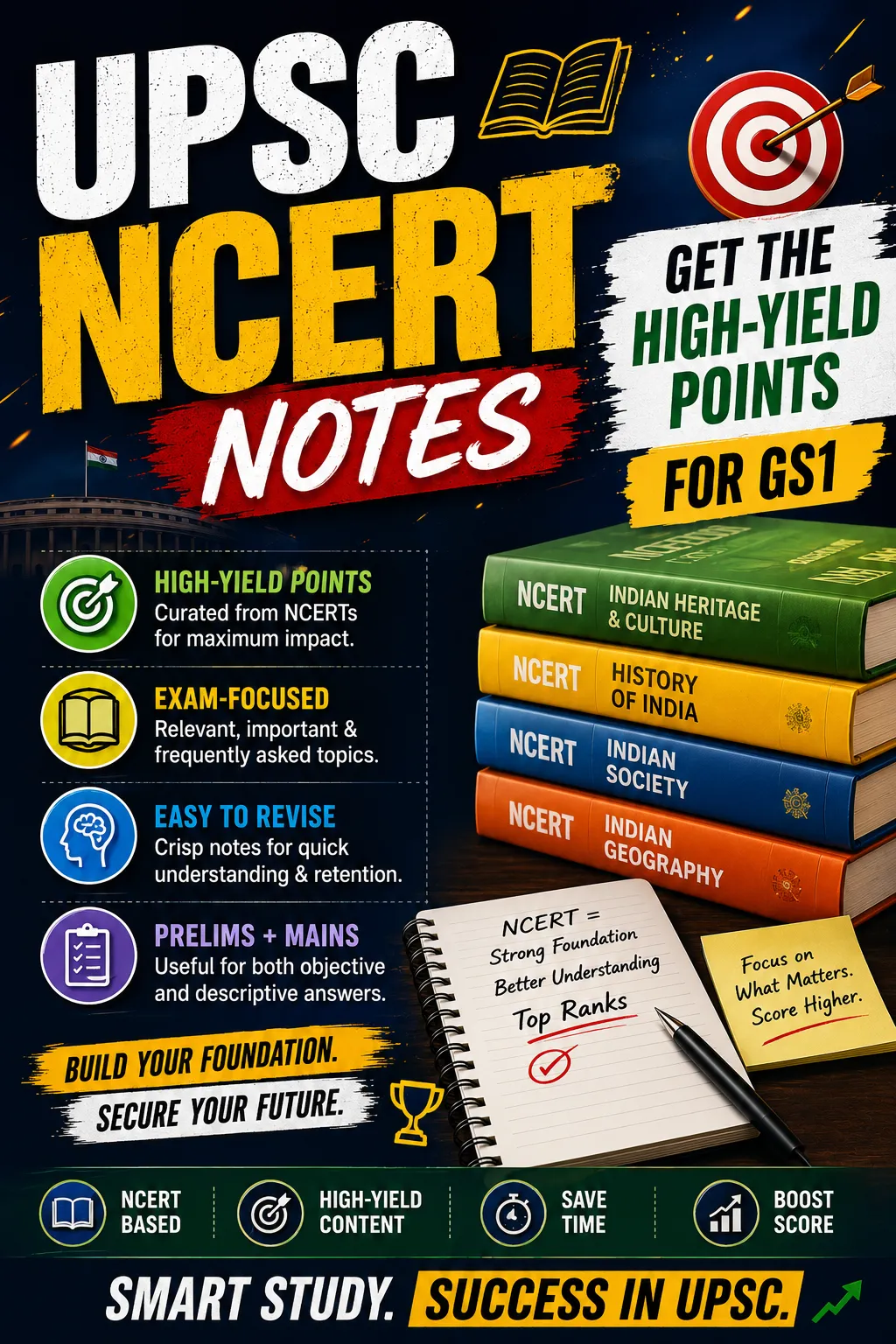
Class 11 and 12 NCERTs are the bedrock for Physical and Human Geography. However, for resource distribution, location of industries, and dynamic geography topics, supplement them with recent socio-economic data, atlas work, and current spatial developments.
3. How do I cover Indian Society effectively without overly dense sociological textbooks?
Stick strictly to the terms mentioned in the official UPSC syllabus. Use standard basic notes or compiled study material, collect relevant facts and figures from recent reports, and practice past 10 years' Mains questions (PYQs) to understand the required depth.
4. How important are maps and diagrams in GS Paper 1 answers?
They are crucial. A neat, accurate map or process diagram in Geography or History saves writing time, breaks visual monotony for the evaluator, and demonstrates clear spatial understanding, often yielding an extra 1 to 1.5 marks per question.
5. Should I write answers in bullet points or paragraphs for GS Paper 1?
A hybrid approach works best. Use brief paragraphs for introductions and conclusions, and structured bullet points with clear, bolded subheadings for the main body. This ensures your key arguments stand out immediately during evaluation.
Final Thoughts
Clearing GS Paper 1 is not about mastering every piece of historical trivia or memorizing every geographical coordinate. It is about treating the syllabus as a defined, finite project. Map every topic to concise notes, practice representing concepts visually, and focus your energy on high-yielding segments like Geography and Society alongside core History. Stop counting the hours you sit at your desk start measuring the clarity and structure you can produce on paper.






























Sign in to leave a comment.