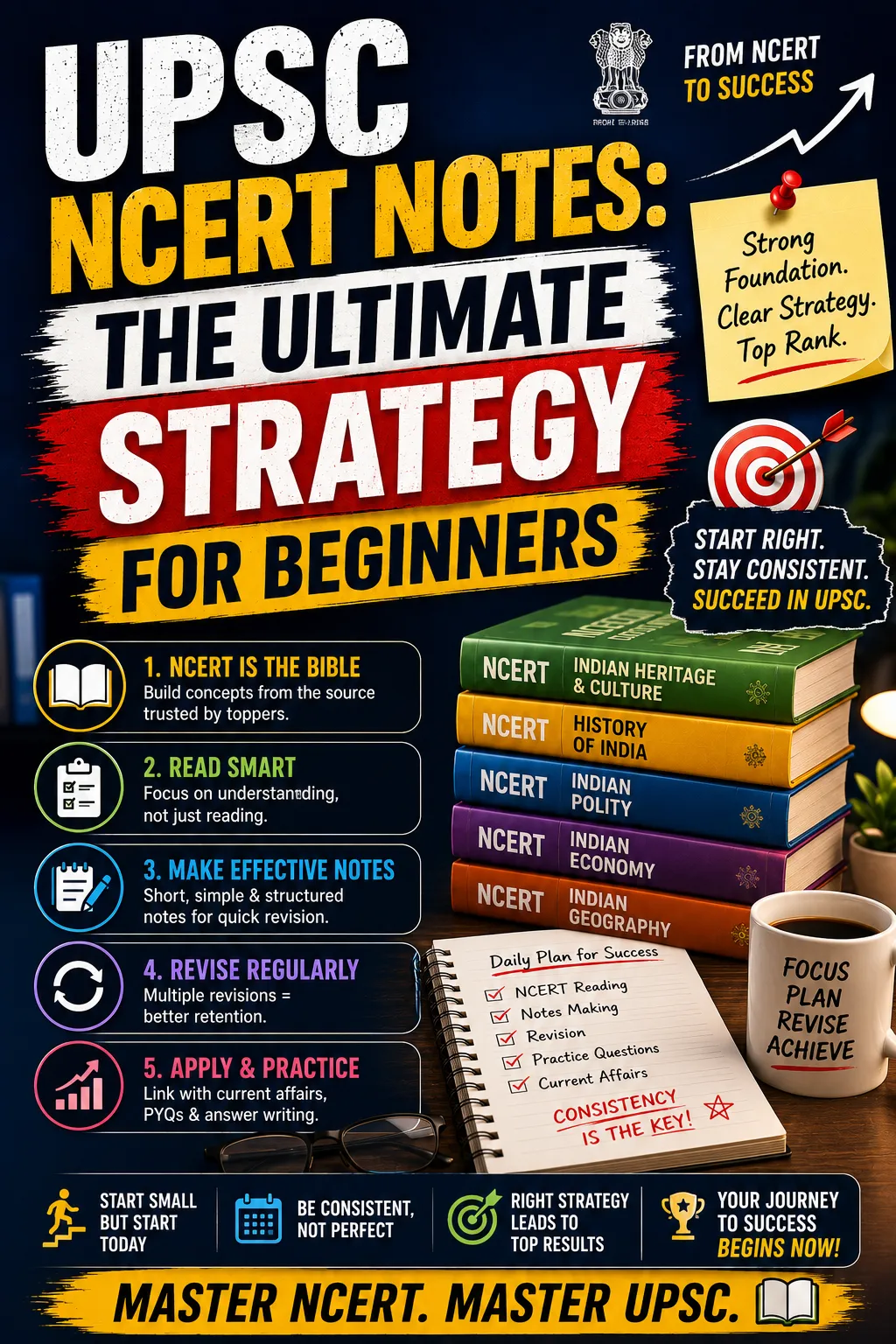

If you have just decided to prepare for the Civil Services Examination, the sheer volume of study material can feel overwhelming. You sit down at your desk, look at a syllabus that seems to cover everything under the sun, and instantly encounter the most common piece of advice given to every beginner: "Start with NCERTs."
But knowing you need to read them is different from knowing how to process them. Soon, you find yourself staring at a stack of over forty textbooks from classes 6 to 12. A nagging question settles in: How do I condense thousands of pages of school books into crisp, high-yield notes that will actually help me clear the exam?
Many aspirants fall into the trap of turning note making into a passive copying exercise. They end up rewriting the textbooks word-for-word, creating a second, slightly messier version of the original book let’s break down how to avoid that trap and build a highly effective system for creating and using upsc ncert notes that save you time, sharpen your conceptual clarity, and give you a genuine edge.
Why NCERTs are Non-Negotiable (and the Note-Making Trap)
NCERT textbooks serve as the absolute bedrock of your preparation. They are not recommended because they contain complex, high-level theories; they are recommended because they explain foundational concepts in the simplest language possible. Whether it is understanding the mechanism of monsoons in geography or tracing the structural changes in Indian society, these books build the mental framework upon which you will later layer standard reference books and current affairs.
However, the way you read a book for the first time should not be the way you make notes.
The First-Read Mistake: Never pick up a highlighter or a pen during your very first reading of an NCERT. When everything is new to you, everything feels important. If you try to make notes immediately, you will write down basic facts that your brain would have easily retained anyway after a second reading.
The Step-by-Step Strategy to Build Effective NCERT Notes
High-yield notes are built through iteration, filtering, and a deep understanding of the exam syllabus. Here is a practical workflow to help you build clean, actionable insights from your textbooks.
Step 1: Decode the Syllabus First
Before opening a single history or polity textbook, memorize the micro-topics of the UPSC Mains syllabus. When you know exactly what the exam tests—such as "Secularism," "Continental Drift," or “Bhakti Movement” your brain automatically filters out the stories, conversational dialogues, and filler text meant for school children, leaving you with the core analytical points.
Step 2: The Three-Reading Rule
To create truly effective ncert notes for upsc, structure your interaction with the textbooks across three distinct stages:
- The First Reading (The Storyteller Phase): Read the chapter like a story. Do not try to memorize dates, names, or specific figures. Your only goal here is to understand the narrative arc or the basic phenomenon being discussed.
- The Second Reading (The Analytical Phase): Read with a pencil. Underline key phrases, definitions, and cause-and-effect relationships. This is where you begin to see how a concept connects back to the syllabus.
- The Third Reading (The Extraction Phase): This is where you actually write. Summarize the underlined portions in your own words. If an entire chapter can be condensed into a single page of bullet points or a flowchart, you have succeeded.
Step 3: Organize Formats Geometrically
Human memory responds incredibly well to spatial layouts. Instead of writing long paragraphs, use flowcharts for historical timelines, tables for comparing economic sectors, and rough maps for geography. For instance, instead of writing a paragraph about the factors influencing the location of the ancient iron and steel industry, draw a quick spider diagram mapping out raw materials, water sources, labor, and market proximity.
Digital vs. Paper: Finding Your System
There is no single "right" medium for note-making, but your choice should align with how you plan to revise.
If you prefer physical paper, use loose sheets kept in a ring binder rather than bound notebooks. This allows you to insert new pages when you learn something complementary from a standard reference book or a newspaper article later in your cycle.
If you choose the digital route, tools like Notion, Evernote, or OneNote make your notes completely searchable and endlessly editable. Many beginners spend hours searching online for a ncert notes pdf for upsc to skip the writing process entirely. While downloading a ready-made ncert notes for upsc pdf free download can be incredibly useful as a quick reference or a benchmark to check against your own work, remember that the primary cognitive benefit comes from the process of summarizing the text yourself. The mental heavy lifting you do while condensing a chapter is what builds long-term retention.
What Real Aspirants Learned Along the Way
Every year, thousands of candidates navigate this exact phase. Here are two realistic reflections from individuals who had to recalibrate their approach to foundational notes.
Anjali M., Delhi: "During my first six months, I thought making notes meant creating beautiful, color-coded summaries of every single chapter from Class 6 onwards. I wasted weeks. I eventually realized that Class 6 to 8 books don't need dedicated notes you can just note down the unique facts in the margins of the book itself save your comprehensive note-making energy for Classes 9 through 12, where the core analytical concepts live."
Rohan K., Bengaluru:
"I downloaded a massive, pre-compiled ncert notes pdf for upsc thinking it would save me two months of effort. But when I sat down to revise, none of it stuck because I hadn't gone through the pain of processing the raw material myself. I had to go back, read the original texts, and make brief mind maps. Don't mistake owning material for understanding it."
Common Mistakes to Avoid
- Treating all NCERTs equally: You do not need to make deep notes for every subject. For example, Old NCERTs for History and New NCERTs for Geography (Classes 11 and 12) require meticulous attention. However, for Fine Arts or Society, a light, high-level summary focused on definitions and core themes is more than enough.
- Ignoring the diagrams and maps: UPSC frequently extracts conceptual questions directly from textbook illustrations, map captions, and sidebar box items. Ensure your notes capture these visual summaries.
Forgetting to leave white space: Always leave a 2-inch margin on the side of your paper or ample space at the bottom of your digital document. As you transition to advanced books like Laxmikanth for Polity or Ramesh Singh for Economy, you will want to add advanced nuances directly next to your foundational notes.
Frequently Asked Questions (FAQs)
1. Is it necessary to read NCERTs from Class 6 to 12 for all subjects?
Not necessarily. For Geography and History, starting from Class 6 is highly beneficial because the concepts build sequentially. However, for Economics and Polity, focusing heavily on Classes 9 through 12 is generally sufficient to establish the necessary conceptual base for the exam.
2. Can I rely entirely on a ncert notes for upsc pdf free download found online?
While third-party notes are excellent tools for rapid revision or filling gaps in your own summaries, they shouldn't completely replace your primary reading. Processing the textbooks yourself helps build the comprehension skills required to tackle unpredictable analytical questions in the Mains exam.
3. How often should I revise my foundational notes?
Ideally, your notes should be reviewed right before you transition to standard reference books for a specific subject, and then integrated into your weekly revision cycles. The goal is to get your notes concise enough that you can review an entire subject's foundational concepts in a single weekend.
4. Should my notes be objective or analytical?
They must be both. For the Prelims stage, your upsc ncert notes need to capture precise facts, timelines, locations, and terms. For the Mains stage, they should emphasize the "why" and "how"—the causes behind historical events, social changes, or geographic phenomena.
5. When is the best time to stop reading NCERTs and move to advanced books?
Once you can look at the table of contents of an NCERT textbook and clearly explain the core logic of each chapter to yourself without opening the book, your foundations are solid. At that point, transition immediately to advanced reference books, using your notes as an anchor.
A Grounded Approach Forward
Mastering the foundational syllabus is not about speed; it is about building a clean, uncluttered understanding of how the world works, how societies evolve, and how institutions function. Notes are simply a tool to help you document that understanding so you don't have to re-read forty textbooks when the exam approaches.
Keep your summaries minimal, structure them around the official syllabus, and don't be afraid to leave blank spaces for the insights you will gather further along your preparation journey. Consistent, steady filtering of information will serve you far better than a frantic rush to finish pages.



























Sign in to leave a comment.