
You are standing in front of a bookshelf, looking at a stack of roughly 40 to 45 textbooks spanning history, geography, society, and science. A voice in your head says you need to memorize all of them to even stand a chance.
If you are preparing for the Civil Services Examination, this is the exact moment where the initial enthusiasm hits a wall of pure exhaustion. Every topper, mentor, and forum tells you that building a foundation requires ncert notes for upsc preparation. But what no one tells you is how easily you can drown in them. You start highlighting a page, and by the time you are done, the entire page is a sea of yellow highlighter. You haven't made notes; you have just re-written the textbook in your own handwriting.
Let’s talk about how to break this cycle. You do not need to memorize every line of text from Class 6 to 12. For General Studies 1 (GS1) which covers History, Geography, and Indian Society you need a strategy that extracts the high-yield, analytical data while filtering out the school-level explanations. Here is how to approach upsc ncert notes without losing your sanity.
Why Standard NCERT Reading Fails the UPSC Test
NCERTs are written for school children. They use storytelling, fictional characters (like Paheli and Boojho), and repetitive examples to concrete a concept in a 12-year-old's mind.
When you read them for GS1, your brain needs to switch from a passive reader to an analytical examiner. The main exam doesn't care about the stories; it cares about the underlying structural cause, the socio-economic impact, and the geographical patterns.
For example, when a Class 7 history textbook spends three pages talking about a medieval king’s courtly life, a school student needs to visualize the court. You, however, need to extract the administrative terms, the taxation structure, and how it influenced the architectural style of that era. If your notes contain the story rather than the structural framework, they won’t help you write a 250 word answer in the mains exam.
The GS1 High-Yield Breakdown: What to Extract
General Studies 1 is massive, but it is highly structured. When compiling or looking for an ncert notes pdf for upsc, you should ensure the content is organized by these specific analytical lines.
1. History: Art & Culture and Modern India
Instead of copying chronological timelines blindly, focus on the evolutionary shifts in society and art.
- Ancient & Medieval: Focus heavily on terminology. Look for words related to land revenue (like Bhaga or Bali), administrative posts, and the architectural elements of temples (like Nagara vs. Dravida styles).
Modern India (Class 12 Themes): Look for the why behind events. Why did the Revolt of 1857 break out in the specific regions it did? What were the economic critiques of British rule?
2. Geography: Physical and Human
Geography is the most scientific part of GS1. It requires crisp diagrams and conceptual clarity rather than long paragraphs.
- Fundamentals of Physical Geography (Class 11): This is your holy grail. Your notes must visually map out geomorphic processes, plate tectonics, wind patterns, and ocean currents.
Water and Landforms: Instead of text, draw rough schematics of glacial landforms, karst topography, or how a rain-shadow zone forms.
3. Indian Society
Society questions in GS1 often look current, but their roots are purely in the Class 11 and 12 Sociology NCERTs.
- Core Concepts: Extract clear definitions of secularism, regionalism, communalism, and caste structures.
- The Structural Shift: Pay attention to how globalization or urbanization changes traditional family structures and rural economies.
Real Aspirant Experiences: The Turning Point
Sometimes it helps to see how others shifted their approach from passive reading to active note-making. Here are two realistic perspectives from people who spent months figuring this out the hard way.
Anjali M., Rank 312 (On her second attempt):
"In my first year, I downloaded a massive, 800-page bundled ncert notes for upsc pdf free download file from a Telegram channel. I thought I saved time. But when I sat down to write mock answers for Geography, I couldn't recall a thing because I hadn't processed the information myself. On my second try, I threw out the massive PDFs and made short, 2-page mind maps for each major NCERT chapter. I focused only on core processes and terms. That's when my scores actually improved."
Vikramjeet S., Mains Qualified (2025):
"I used to think history notes needed to be a detailed summary of the chapter. Then I realized the mains paper asks about trends like the rise of bhakti as a social movement rather than just individual saints. I started structuring my upsc ncert notes around cause, feature, and consequence. It changed everything."
Common Mistakes When Handling NCERT Notes
If you want your notes to actually serve you during the high-pressure days between Prelims and Mains, avoid these classic traps:
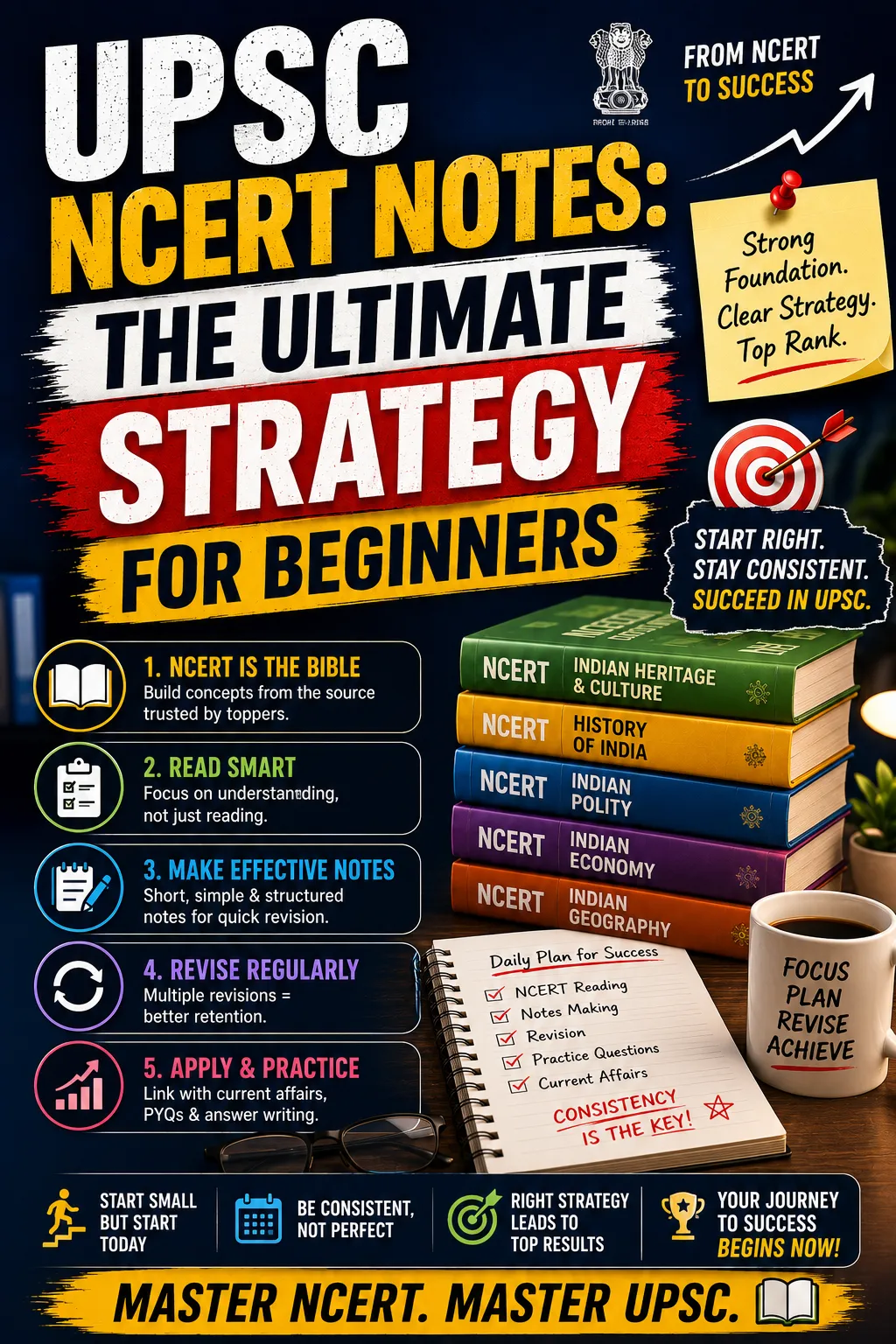
- Making Notes on the First Reading: This is a guaranteed way to copy the whole book. Your first reading should be purely for understanding the plot. Only on the second or third reading do you understand what is actually unique and worth writing down.
- Ignoring the Maps and Diagrams: The small maps showing Ashokan inscription sites or mineral distributions in India are goldmines for Prelims. Do not skip them; copy them roughly into your personal files.
- Treating NCERTs as the Final Word: NCERTs build the skeleton. You still need to add the muscle using standard reference books (like Laxmikanth for Polity or Spectrums for Modern History) and current affairs. Your notes should leave margins wide enough to add these extra points later.
How to Structure a High-Yield Page
To make your notes scannable, structure them visually. Avoid running prose. A high-yield note page for a topic like "Monsoon in India" should look something like this:
- The Mechanism: Core drivers (ITCZ movement, heating of the Tibetan plateau, Jet streams).
- Visual Map: A quick 10-second hand-drawn outline of India showing the Southwest and Northeast monsoon routes.
- Impact Factors: El Niño vs. La Niña variations (summarized in a simple table or flow chart).
- Mains Link: How monsoon variability directly affects Indian food security and the rural banking sector.
Frequently Asked Questions
Which NCERT books are absolutely essential for GS1?
For History, focus on the New NCERTs (Class 6 to 12) and the Class 12 Themes in Indian History (Parts I, II, and III). For Geography, the Class 11 Fundamentals of Physical Geography and India: Physical Environment are non-negotiable. For Society, read the Class 11 and 12 Sociology textbooks to understand structural changes in Indian culture.
Can I rely entirely on a pre-made ncert notes pdf for upsc?
While a high-quality pre-made note can save you time initially, it cannot replace personal processing. Use pre-made summaries to cross-check if you missed anything important, or use them as a quick revision tool, but ensure you active-recall the concepts yourself.
How do I compress Class 6 to 10 NCERTs efficiently?
Most concepts in Class 6 to 10 are repeated and expanded upon in Class 11 and 12. If you find a topic like "Layers of the Earth" in Class 7, skip making extensive notes there. Instead, wait until you open the Class 11 Physical Geography book, which covers the exact same topic with the depth required for the exam.
Where can I find a reliable ncert notes for upsc pdf free download for my revision?
Many educational platforms provide free summaries of foundational texts. When searching for an ncert notes for upsc pdf free download, look for compilations that categorize chapters by the official syllabus topics rather than just listing them chronologically by class.
How often should I revise my foundational notes?
You should review them at least once before you move on to standard reference textbooks, and then integrate them entirely into your weekly revision cycle. By the time Prelims approaches, you should be able to flip through your entire geography or history summary bundle in just a few hours.
Grounded Final Thoughts
Note-making is an active process of reduction, not collection. The goal isn’t to build a beautiful, flawless archive of everything that has ever happened in human history; the goal is to build a highly functional tool that allows you to recall facts under pressure and structure an analytical argument in less than seven minutes. Focus on patterns, terms, and structural causes. Keep your paragraphs brief, your diagrams clear, and let your notes be a reflection of your own understanding rather than a mirror image of the textbook.





























Sign in to leave a comment.