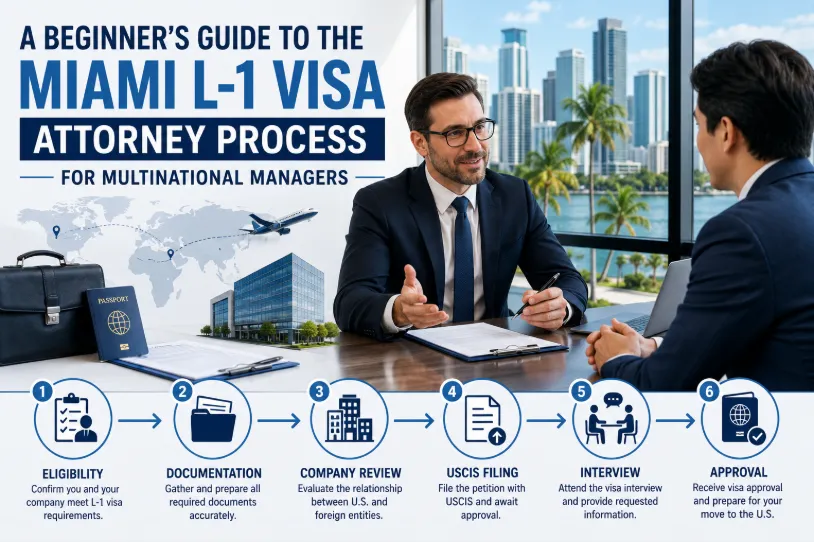

A regional manager at a manufacturing company in São Paulo gets an unexpected assignment. Her company wants to open a small U.S. office in Miami, and she is asked to lead the launch. She has never touched U.S. immigration law, and the term "L-1 visa" means nothing to her yet.
Within a week, she is searching for a Miami L-1 visa attorney just to understand what the move actually requires. Her situation is common. Every year, thousands of managers, executives, and specialized employees are pulled into the L-1 visa process, not out of curiosity, but out of sudden professional necessity.
This guide walks through what beginners should know before that search even starts.
The Real Challenge Behind the Scenario
The manager's real problem is not paperwork. It is proving that her role in Brazil and her planned role in Miami both meet a specific legal definition. The L-1 visa category lets multinational companies transfer executives, managers, or employees with specialized knowledge to a U.S. office, branch, subsidiary, or affiliate. That sounds straightforward, but the details create real friction for first-time applicants.
Companies must show a qualifying relationship between the foreign entity and the U.S. entity. The transferring employee must have worked abroad for the organization for at least one continuous year within the past three years. New U.S. offices face extra scrutiny, since officers want evidence the office can actually support an executive or managerial position within a reasonable period, not just a lease and a business card.
What the Data Shows About L-1 Visa Usage
Government data shows the L-1 category remains active and generally favorable toward well-prepared petitions. Combined L-1A and L-1B approval rates rose to more than 92 percent in the first half of fiscal year 2025, up from roughly 90 percent a year earlier, according to petition data tracked through USCIS's Immigration and Citizenship Data portal. Filing volume grew alongside that improvement.
L-1B petitions for specialized knowledge employees increased by nearly 28 percent between the first half of 2024 and the same period in 2025, based on the same USCIS reporting, suggesting employers are leaning on this category more, not less, even as global hiring rules tighten.
Country-level figures from the U.S. Department of State show where much of that demand originates. Indian nationals received roughly 18,500 L-1 visas in fiscal year 2024, more than a quarter of all L-category visas issued that year, according to the Department of State's Report of the Visa Office. China ranked a distant second.
Together, these numbers point to a visa category that large multinational employers already use routinely, even though it still feels unfamiliar to the individual employee experiencing it for the first time.
Practical Considerations Before Filing
For most first-time applicants, delays trace back to weak documentation rather than a flawed transfer strategy. A few habits make the biggest difference:
- Confirm the corporate relationship early. Organizational charts, ownership records, and financial statements should clearly connect the foreign company to its U.S. counterpart before any petition gets drafted.
- Keep the manager argument and the specialized knowledge argument separate. L-1A and L-1B rely on different evidence, and blending both arguments in one petition tends to weaken each of them.
Anyone new to this process, including a manager researching a Miami L-1 visa attorney consultation for the first time, benefits from starting evidence collection months before the planned transfer date rather than scrambling after a start date is already set. New offices in particular should have a realistic staffing and revenue plan ready, since that plan often carries as much weight as the employee's own resume.
One Takeaway for Executives, One for Specialized Employees
Executives and managers filing under the L-1A category should focus on organizational authority. Reviewers want to see that the applicant directs the work of other professionals, manages an essential function, or exercises real discretion over department decisions, not simply that the applicant performs technical tasks well. A clear reporting chart and a description of decision-making authority tend to matter more than a long list of job duties.
Specialized employees filing under L-1B should focus on distinctiveness instead. The strongest petitions describe proprietary processes, unique internal tools, or product knowledge that would be difficult to transfer quickly to another worker. The goal is to show why this specific person's knowledge, not general industry experience, is what the U.S. office needs.
The Takeaway
The manager in this scenario eventually learns that the L-1 visa process rewards preparation over improvisation. The legal standard is specific, but it is not mysterious once broken down into its parts: a qualifying corporate relationship, a year of prior employment abroad, and a clearly defined role on the U.S. side.
For beginners facing a similar transfer, the practical path forward is straightforward. Start early, gather organizational and financial documentation before any filing deadline pressure builds, and be honest about whether the role fits the executive, managerial, or specialized knowledge definition before building an argument around it.
Every transfer story looks a little different, but the underlying framework stays consistent. Employees and employers who treat the L-1 category as a structured process, rather than a formality, tend to move through it with far less friction.






























Sign in to leave a comment.