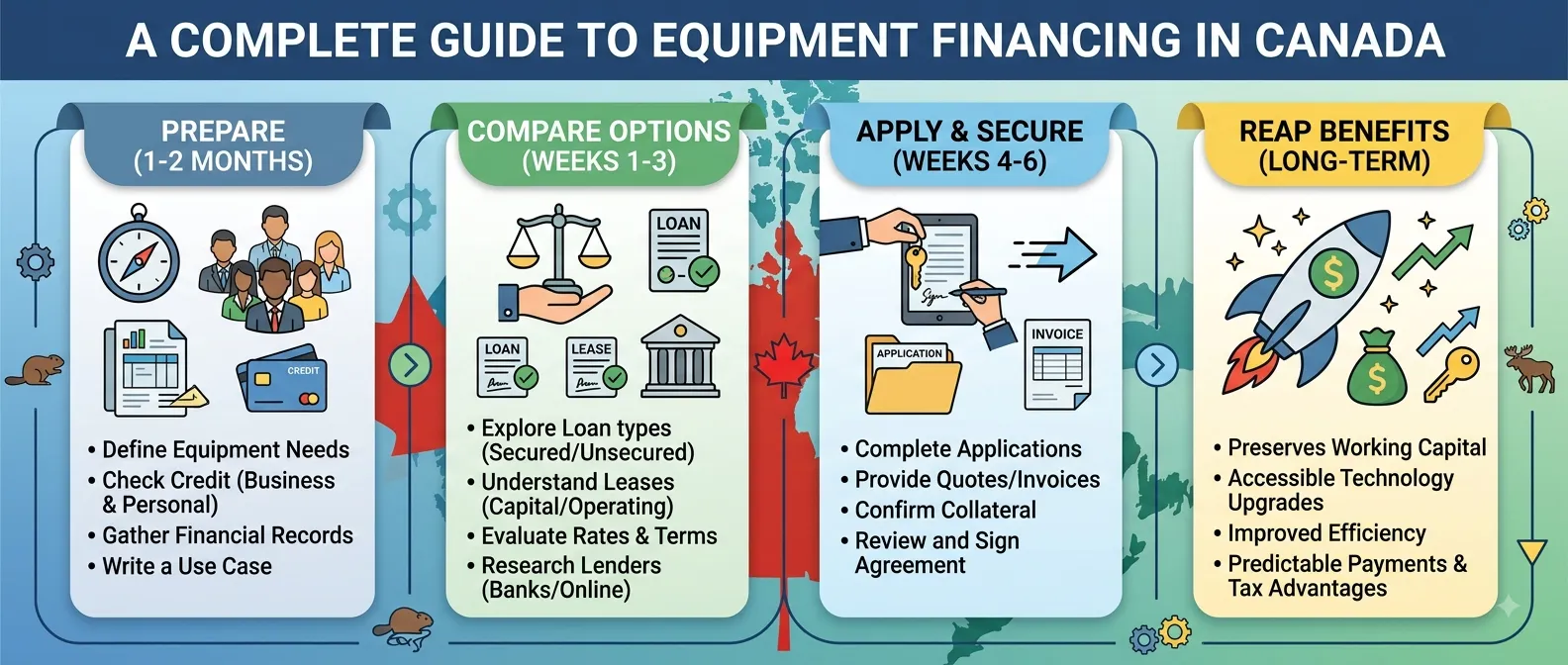

Equipment is one of the largest capital expenditures most small and medium-sized businesses will face, and how you finance it can shape your company's financial flexibility for years. From manufacturing lines and construction machinery to fleet vehicles and specialized technology, few businesses can — or should — pay cash for major equipment purchases. Understanding the landscape of financing options available is the first step toward making a decision that supports growth rather than constraining it.
At its core, equipment financing allows a business to acquire the assets it needs while spreading the cost over time, preserving working capital for day-to-day operations, payroll, and growth initiatives. Instead of tying up a large lump sum in a single purchase, businesses can match payments to the revenue the equipment helps generate. This alignment between cash outflow and cash inflow is one of the primary reasons financing is often smarter than paying outright, even for businesses with strong cash reserves.
Equipment financing Canada generally falls into a few main categories: term loans, capital leases, operating leases, and asset-based lending facilities. A term loan provides funds to purchase the equipment outright, with the asset serving as collateral and the business owning it from day one. A lease, by contrast, allows the business to use the equipment for a set period in exchange for regular payments, with options at the end of the term to purchase, return, or upgrade the asset. Asset-based lending facilities are typically revolving structures that use existing equipment as collateral to support ongoing working capital needs.
Choosing between these structures depends heavily on the nature of the equipment and the business's goals. Fast-depreciating or rapidly evolving equipment — certain types of technology or specialized machinery — often makes more sense to lease, since it avoids being stuck with an obsolete asset. Equipment with a long useful life and stable value, like certain heavy machinery or vehicles, may be better financed through a term loan where ownership builds equity over time. Tax treatment also differs between leases and loans, which is worth reviewing with your accountant before finalizing a structure.
Lenders in this space range widely, from traditional banks to specialized equipment finance companies, asset-based lenders, and private credit providers. Banks often offer the most competitive rates for businesses with strong financials and established banking relationships, but they can also be the slowest and most conservative in terms of approval criteria. Specialized and alternative lenders may move faster and take a more flexible view of collateral and creditworthiness, though often at a higher cost of capital. Understanding where your business fits in this spectrum is key to setting realistic expectations.
The approval process typically involves a review of your financial statements, cash flow history, and the specifics of the equipment being financed — its age, condition, expected useful life, and resale value if used. Businesses with strong, well-organized financials and a clear explanation of how the equipment supports revenue generation tend to move through underwriting more smoothly. This is particularly true for asset-intensive industries like manufacturing, transportation, distribution, and construction, where lenders have well-established frameworks for evaluating collateral.
One factor business owners frequently underestimate is how equipment financing decisions ripple into future borrowing capacity. Taking on financing with restrictive covenants or aggressive amortization schedules can limit flexibility down the road, whether that means securing working capital, pursuing an acquisition, or raising growth capital. Structuring equipment financing with an eye toward your broader capital strategy — not just the immediate purchase — tends to serve businesses better over the long run.
New versus used equipment financing also deserves separate consideration. New equipment typically qualifies for more favorable terms, since lenders have clearer data on expected performance and resale value. Used equipment can still be financed, often at competitive terms if the equipment is well-maintained and from a reputable manufacturer, but expect more conservative advance rates and potentially shorter terms to account for the reduced remaining useful life and less predictable resale value.
Documentation requirements are another practical consideration business owners should prepare for. Lenders will typically request recent financial statements, tax filings, a description of how the equipment will be used, and details on the specific asset being financed, including vendor quotes or purchase agreements. Having this documentation organized and ready before approaching lenders can meaningfully speed up the approval process and demonstrate the kind of preparedness that lenders respond well to.
Given the range of options and the long-term implications of getting the structure wrong, many business owners choose to work with an independent advisor rather than negotiating directly with a single lender. Helm & Harbour Capital provides advice-first equipment and asset-based finance support for Canadian small and medium-sized businesses, helping owners evaluate options across the market and structure financing aligned to their growth objectives. If your business is considering an equipment purchase or upgrade, we welcome a confidential conversation about the options available to you.























Sign in to leave a comment.