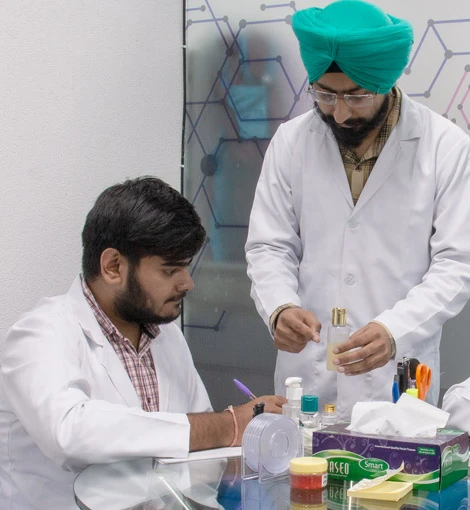

The cosmetic product formulation is the most essential and fascinating aspect for the cosmetic chemist. Consumers generally appreciate the unique product created with a combination of imaginative ideas and cosmetic science. The skin of the customer is in direct contact with cosmetic items. Therefore, if any dangerous chemical is present, it can cause a great deal of harm to humans. Cosmetics laboratories in India make sure instructions are mentioned on the packaging to ensure safety. Also, as per the provisions of the Drugs and Cosmetics Act, third-party manufacturers of cosmetics and cosmetic contract manufacturers in India are obligated to carry out appropriate tests on these items and guarantee their safety. A professional in cosmetic product formulation took care of safety and turned concepts for cosmetic items into working products by using the following six steps:
Step 1: Describe the product.
Your intentions and motivations for developing cosmetic products should be clearly articulated. Determine the vision you want your product to accomplish. Is it a moisturizer, a washing product, a colouring product, or even a combination of things? Consider the form of the cosmetic product as well as the visual qualities like colour, thickness, clarity, etc. Based on these parameters, determine whether you were successful when you were finished. Get a sample so you may examine it in cosmetics laboratories in India.
Step 2: Create a starting formula
The next step is to come up with a solid foundational formula. There are several places to find starting formulas. You can check out some of the best books about cosmetic science. You can also browse online drug guides or You can use formulas from raw materials for this purpose. Patents are yet another helpful resource. Third-party manufacturers of cosmetics should get their products patented.
Step 3: Get your batch ready
Cosmetic Contract Manufacturing and other cosmetic companies must decide how much of their initial formula they need to produce following the creation of a spreadsheet that details the quantities of each ingredient. Then, after the batch is complete, you must provide the specifications that you will test. After that, you'll need to collect all the raw materials and manufacturing tools required to make the batch.
Step 4: Making the batch
Cosmetic product creation is similar to cooking. You weigh or measure your ingredients, combine them according to the technique, and then heat and cool them as needed. You should record all of your observations and thorough notes in your lab notebook during the procedure.
Fifth step: Test your batch
Once your formula is complete, you should test it to determine how well you did. Take the necessary measures, such as pH and viscosity, after allowing the sample to acclimatize to room temperature to determine whether you are within specifications. You should run some performance tests in addition to specification tests to determine how well the product works. Testing in cosmetics laboratories in India is also necessary. You should do a stability test if the formula meets your expectations.
Step 6: Review and Repetition of the Formula
You'll need to make tweaks to see whether the product can be enhanced after you've tested it and identified any areas where it falls short. You can also assign this task to Third-Party Manufacturing Cosmetics. In my experience, knockout trials are the most useful for determining how each element affects the final mixture. Knowing the functions of the ingredients can help you decide which ones to add or
decrease to improve your formula.
Key Takeaway
Cosmetic product formulation is both a science and an art. With years of experience, Dermasist Innovation Lab creates useful cosmetic product formulations by taking special care of your safety. They establish a personalized style and, ideally, create good product formulations that are genuinely one-of-a-kind. They always prefer to use an ingredient at a percentage that has a unique impact on a formula.














Sign in to leave a comment.