
Introduction
Let’s face it—traditional SEO just doesn’t cut it anymore. In 2025, if your SEO strategy begins and ends with Google, you’re practically invisible to half your audience. People are searching everywhere—from YouTube shorts to Amazon reviews, Instagram Reels, AI chatbots like ChatGPT, and even their smart fridges (okay, almost). The way people search has evolved, and it's time your SEO strategy catches up.
Ignoring this shift is like refusing to upgrade your Nokia in the era of iPhones. If you're not visible on every channel your audience uses, you're leaving serious traffic (and money) on the table. But here’s the good news—if you adapt now, you're miles ahead of your competition.
This guide breaks down how modern businesses and agencies can dominate the search game using Search Everywhere Optimisation (SEvO). It’s the next-level strategy your brand needs to survive and thrive in a fragmented, AI-driven digital world. You'll learn what SEvO is, how to nail platform-specific strategies, and how to build authority that even AI can't ignore.
Stick with us, and you'll walk away with a clear, actionable roadmap. Ready to future-proof your SEO?
The Evolution from SEO to Search Everywhere Optimisation (SEvO)
Remember the good old days when you could sprinkle a few keywords, get some backlinks, and boom—page 1 of Google? Yeah, those days are toast.
Today, search is happening everywhere. We’re talking:
- Google and Bing
- YouTube and TikTok
- Instagram and Pinterest
- Amazon and app stores
- ChatGPT, Gemini, and other AI tools
- Reddit, Quora, and niche forums
- Voice assistants like Alexa and Siri
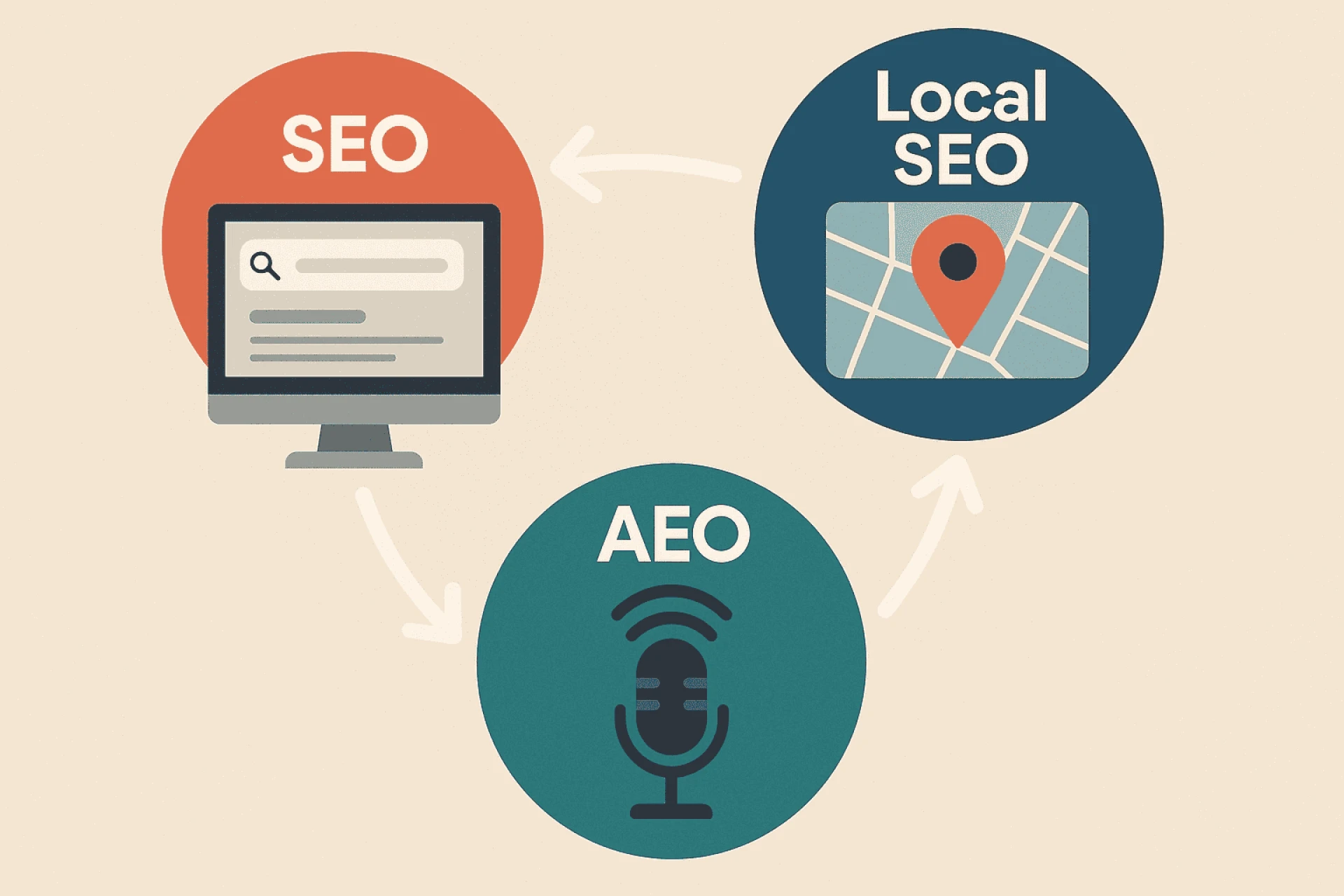
This isn’t your mom’s SEO strategy—it’s Search Everywhere Optimisation, aka SEvO. It’s all about building multi-platform brand visibility. You're no longer just optimising a blog for Google. You're shaping your content to fit TikTok’s algorithm, structuring data for voice assistant answer formatting, and feeding ChatGPT what it needs for Answer Engine Optimisation (AEO).
For the best SEO company in Kolkata, keeping clients visible across all these channels isn’t optional—it’s the standard. And if you’re serious about winning in 2025, SEvO isn’t just a trend—it’s survival.
Search Landscape Diversity: Mapping Discovery Channels Beyond Google
Here’s the truth: people now start their search on whatever platform they’re on. That means search journeys might begin on TikTok, Instagram, Amazon, or even a chatbot. Google is only a single component.
Let’s break it down:
- Traditional Search Engines – Google, Bing
- Video Platforms – YouTube, TikTok
- Social Search – Instagram, Pinterest, Twitter (X)
- Marketplaces – Amazon, Flipkart, Etsy, app stores
- AI Tools – ChatGPT, Gemini, Copilot
- Community Spaces – Reddit, Quora, Stack Overflow
- Voice Assistants – Alexa, Siri, Google Assistant
Each channel has its search algorithm and user intent behaviour. So if you're optimising the same way across all platforms, you're not optimising at all.
This is where the pros stand out. Top-tier omni‑channel SEO agencies run platform audits—figuring out where your audience hangs out and how they search there. Then, they tailor the content, keywords, and formats accordingly. That's SEvO's strategy for agencies done right.
Platform-Specific Optimisation Strategies
Okay, time to get technical (but not boring). Here’s how different platforms require different SEO tactics:
- YouTube & TikTok
- Optimise video titles, thumbnails, and hashtags
- Add transcripts and time-stamped descriptions
- Use relevant schema markup SEO services for videos
- Amazon & App Stores
- Focus on product titles, bullet points, and keyword-rich descriptions
- Nail the review game
- Implement App Store Optimisation (ASO) techniques
- AI Chatbots (like ChatGPT)
- Use structured Q&A content
- Embed semantic entities with JSON-LD
- Guide AI bots using the llms.txt AI crawler guidance files
- Instagram & Pinterest
- Prioritise visual storytelling and alt-text SEO
- Leverage contextual authority optimisation
Tag relevant trends for social search optimisation
- Voice Assistants
- Write concise, clear answers
- Include the FAQ schema for snippet optimisation
- Adapt content for voice assistant answer formatting
A top agency will repurpose content intelligently across all these platforms—what we call platform‑specific content repurposing.
Answer Engine Optimization (AEO) With Generative Engine Optimization (GEO)
Let’s get nerdy (in a good way). AEO is about getting your content pulled into instant answers by AI engines, like ChatGPT, SGE, or Bing Chat. Think of it as trying to land your answer inside the chatbot, not just on a webpage.
GEO, on the other hand, is about ensuring that generative AI citation tracking systems include your brand when they spit out recommendations.
To win here:
- Write conversational content with direct Q&A
- Use schema markup (especially FAQ, HowTo, and Article types)
- Create an llms.txt file to help AI crawl and understand your site
- Track brand mentions in AI engines and train your content to align with entity clustering for authority.
This isn't optional anymore. If you want to dominate the AI service in Kolkata space, your content has to talk to machines—and be so good they talk about you.
Technical Foundation: Schema, Metadata, and Crawl Control
This is the backend stuff that separates amateurs from pros.
- Implement structured data (JSON-LD) for everything—FAQs, products, videos, reviews, events, local info
- To direct AI crawlers and limit access when required, create and maintain a llms.txt file.
- Prioritise site speed, mobile UX, and clean code (because AI doesn’t like mess)
- Make sure assets like images, PDFs, and videos are multimodal search engine optimisation ready
If you're serious about winning across platforms, the technical base must be flawless. If you have loose bolts and no engine, you won't win the race. It's like tuning a racing car.
Content Architecture: Semantic Clustering & Authority Building
Keywords are dead. Okay, not dead dead, but if you're just shoving in phrases like "Best SEO Company in Kolkata," you're playing checkers while others play chess.
The smart move now? Semantic clustering.
Build content clusters that group:
- Blog posts
- Videos
- FAQs
- Social posts
…all around a topic or entity, not just a keyword. It’s how you build contextual authority that AI engines recognise.
Use internal linking, consistent author bios, multiplatform cross-referencing, and expert commentary. You want AI tools to say, “Oh yeah, this brand knows its stuff.”
Metrics & Measurement for SEvO Success
Forget old-school vanity metrics. SEvO needs smarter KPIs. Here’s what to track:
- Citations in AI-generated answers
- Visibility in social search
- Voice assistant appearance
- Engagement metrics on TikTok, YouTube Shorts
- Rankings in app stores
Advanced agencies now use AI SEO metrics dashboards that combine all of these. The goal? Tie visibility back to leads and revenue, not just pageviews.
Workflow Integration: From SEO to SEvO-Driven Services
Building an SEvO agency isn’t just about learning new tactics—it’s about integrating them into your workflow.
That means:
- Running platform-specific audits for every client
- Repurposing every blog into short-form videos, Q&As, and infographics
- Cross-training SEO, social media, and content teams
- Automating multi-platform publishing
For a top-tier SEO firm, SEvO becomes a full-stack service—from strategy to execution.
Challenges & Risks: Algorithm Changes and Resource Allocation
Let’s be real. Optimising for 30+ platforms sounds insane, and it kind of is. You’ll deal with:
- Constant AI model updates
- Algorithm mood swings (TikTok is a drama queen)
- Burnout from over-optimisation
- Fragmented brand voice
How do pros handle it?
- Use the 70/20/10 rule: 70% focus on high-impact platforms, 20% on emerging, 10% on experimental
- Maintain a unified content governance system
- Implement version control and platform-specific test cycles
It’s not easy, but with the right system, it’s scalable.
Final Notes: Elevating SEO to Omnichannel Brand Optimisation
Here’s the bottom line: in 2025, Search Everywhere Optimisation isn’t just a buzzword—it’s how smart brands stay relevant.
It’s not about chasing Google rankings. It’s about omnichannel discoverability—being everywhere your audience searches, scrolls, and speaks.
Whether it’s an AI assistant, TikTok scroll, or chatbot session, you want to be the first name that pops up. And to do that, you need a strategy that’s structured, scalable, and smart.
Hire an Expert SEO Company for Your Business
You’ve got two options now: try duct-taping your own SEvO system, or partner with a team that already does it like a pro.
Keyline Digitech isn’t just another digital agency. They’re one of the most trusted, long-standing, and forward-thinking names offering SEO services and AI services in Kolkata. From traditional SEO to advanced AI‑powered content discoverability, they’ve got it all.
Whether you're a startup, enterprise, or eCommerce brand, Keyline’s got the expertise, the team, and the tools to make your brand visible everywhere. And we mean everywhere.
So if you're ready to level up, go talk to the experts at Keyline Digitech.
Frequently Asked Questions
1. What is Search Everywhere Optimisation (SEvO)?
SEvO is an evolved form of SEO that optimises content for visibility across all discovery platforms—not just Google. This includes TikTok, YouTube, ChatGPT, app stores, social media, and more.
2. How does SEvO differ from traditional SEO?
Traditional SEO focuses on Google rankings. SEvO, however, adapts strategies to optimise content for each platform’s algorithm, including AI tools and social platforms.
3. Why is AEO important in 2025?
Answer Engine Optimisation (AEO) ensures your content appears in AI-generated responses, like ChatGPT or Google SGE. It is essential to be seen in conversational search settings.
4. What technical tools support SEvO?
Key tools include structured data (schema), llms.txt files, AI SEO dashboards, semantic clustering frameworks, and multimodal optimisation strategies.
5. Can small businesses benefit from SEvO?
Absolutely. SEvO levels the playing field by letting small brands become visible across platforms where big brands may not have optimised yet.









Sign in to leave a comment.