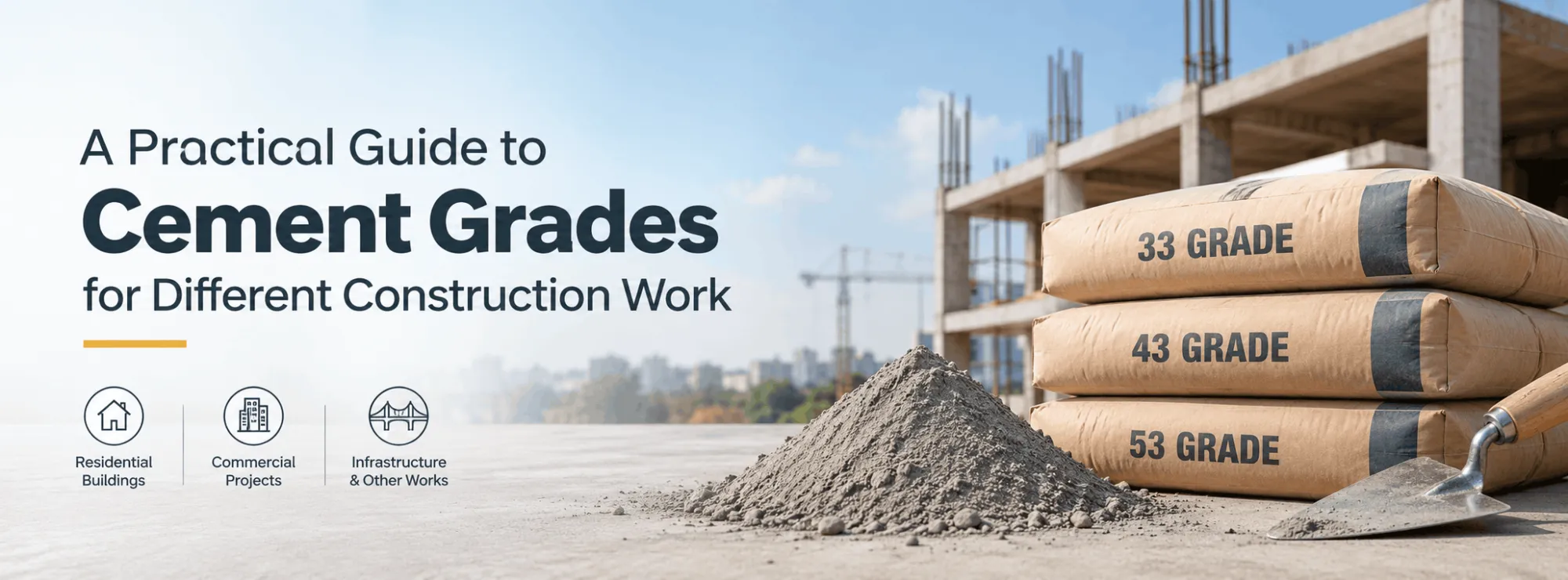

Choosing cement for a construction project can seem simple until you actually start comparing the different grades available. You may come across 33, 43 and 53 grade cement and wonder which one is suitable for a foundation, slab, column or other part of a building.
The important thing to remember is that cement grades for construction are not simply about choosing the highest number. Different construction jobs have different requirements. A foundation has to deal with the weight of the entire building, while a slab has to handle its own load along with furniture, people and other loads placed on it.
Understanding what the different grades mean can make the selection process much easier and help you make a more informed construction decision.
What Do Cement Grades Actually Mean?
The number given to a cement grade tells you about its characteristic compressive strength after 28 days under standard testing conditions. This strength is measured in MPa, or megapascals.
For example, 43 grade cement is designed to achieve a characteristic strength of 43 MPa after 28 days. Similarly, 53 grade cement is designed to achieve 53 MPa under the specified test conditions.
33, 43 and 53 Grade Cement
Here is a simple way to understand the commonly discussed OPC grades:
| Cement Grade | Strength at 28 Days | Typical Applications |
|---|---|---|
| 33 Grade | 33 MPa | General applications where permitted |
| 43 Grade | 43 MPa | General building and concrete work |
| 53 Grade | 53 MPa | Higher-strength concrete and structural work |
This is why knowing about cement grades and their uses is more useful than simply looking for the highest strength number. The right choice depends on the type of construction, the required concrete strength and the specifications of the project.
Choosing Cement Grades for Different Construction Work
Every part of a building has a different job to do. Naturally, the cement and concrete used for those parts may also have different requirements.
Cement Grade for Foundation
The foundation is one of the most important parts of a building because it transfers the building's load safely into the ground. It can also be exposed to moisture, groundwater and different soil conditions.
The right cement grade for foundation work depends on factors such as the soil, environmental exposure, structural design and concrete mix specified for the project.
For an RCC foundation, it is better to follow the structural design rather than simply choosing cement based on its grade or price. The cement needs to work as part of the complete concrete mix.
Cement Grade for RCC Construction
RCC, or reinforced cement concrete, is commonly used for structural elements such as columns, beams, slabs and foundations. It combines concrete with steel reinforcement to provide the required strength. The cement grade for RCC construction should be selected according to the concrete strength and structural requirements specified for the project.
Cement Grade for Slab
A slab may look straightforward, but it has an important job. It needs to support its own weight as well as the loads placed on it. So, choosing the correct cement grade for slab
Therefore, choosing the correct cement grade for slab construction should be based on the structural design and required concrete strength.
43 or 53 grade cement may be considered for different RCC slab applications, depending on the project requirements. The final selection should follow the specifications given by the structural engineer and the relevant Indian Standards.
Cement Grade for Residential Construction
Cement is used throughout a house, from the foundation and columns to the roof slab, masonry, plastering and flooring.
This means the cement grade for residential construction should not necessarily be the same for every application.
Structural concrete may have specific strength requirements, while plastering or other non-structural work may have different needs. Looking at each application separately can help avoid unnecessary choices and expenses.
How to Select the Right Cement Grade
Knowing the types of cement grades is useful, but selecting one for a real project requires looking beyond the number printed on the bag.
Start With the Structural Requirement
The first thing to check is the construction plan. Structural drawings and project specifications generally mention the required concrete strength and material requirements.
These specifications should take priority over general advice because the right cement depends on how the structure has been designed.
Consider the Site Conditions
Construction does not happen in the same conditions everywhere. Some sites may have high moisture, groundwater, coastal exposure or other environmental factors that can affect the durability of concrete. In such cases, the type of cement may be just as important as its strength grade.
Think About How the Cement Will Be Used
The way cement is being used also matters. Concrete for a structural element has different requirements from cement used for plastering or other finishing work.
The cement should provide the required strength while also being suitable for the work being carried out.
Do Not Overlook Curing
Choosing the right cement is only part of the job. Once concrete has been placed, proper curing is essential for it to develop its intended strength. If concrete is not given enough moisture during the curing period, its performance can suffer even when good-quality cement and the correct grade have been used.
A Simple Way to Think About Cement Grades
Instead of asking, “Which is the strongest cement?”, it is better to ask, “Which cement is suitable for this particular job?”
A foundation needs to safely transfer the building's load to the ground. A column needs to support structural loads. A slab needs to carry loads placed on it. Plastering, masonry and flooring have their own requirements.
This way of looking at cement grades for building construction makes the selection process much clearer. It also helps avoid the common assumption that the highest grade is always the best option.
Conclusion
Choosing cement is not simply about picking the biggest number available. Once you understand the basics of cement grades for construction, it becomes much easier to understand why different grades are used for different jobs. Whether it is a cement grade for foundation, cement grade for slab or cement grade for RCC construction, the project design and applicable standards should always guide the final decision.
And remember, cement grade is only one part of good construction. Proper mixing, the right proportions, quality materials, careful placement and adequate curing all have an important role in creating a strong and durable structure.



















Sign in to leave a comment.