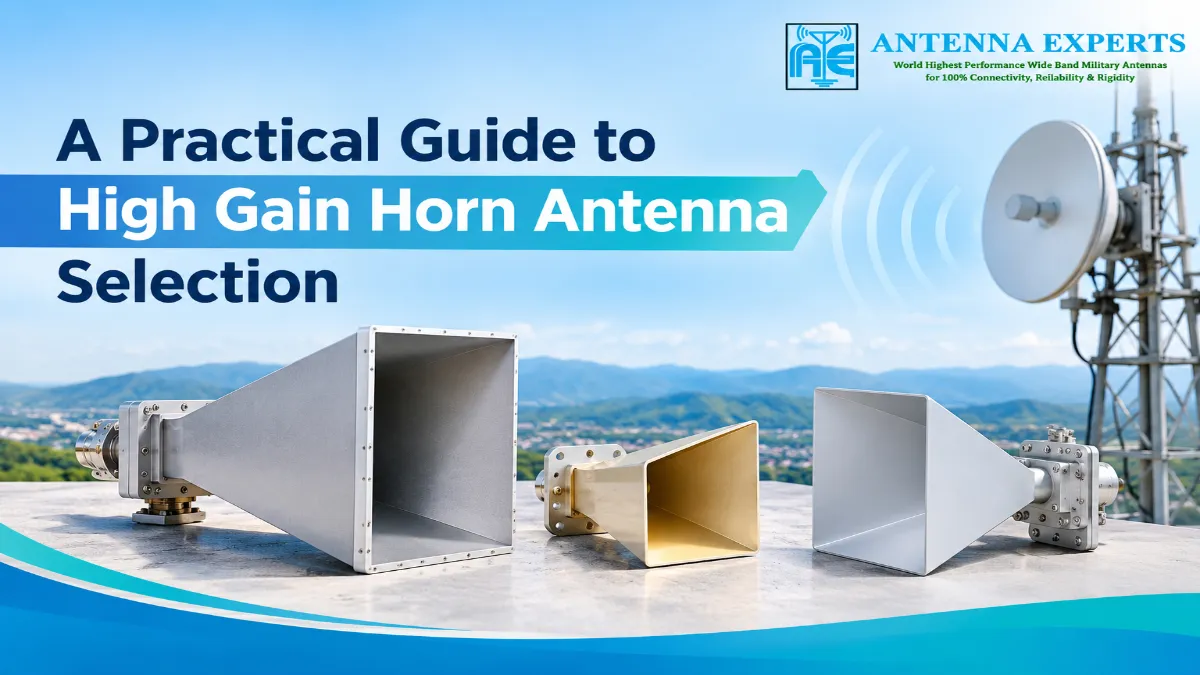

A high gain horn antenna is not automatically the right antenna just because it has the highest gain number on the datasheet. Frequency coverage, beamwidth, polarisation, power handling and the test or monitoring setup will all decide whether a horn antenna actually works for your application. Pick on gain alone and you can end up with an antenna that is too directional for your test distance, or one that cannot handle the connector or mounting you already have in place.
This guide walks through the factors that matter, in the order an RF or EMC engineer would actually check them, so you can shortlist the right horn antenna instead of the biggest one.
What Is a High Gain Horn Antenna?
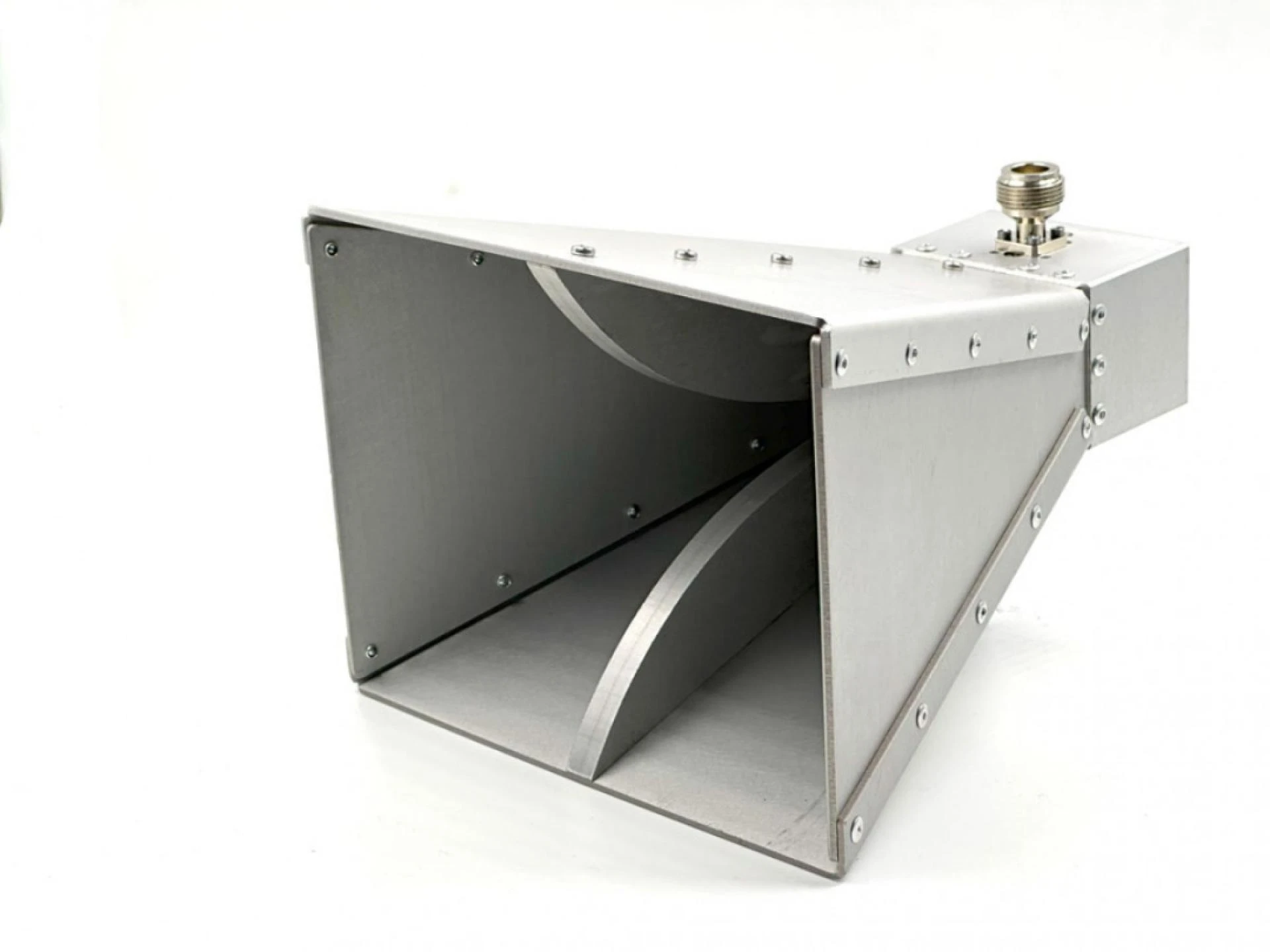
A horn antenna is a flared metal waveguide that channels radio waves into a focused beam. The flare, pyramidal, conical or sectoral, gradually widens the waveguide opening (the aperture) so energy leaves the antenna in a narrow, predictable pattern instead of spreading in every direction.
Horn antennas are common at microwave and UHF Antenna frequencies because they are simple to build, mechanically rugged and easy to calibrate. Three properties explain most of their use:
Key Factors in High Gain Horn Antenna Selection
- Frequency Range
The antenna should have all the frequencies needed for the application, with margin at both ends. A horn rated from 1 GHz to 18 GHz will not work well at the band edges so if your test plan goes to 18 GHz, a horn specified to 20 GHz provides cleaner data. Standard gain (pyramidal) horns typically cover about 1 GHz to 40 GHz depending upon the model. Broadband double-ridge horns extend usefully down to about 170-200 MHz. Check the actual band vs. what the manufacturer’s calibration data shows it should be, not a general industry range.
2. Antenna Gain
The gain you need depends on the test distance and the field strength or signal level you need to generate or detect. A radiated immunity test which requires a high field strength at a given distance requires more gain than a general spectrum survey where sensitivity over a large area is more important than peak signal. The application asks for a certain field strength or link budget . Ask for that and then give a gain figure .
3. Horn Antenna Beamwidth
Beamwidth narrows as gain increases. A high gain horn Antenna concentrates energy in a tight beam, which is useful for pointing at a single device or a known bearing, but means the antenna and the target must stay aligned. For EMC chambers with fixed test distances, check that the horn's beamwidth actually illuminates the full equipment-under-test volume at that distance; a beam too narrow leaves parts of a large device under-tested.
4. Polarisation
Horn antennas are available as single polarised (vertical or horizontal only) or as a dual polarised horn antenna, which transmits and receives on two orthogonal polarisations through separate ports.
- Single polarisation suits applications where the signal orientation is known or fixed, and keeps the antenna and feed simpler.
- Dual polarisation suits spectrum monitoring, interference investigation and any test where the incoming signal's polarisation is unknown or variable, you measure both planes without physically rotating the antenna.
5. VSWR and Impedance
VSWR (voltage standing wave ratio) describes how well the antenna's impedance matches the 50-ohm feed line across its band. A 2.0:1 VSWR or tighter will usually get the job done commercial antennas often carry stricter specs, closer to 1.5:1 across the band of use
6. Power Handling
Radiated immunity work pushing high field strengths at distance, the antenna needs to be rated for the driving amp's power, with margin built in. Check continuous and peak ratings both, and make sure the connector and internals can take it too the horn's only as good as the weakest link in the chain.
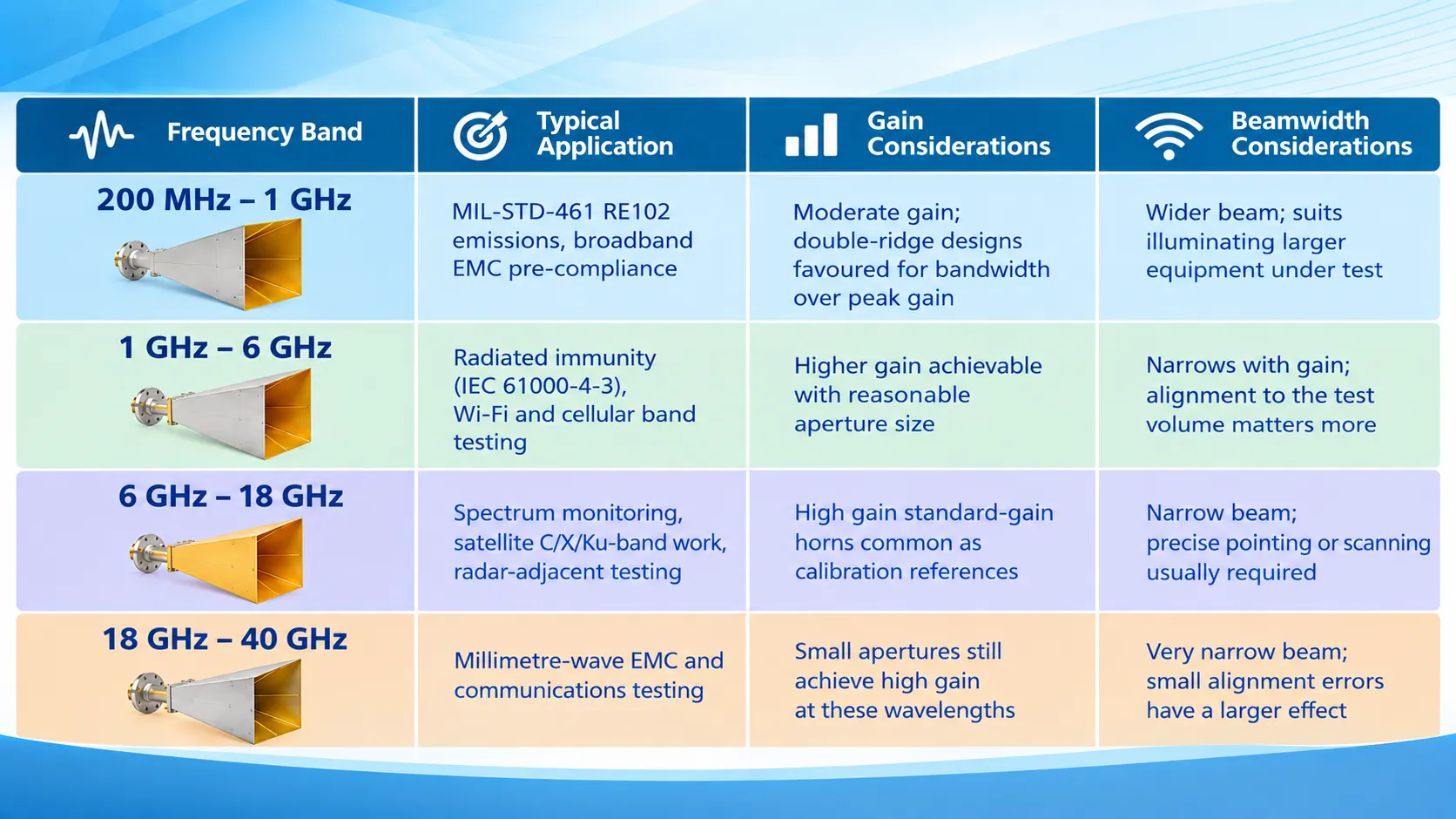
Horn Antenna Gain and Frequency Chart
Exact gain and beamwidth depend on the specific horn design so treat the figures below as general guidance rather than a specification for any one model.
How to Choose a Horn Antenna Manufacturer in India
A horn antenna manufacturer in India should be evaluated on more than price. Check the following before shortlisting:
● In-house manufacturing capability, including welding, machining and finishing, rather than outsourced assembly of bought in parts.
● Test and calibration facilities, ideally including an open area test site or anechoic chamber for gain and pattern verification.
● Quality systems and certification — ISO 9001 for quality management is the baseline sector-specific certifications matter for defence and aerospace buyers.
● Documentation, including datasheets, test reports and compliance declarations that can be verified independently.
● Export and logistics experience, particularly for buyers outside India who need customs and shipping handled correctly.
● After-sales technical support for calibration, repair and application questions.
Why Antenna Experts
Antenna Experts designs and manufactures RF antennas, including horn antennas, in India, with products developed, produced and tested in-house. The company holds ISO 9001:2015 (quality management), ISO 14001:2015 (environmental management) and ISO 18001:2015 (occupational safety) certification, and is a NATO NCAGE code holder, which is relevant for buyers in defence and government procurement. Its antenna systems are manufactured to comply with MIL-STD-810G environmental testing requirements, and with RoHS, REACH and WEEE compliance for the EU market.
Antenna Experts also manufactures a broader catalogue of RF antennas, including the dual polarized log periodic antenna range for applications that need wideband dipole-array performance alongside or instead of a horn. Buyers evaluating the company as a horn antenna manufacturer in India can review its certifications and manufacturing background directly, and readers who want to work through the underlying maths themselves can refer to the company's antenna gain formulas reference.
FAQs
What frequency range does a high-gain horn antenna cover?
It really depends on the design. Broadband double-ridge horns generally span somewhere around 170 MHz up to 40 GHz depending on the model, while standard-gain pyramidal horns typically cover roughly 1 GHz to 40 GHz.
What gain range counts as "high gain" for a horn antenna?
There's no set industry cutoff. In practice, a horn gets called "high gain" when its aperture is large compared to the wavelength it operates at, which gives it a narrower beam and more directivity than a standard-gain horn at that same frequency.
Can a horn antenna be built for a custom frequency band?
Yes, within the physical limits of horn design. A manufacturer with in-house design and test capability can build to a non-standard band, aperture size or connector interface, though lead time and cost typically increase with the degree of customisation.



















Sign in to leave a comment.