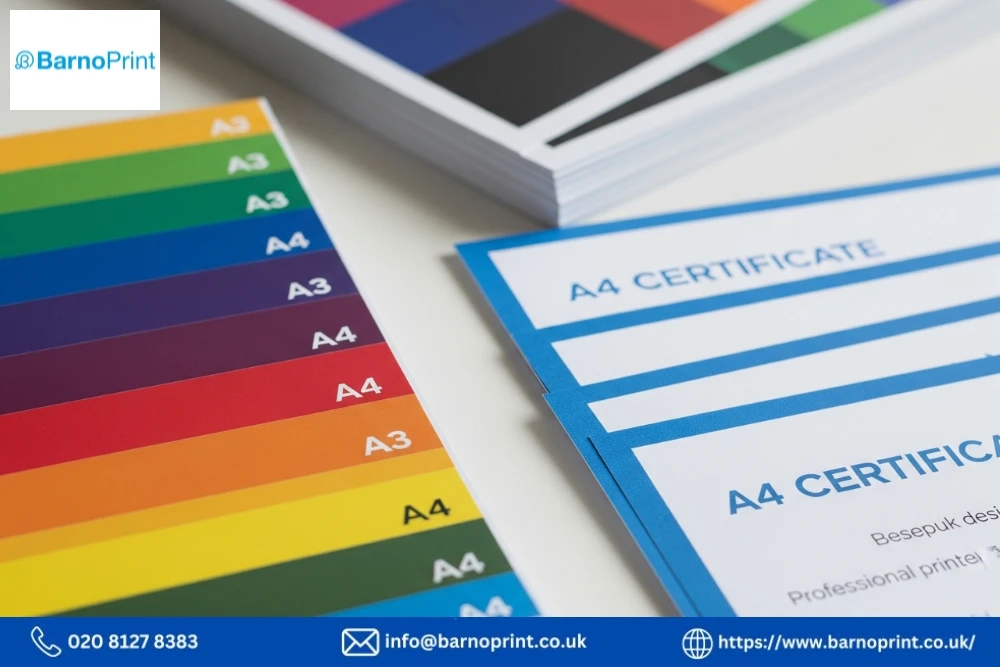
A4 and A3 colour printing are essential services for businesses, designers, and offices across the UK. These formats support everything from professional reports to promotional posters. Choosing the right size, paper stock, printing technology, and finishing options ensures your materials make the right impression. This guide explains the differences, practical applications, and best practices for both formats. It also provides insights on cost, turnaround times, and quality considerations.
What Is A4 & A3 Colour Printing?
Colour printing reproduces full-colour designs using cyan, magenta, yellow, and black (CMYK) inks. This process ensures vibrant, accurate results for text, graphics, and images.
What does A4 mean in colour printing?
A4 measures 210 × 297 millimetres. It is the most common paper size used in the UK. Businesses rely on A4 for:
- Reports and letters: Easy to file and distribute.
- Marketing leaflets and flyers: Cost-effective and suitable for mailing.
- Internal documentation: Staff manuals and forms benefit from consistent sizing.
The size is economical, widely supported, and suitable for high volume colour printing.
What does A3 mean in colour printing?
A3 measures 297 × 420 millimetres, offering double the area of A4. Its larger format makes it ideal for:
- Posters and signage: Visible from a distance and attention-grabbing.
- Architectural or engineering drawings: Greater detail and clarity.
- Presentation spreads: Effective for showcasing designs or infographics.
A3 prints require more resources but provide higher visual impact where size matters.

Why Choose Colour Printing Over Monochrome?
Colour printing improves readability, engagement, and retention. It is particularly effective for:
- Brand consistency: Ensures logos and corporate colours appear accurate.
- Professional appearance: Full-colour documents signal attention to detail.
- Visual impact: Colour draws the reader’s eye to key information.
Studies indicate that readers retain information from colour documents more effectively than black-and-white versions, making it a valuable tool for marketing and communication.
A4 vs A3 Colour Printing – What’s the Difference?
The decision between A4 and A3 depends on purpose, budget, and visual requirements.
Size and format considerations
- ISO 216 standard: Defines A-series paper sizes. A3 is exactly twice the size of A4, allowing scalable designs without distortion.
- Bleed and safe margins: Maintain at least 3 millimetres around edges to prevent cropping.
- Scalability: A3 folded once becomes A4, simplifying document handling for combined projects.
Cost implications for colour printing
- Material usage: A3 consumes more paper and ink than A4, resulting in higher unit costs.
- Volume discounts: Bulk printing reduces the per-page cost for both A4 and A3.
- Equipment requirements: A3 requires compatible printers, slightly increasing setup costs.
Use-case suitability
- A4: Ideal for internal documents, handouts, and standard marketing materials.
- A3: Suited to posters, large diagrams, or visual presentations where detail and visibility are crucial.
- Combination: Marketing packs may use A4 brochures with A3 inserts to balance cost and impact.
Printing Technology & Quality – Making Your Colour Print Shine
Digital vs offset vs inkjet vs laser colour printing
- Digital printing: Best for short runs; delivers fast turnaround and consistent colour.
- Offset printing: Cost-effective for large volumes; produces precise, high-quality prints.
- Inkjet printing: Excellent for photographic or gradient-heavy images; offers high detail.
- Laser printing: Ideal for documents requiring crisp text and solid colour fills.
Printer/MFP capabilities for A3 & A4
- Multifunction printers (MFPs): Handle both sizes, duplex printing, and network connectivity.
- Paper handling: Support media weights up to 350 gsm.
- Resolution: Print resolutions exceeding 1200 dpi ensure sharp and consistent output.
Resolution, colour accuracy and proofs
- DPI (dots per inch): Minimum 300 dpi guarantees sharp details.
- Proofing: Confirms colour, layout, and design before full production.
- Colour management: Use CMYK mode and embed fonts to maintain consistency.
Selecting the Right Paper Stock & Finishing Options
Paper stock choices for A4 & A3 colour print jobs
- Lightweight (90–120 gsm): Suitable for internal documents and short-term use.
- Medium weight (130–200 gsm): Ideal for leaflets and brochures.
- Heavyweight (250–350 gsm): Perfect for premium marketing materials, posters, and long-lasting prints.
- Finish options:
- Matt: Smooth, professional appearance with low glare.
- Gloss: Enhances brightness and visual depth.
- Silk: Balanced texture and colour saturation.
Finishing options that elevate colour prints
- Binding: Wire, comb, or saddle-stitch for reports and booklets.
- Lamination: Matt or gloss for protection against wear and moisture.
- Duplex printing: Reduces paper use while producing double-sided documents.
- Hole-punching and trimming: Refines presentation for portfolios, manuals, or marketing packs.
Typical Use-Cases & Applications of A4 & A3 Colour Printing
Business documents, brochures, presentations (A4)
- Reports: Clear layout, readable fonts, and consistent colour branding.
- Brochures and flyers: Compact, cost-effective, and easy to distribute.
- Internal communication: Manuals and training materials that require professional presentation.
Posters, architectural drawings, large-format flyers (A3)
- Event posters: High visibility and impact from a distance.
- Technical drawings: Engineers and architects require A3 for detailed schematics.
- Marketing displays: In-store signage or promotional materials that need to grab attention.
Marketing packs and design spreads (both sizes)
Combining A4 and A3 prints enhances visual communication. Use A4 for text-heavy brochures and A3 for visual inserts or foldouts. This approach maintains clarity while creating a professional, cohesive presentation.
Pricing, Turnaround & Volume Considerations for Colour Printing
Price per page and volume discount models
- A4 vs A3: A4 is cheaper per unit due to lower paper and ink usage.
- Bulk orders: Tiered pricing reduces the cost per page significantly.
- Setup efficiencies: Using templates and pre-approved layouts decreases production time and cost.
Same-day or next-day colour printing services
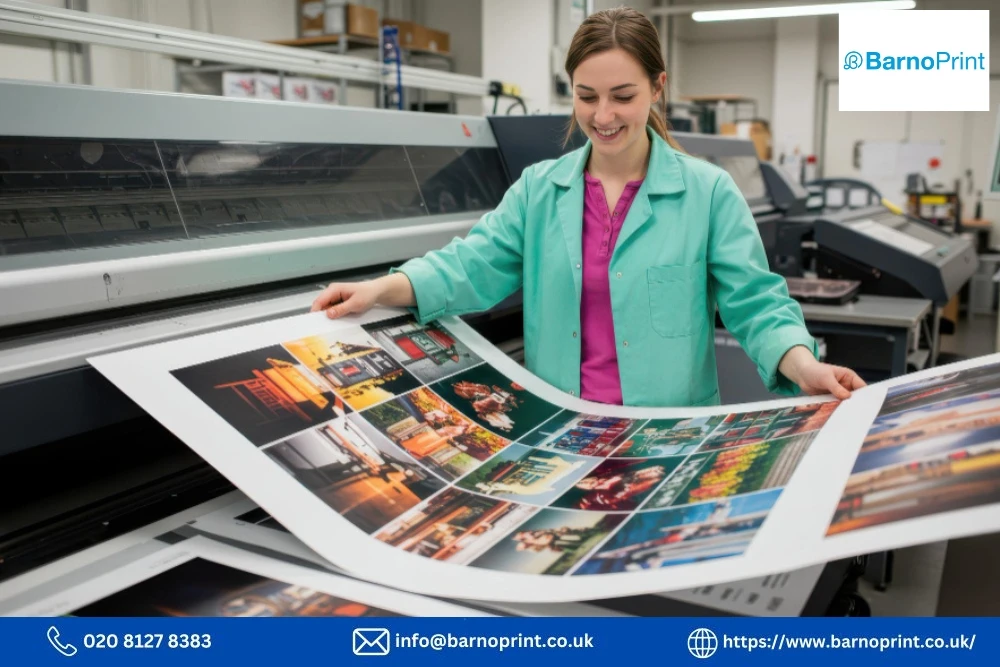
Digital printing enables fast turnaround without compromising quality. Pre-prepared, print-ready PDFs submitted early in the day often receive same-day or next-day service.
How to get an accurate quote
Provide detailed specifications:
- Quantity required
- Paper size (A4 or A3)
- Paper weight and finish
- Single- or double-sided printing
- Colour output
- Finishing requirements such as binding or lamination
Accurate information prevents delays and ensures the final product meets expectations.
Final Thoughts
A4 and A3 colour printing provide professional, high-impact results across multiple industries. A4 is practical for everyday documents, handouts, and standard marketing materials. A3 enhances visibility for posters, technical drawings, and promotional displays. Choosing the correct size, paper stock, and finishing options ensures your prints convey your message effectively. Accurate preparation, combined with professional printing technology, guarantees consistent, high-quality results every time.
Frequently Asked Questions (FAQ) about A4 & A3 Colour Printing
Q: What resolution should I supply for A3 colour print?
A: 300 dpi at full size ensures clarity. Lower resolutions reduce sharpness and image quality.
Q: Can I get a proof before full-run?
A: Yes, proofs allow verification of colour, layout, and design before printing the entire run.
Q: What file formats work best for colour printing?
A: PDF is preferred, with fonts embedded and CMYK colour mode. TIFF and EPS work for image-heavy files.
Q: Can I print A3 without investing in an A3 printer?
A: Yes, professional print providers offer A3 services. Files can be uploaded online or submitted in-store for printing.
Q: How to choose paper finish for colour printing?
A: Select gloss for vibrant images, silk for balance, and matt for readability. Match the finish to the purpose and handling frequency of the document.




















Sign in to leave a comment.