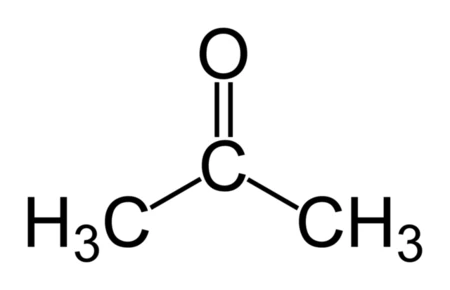

What is Acetone?
Acetone, a colorless and flammable organic solvent, is one of the most common compounds in both industrial and laboratory settings. Its chemical simplicity and effectiveness make it a key player in various industries, from pharmaceuticals to cosmetics. Acetone is also naturally found in the human body, primarily as a byproduct of metabolism.
Common Names: Acetona, Propanone, Dimethyl Ketone
Acetone is also known by several other names, including:
- Propanone (IUPAC name)
- Dimethyl ketone
- Acetona (commonly used in Spanish-speaking regions)
- β-ketopropane
These names may differ, but they all refer to the same chemical compound with the formula C₃H₆O.
Acetone Chemical Formula & Structure
Acetone's formula is C₃H₆O, which reveals its composition:
- 3 carbon atoms
- 6 hydrogen atoms
- 1 oxygen atom
This structure classifies it as the simplest ketone, due to the presence of a carbonyl group (C=O) bonded to two methyl groups.
Molecular Geometry of Acetone
The molecule adopts a trigonal planar geometry around the carbonyl carbon. This shape ensures optimal overlap of orbitals and contributes to the compound's high reactivity and polarity.
Electron Configuration and Bonding
- Carbon: sp² hybridized in the carbonyl group
- Oxygen: holds lone pairs, enabling hydrogen bonding
- The double bond (C=O) creates a site of electrophilicity, crucial for acetone's role in organic reactions.
Acetone Molar Mass and Molecular Weight
Understanding the molar mass of acetone is key in chemistry calculations and formulations.
How to Calculate Acetone’s Molar Mass
Acetone’s molecular formula: C₃H₆O
Breakdown:
- Carbon (C) = 12.01 × 3 = 36.03 g/mol
- Hydrogen (H) = 1.008 × 6 = 6.048 g/mol
- Oxygen (O) = 16.00 × 1 = 16.00 g/mol
- Total Molar Mass = 36.03 + 6.048 + 16.00 = 58.08 g/mol
Acetone Molar Mass in g/mol and amu
- Molar Mass: 58.08 grams/mole
- Molecular Weight: 58.08 atomic mass units (amu) These terms are often used interchangeably, though technically distinct (one per mole, the other per molecule).
Molecular Weight of Acetone vs Molar Mass
Key Differences Explained
- Molecular weight refers to the mass of a single molecule, expressed in atomic mass units (amu).
- Molar mass is the weight of one mole of acetone molecules, expressed in grams per mole (g/mol).
Despite the slight distinction, both values for acetone are 58.08 when rounded.
Importance in Chemical Reactions
Accurate knowledge of molar mass:
- Ensures precise stoichiometry
- Helps in determining reagent quantities
- Plays a role in purity analysis
Physical and Chemical Properties of Acetone
Property Value Molecular Formula C₃H₆O Molar Mass 58.08 g/mol Boiling Point 56.05 °C Melting Point -94.7 °C Density (at 20°C) 0.7845 g/cm³ Solubility in Water Miscible Appearance Colorless liquid Odor Sweet, pungent smell
Solubility and Flammability
- Highly flammable, with a low flash point (~ -20 °C)
- Miscible with water, ethanol, and most organic solvents
Propanone Density: Lab and Industrial Relevance
Density plays a critical role in volume-to-mass conversions.
Measuring and Calculating Propanone Density
- Standard Density: 0.7845 g/cm³
- Varies slightly with temperature
- Used in solvent selection, chemical synthesis, and analytical labs
Acetone in Everyday Use
Despite being a lab staple, acetone is everywhere.
Nail Polish Removers, Paint Thinners, and Cleaners
- Nail polish remover: Most contain over 90% acetone
- Paint thinners & degreasers: Used to dissolve resins and grease
- Glass cleaners: Due to its quick evaporation and lack of residue
Role in Cosmetics and Medical Fields
- Cosmetic sterilizers: Quick-drying surface cleaner
- Medical wipes: Removes adhesives from skin safely
Safety, Storage, and Handling of Acetone
Flammability, Health Hazards, and First Aid
- Store in cool, ventilated areas away from flames
- Avoid inhalation and direct contact with skin/eyes
- First aid includes moving to fresh air and flushing affected areas
Risk Precaution Inhalation Use mask or fume hood Skin contact Use gloves Fire hazard Store away from ignition
Acetone vs Methylene Chloride: Comparison Guide
Chemical Formula and Physical Differences
Property Acetone Methylene Chloride Formula C₃H₆O CH₂Cl₂ Molar Mass 58.08 g/mol 84.93 g/mol Density 0.7845 g/cm³ 1.33 g/cm³ Boiling Point 56.05 °C 39.6 °C
Industrial Applications and Safety Profiles
- Acetone: Safer, less toxic, widely used in personal care
- Methylene Chloride: Powerful solvent but toxic and carcinogenic
Environmental Impact of Acetone and Methylene Chloride
Biodegradability and Air Quality Concerns
- Acetone is readily biodegradable and has low environmental persistence
- Methylene chloride contributes to air pollution and has ozone depletion potential
Proper disposal and usage of both chemicals are crucial for safety and environmental protection.
Acetone in Organic Chemistry and Synthesis
Solvent Role and Reaction Mechanism
- Polar aprotic solvent
- Used in aldol reactions, polymer production, and cleaning reaction vessels
- Ideal for dissolving both polar and non-polar compounds
Lab Use: How Acetone is Used in Scientific Research
- Cleaning glassware due to rapid evaporation
- Used in spectroscopy, tissue sample preparation, and DNA extraction protocols
Its low boiling point and high volatility make it a perfect lab companion.


















Sign in to leave a comment.