

A Gate Barrier System is the first physical decision point at almost every secured site in Oman — the moment a vehicle is either welcomed in or held back. As Muscat, Sohar, Salalah, and Duqm expand their industrial, residential, and free-zone footprints, facility owners are discovering that the barrier at the gate has to do far more than simply lift and lower; it has to identify, authorise, and log every vehicle that passes beneath it.
Oman's entry infrastructure faces a distinctive combination of demands: extreme summer heat that stresses motors and lubricants, coastal humidity that accelerates corrosion, and a rapidly growing mix of gated communities, logistics parks, government compounds, and free-zone facilities that each expect a different balance of speed, security, and durability from their access hardware.
Tektronix designs and deploys gate barrier systems across Oman, Saudi Arabia, and Qatar, matching barrier technology, credential recognition, and climate-rated hardware to each site's real traffic pattern rather than a generic, one-size-fits-all specification. This guide walks through the barrier technologies available, how they fit different site types, and what Oman-specific factors should shape a procurement decision.
Why Oman Facilities Need More Than a Simple Boom Gate
A gate that simply opens and closes on a timer or a button press was adequate for a low-security site a decade ago. Today, insurers, master developers, government tenants, and free-zone authorities across Oman increasingly expect entry infrastructure that can prove who entered, when, and under what authorisation — not just that a barrier arm was present at the gate.
The operational gaps that a basic, unmanaged barrier leaves open include:
- No record of which vehicle or driver passed through a given entry point at a given time
- No way to restrict access by time of day, vehicle category, or destination zone within a larger site
- Manual guard-operated barriers that create bottlenecks during shift changes and peak arrival periods
- No integration between the physical barrier and a facility's broader security or parking management systems
- Hardware not rated for the duty cycle or climate conditions the site actually experiences, leading to premature failure
Closing these gaps starts with treating the barrier as part of a wider vehicle access control solution rather than a standalone mechanical product.
Boom Barrier System: The Core Technology Behind Every Gate
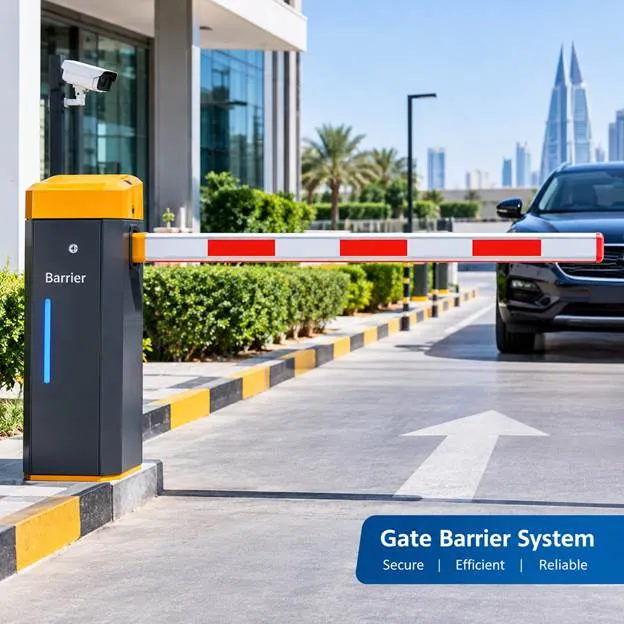
A Boom Barrier System is the mechanical foundation most vehicle entry points in Oman are built around — a counterbalanced arm that raises and lowers to control a single traffic lane. Modern boom barriers are rated by both opening speed and daily duty cycle, and the right specification depends heavily on how many vehicles a site actually processes per hour rather than the fastest arm available on a manufacturer's datasheet.
A residential compound gate and a logistics depot gate look similar from a distance, but they need very different duty cycle ratings underneath — a mismatch here is the single most common cause of premature barrier failure across the region.
Entry Point Barriers: Matching Hardware to Every Type of Site
Not every Entry Point Barriers deployment looks the same. A government compound, a residential tower, a free-zone logistics facility, and a shopping mall car park each need a different combination of speed, resistance rating, and credential technology at their entry points.
- Government and diplomatic compounds — slower-opening, higher-resistance barriers paired with manned verification for maximum control
- Residential communities — fast-cycling barriers paired with resident credential recognition for smooth daily commuting
- Logistics and industrial sites — heavy-duty barriers rated for continuous, high-frequency truck and staff traffic
- Retail and hospitality car parks — ticketless or plate-based entry designed to minimise queuing during peak footfall
LPR Boom Barrier: Hands-Free Recognition at the Gate
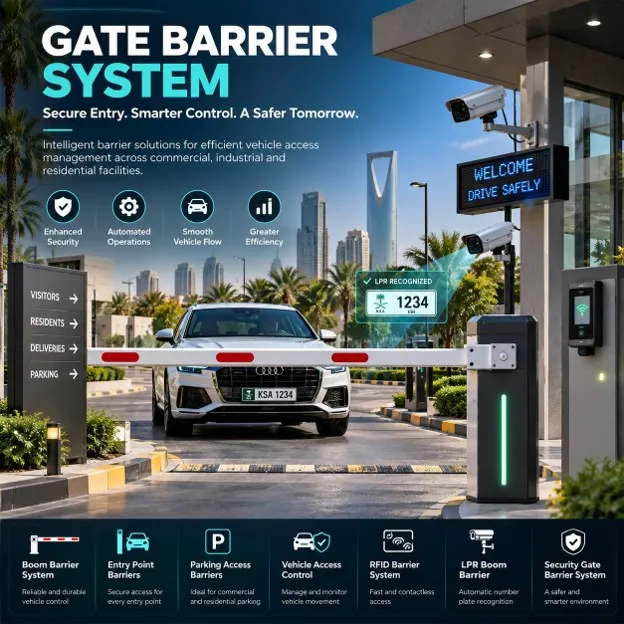
An LPR Boom Barrier combines a standard boom barrier with a licence plate recognition camera, allowing a registered vehicle to be identified and admitted automatically without a driver stopping to present a card or tag. This is particularly valuable at sites with a large, regularly recurring vehicle population — staff car parks, gated communities, and logistics facilities where the same fleet of vehicles passes through the same gate multiple times a day.
Because the plate itself becomes the credential, there is no card to lose, share, or forget, and the resulting access log doubles as a straightforward audit trail for any incident review or occupancy report a site manager needs to produce.
RFID Barrier System: Read Range and Recognition Speed That Matter
Performance for an RFID Barrier System comes down to read range and recognition speed under real approach conditions, not just a manufacturer's laboratory rating. A tag-based system rated for reliable reads at normal driving speed keeps traffic flowing at a busy entrance, while one only tested at a slow, stationary distance will create exactly the kind of queue a facility installed the barrier to avoid.
RFID remains a strong fit for fleet vehicles, staff parking, and contractor access where a physical tag can be permanently affixed to the vehicle, giving facility managers a durable, low-maintenance credential that does not depend on weather conditions or camera angle the way plate recognition can.
Vehicle Access Control: Looking Beyond the Barrier Arm Alone
Genuinely reliable Vehicle Access Control measures performance across the whole system, from credential read through decision logic to physical gate movement, rather than judging a barrier purely on how fast its arm swings. A slow software layer or an overloaded network connection can bottleneck even the fastest physical hardware on the market, so system-level response time deserves as much scrutiny during procurement as the barrier itself.
At multi-gate sites, this also means confirming that credential databases, visitor pre-authorisation, and reporting are centralised, so a security team can manage every entry point from one interface rather than reconciling separate logs gate by gate.
Parking Access Barriers: Built for High-Frequency Daily Cycling
Busy commercial and residential car parks demand Parking Access Barriers rated for genuinely high-frequency daily cycling. A barrier specified for a quiet villa compound will show accelerated wear far sooner when deployed instead at a high-turnover mall, hospital, or office tower car park, where the same arm may cycle hundreds of times before the day is half over.
Pairing the barrier with occupancy counting and space-guidance signage further reduces circulation time inside the car park itself, an increasingly common request from Omani retail and hospitality developments looking to improve the overall visitor experience.
Automatic Road Barrier Networks for Multi-Lane and Multi-Gate Sites
Larger sites with several simultaneous entry lanes need Automatic Road Barrier networks tested for coordinated response, confirming that multiple barriers controlled by the same system open and close in proper sequence under load rather than only being validated individually during commissioning. This coordination matters most at industrial parks, free zones, and toll-style checkpoints where several lanes must process traffic in parallel without one gate's malfunction backing up the entire junction.
Security Gate Barrier System: Where Access Control Meets Perimeter Defence
At sites with a genuine security mandate — government facilities, ports, and critical infrastructure — a Security Gate Barrier System needs to combine standard access-control functions with anti-ram or forced-entry resistance appropriate to the site's threat profile. Performance here is measured not only by how quickly the barrier opens for an authorised vehicle, but by how effectively it resists a deliberate attempt to force entry, an increasingly common specification requirement for Oman's port, logistics, and government sector projects.
Gate Barrier System Oman: Climate, Compliance, and Regional Demands
Specifying a Gate Barrier System Oman-wide means accounting for a climate that genuinely stresses mechanical and electronic components. Summer temperatures across the Sultanate regularly exceed 45°C, affecting motor performance, lubricant viscosity, and electronic component lifespan in ways that barriers designed for milder climates are simply not engineered to handle. Coastal sites in Muscat, Sohar, and Duqm add humidity and salt-air exposure to the equation, making corrosion-resistant housings and connectors a genuine specification requirement rather than an optional upgrade.
Facilities operating within Oman's free zones and special economic zones, including Duqm Special Economic Zone (SEZAD), Sohar Free Zone, and Salalah Free Zone, increasingly specify barrier infrastructure as part of a broader compliance package aligned with zone authority security requirements, alongside standard guidance from the Royal Oman Police (ROP) and civil defence authorities on vehicle access and fire lane management.
Gate Barrier System Muscat: Capital Demands, Highest Standards
A Gate Barrier System Muscat deployment typically faces the Sultanate's highest concentration of gated residential communities, government buildings, hotels, and corporate campuses, all competing for a limited pool of experienced integrators. Muscat installations should reference actual performance testing under regional heat and humidity conditions rather than generic manufacturer specifications developed for temperate markets, since components rated adequately for a European or North American climate can noticeably underperform once installed along the capital's coastline.
Total Cost of Ownership: Why the Purchase Price Is Only the Starting Point
A barrier's sticker price typically represents a small fraction of its cost over a realistic service life once maintenance, downtime, and premature replacement are factored in. Facility owners who specify against real duty cycle and climate data consistently report a lower total cost of ownership than those who select the cheapest unit that technically meets a site's advertised speed requirement.
- Maintenance frequency — an under-rated barrier typically requires service visits considerably more often than one correctly matched to actual site traffic
- Downtime cost — every hour a barrier is out of service at a security-critical or high-traffic site carries a real, quantifiable operational cost
- Replacement cycle — a correctly specified barrier can deliver several times the service life of an under-specified unit running the same daily cycle count
- Spare parts and technician availability — standardising on well-supported hardware families shortens repair turnaround compared with sourcing parts for an obscure or discontinued model
Facility owners who treat barrier procurement as a multi-year infrastructure decision, rather than a one-off purchase against the lowest quote, consistently make better technology choices than those evaluating only the initial invoice.
Integrating the Barrier into a Complete Access Ecosystem
A barrier rarely performs at its best in isolation. The strongest deployments treat the physical arm as one component within a wider access ecosystem, with each layer tested to work together rather than assembled from separately sourced, loosely compatible parts.
- Credential layer — RFID tags, licence plate recognition cameras, or mobile credentials that identify an approaching vehicle before it reaches the barrier
- Decision layer — the access control software that validates the credential against a permissions database and issues an open command
- Physical layer — the barrier arm itself, loop detectors, safety photocells, and obstruction sensors governing safe operation
- Monitoring layer — centralised reporting that logs every open and close event, supporting both security review and predictive maintenance planning
Facility owners who specify each layer with the others in mind avoid the common failure mode of a fast, well-rated barrier being bottlenecked by a slow credential reader or an under-provisioned control system elsewhere in the chain.
Why Facility Owners Across Oman Choose Tektronix
Tektronix specifies gate barrier systems for sites across Oman based on actual duty cycle requirements and climate performance data rather than generic manufacturer defaults, working with established barrier and access control brands to match hardware appropriately to each site's real traffic volume and environmental exposure.
- Site-specific traffic volume and duty cycle assessment carried out before any hardware is specified, avoiding the under-speccing that causes most early failures
- Climate-tested hardware selection appropriate to each site's heat, humidity, and coastal corrosion exposure
- Integration expertise spanning RFID, licence plate recognition, and centralised vehicle access control platforms
- Multi-lane commissioning that validates coordinated barrier response across an entire junction, not each gate in isolation
- Regional delivery experience across Oman, Saudi Arabia, and Qatar, giving multi-country operators a single integration partner rather than a different vendor in every market
Facility owners evaluating vendors for a new deployment or an upgrade of ageing hardware can review Tektronix's gate barrier system solutions for KSA, Qatar, and Oman for a closer look at regional case studies, hardware specifications, and project timelines.
Conclusion
A properly specified Gate Barrier System starts with matching a Boom Barrier System and its Entry Point Barriers configuration to a site's actual traffic pattern rather than a generic datasheet figure. An LPR Boom Barrier and RFID Barrier System each bring hands-free recognition suited to different vehicle populations, while system-wide Vehicle Access Control and well-rated Parking Access Barriers determine whether an entrance performs under real daily pressure. Coordinated Automatic Road Barrier networks and a resistance-rated Security Gate Barrier System extend that reliability to multi-lane and high-security sites alike. Given how demanding Gate Barrier System Oman conditions genuinely are, particularly for Gate Barrier System Muscat installations facing coastal heat and humidity, facility owners who specify against real performance data avoid the premature failures that undermine both security and daily operations.





























Sign in to leave a comment.