In professional audio engineering, subwoofer array design plays a crucial role in delivering coherent, powerful, and controlled low-frequency sound. With modern DSP platforms and advanced speaker configurations, venues can now achieve both high output and precise directivity control, ensuring consistent coverage across diverse environments.
Time Alignment Algorithms for Coherent Summation
Modern digital signal processors calculate inter-element delays within 0.5–4ms, optimizing summation efficiency by up to 3dB across 40–100Hz. By maintaining phase coherence, arrays deliver tighter bass and improved clarity, especially in large-scale venues.
Virtual Displacement in End-Fire Arrays
End-fire subwoofer arrays apply cascaded delay times to create virtual source displacements, narrowing horizontal dispersion by 15–20°. This approach benefits long-throw applications such as outdoor festivals, though it requires EQ compensation above 80Hz to preserve tonal balance.
Phase Inversion and Cardioid Subwoofer Arrays
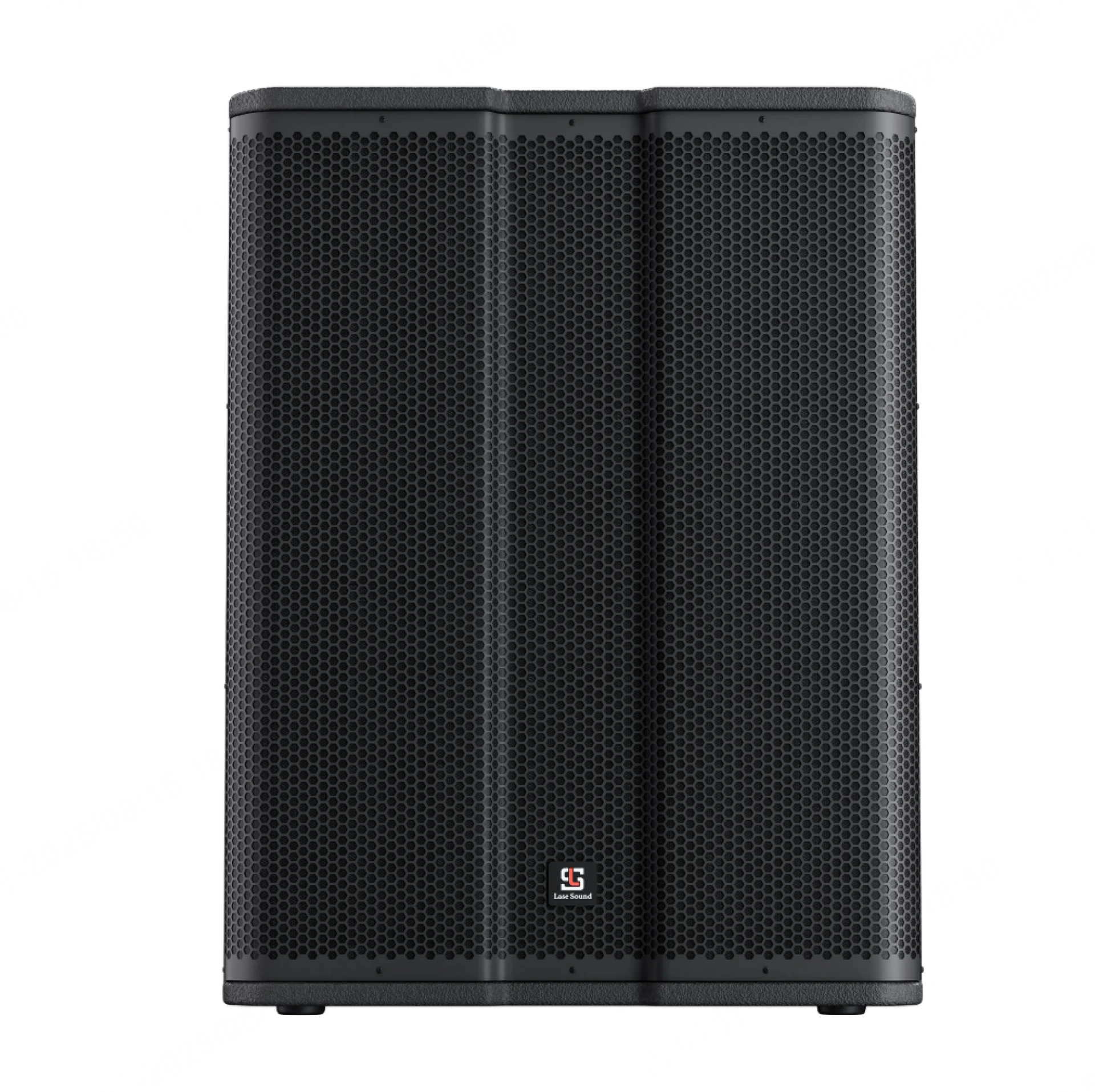
Cardioid configurations achieve rear cancellation of up to 12–15dB between 40–80Hz through polarity reversal and quarter-wavelength delays. For example:
- 6.8ms delay for 40Hz cancellation
- 2.3ms delay for 120Hz suppression
- 5–7dB level matching for balanced output
This design reduces unwanted bass buildup on stage while projecting clean, powerful low frequencies toward the audience.
Validating Subwoofer Array Designs
Professional validation methods include:
- Boundary Element Method (BEM) simulations: Predict directional behavior with 92% accuracy.
- Ground plane measurements: Test in half-space to reduce environmental reflections.
- Directivity Index (DI) analysis: Cardioid arrays often achieve higher DI at 40Hz compared to end-fire configurations.
Industry Challenge: Balancing Scale and Control
Larger arrays deliver +3–6dB output per doubling, but maintaining phase alignment becomes increasingly complex. Below 50Hz, directivity collapses, making hybrid configurations necessary to balance output zones with coverage control.
LASE Sound Subwoofer Solutions
As showcased in the LASE Sound product range, modern subwoofer systems integrate advanced DSP alignment tools, cardioid-capable enclosures, and modular configurations to meet the acoustic demands of concert halls, stadiums, and houses of worship. With innovations such as precision time-alignment DSP, phase-optimized designs, and hybrid subwoofer technologies, LASE Sound delivers professional-grade solutions trusted worldwide.
Whether exploring their line array systems, professional subwoofers, or integrated DSP platforms, audio engineers can find reliable tools at LASE Sound. These solutions ensure optimal performance for both touring and fixed installations.
FAQ
What is a subwoofer array?
A subwoofer array is a configuration of multiple subwoofers working together to control low-frequency directivity and output.
How do cardioid arrays work?
They use phase inversion and delay processing to cancel rear energy while reinforcing front projection.
Why is spacing important?
Proper spacing avoids destructive interference and lobing, ensuring coherent sound delivery.
What role do DSPs play?
DSPs allow precise delay, polarity, and EQ adjustments, ensuring optimal subwoofer performance.
For more details on professional audio solutions, visit LASE Sound or contact them directly:
Phone: +86-17817358919
Email: [email protected]
Address: Huashan Town, Huadu District, Guangzhou
Website: https://www.lasesound.com/



























Sign in to leave a comment.