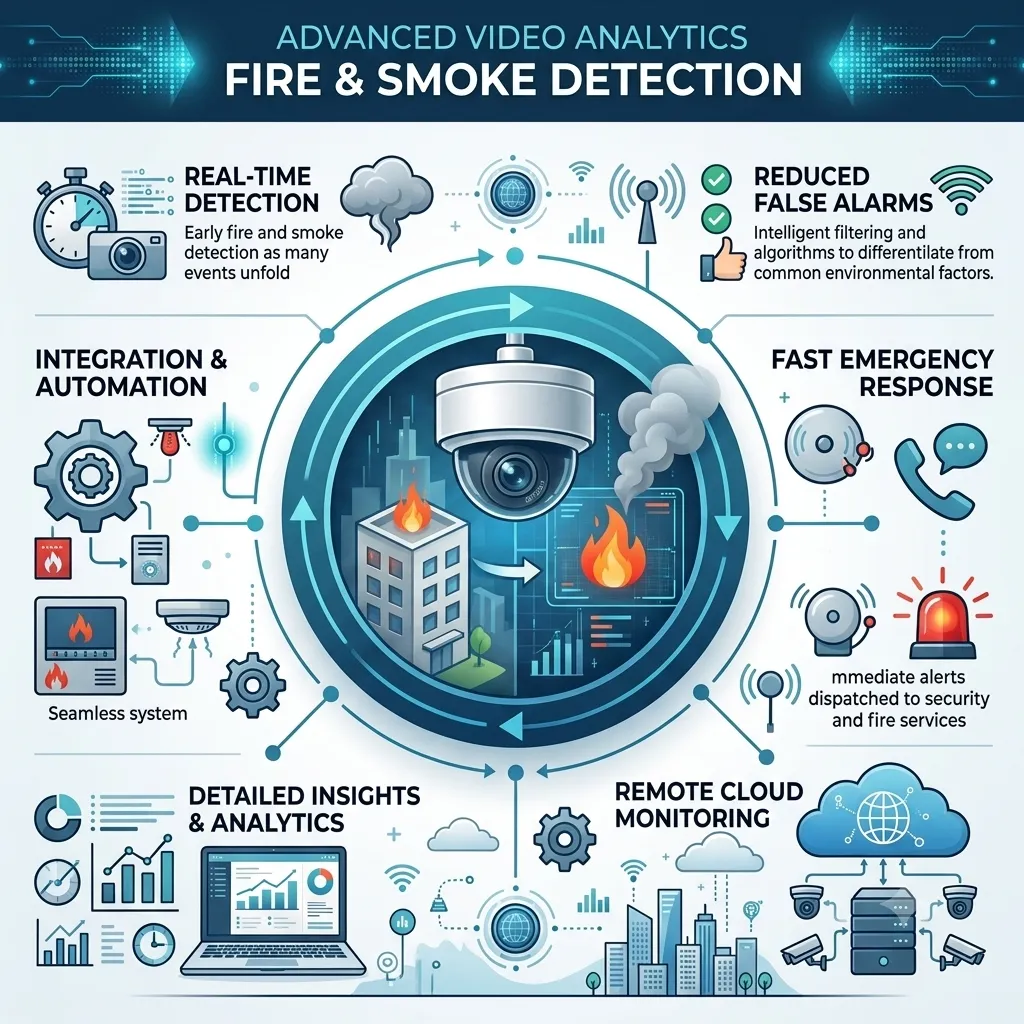

Video Analytics is changing how UAE buildings detect fire and smoke, catching hazards through camera feeds seconds — sometimes minutes — before a ceiling-mounted sensor would ever trigger. As Dubai and Abu Dhabi add ever-taller towers, sprawling logistics parks, and multi-building campuses to their skylines, relying solely on point-source smoke detectors leaves dangerous coverage gaps in atriums, warehouses, and outdoor storage yards. This guide explains how the technology works and why Tektronix’s Video Analytics Solutions are being deployed across the region’s highest-risk facilities.
Video Analytics Software Architecture: From Camera to Alert
A complete deployment layers several components on top of existing camera infrastructure. Understanding this architecture helps facilities teams evaluate Video Analytics Software vendors on technical depth rather than a features checklist alone.

• Edge or server-side processing: Analysis can run directly on capable cameras or centrally on a server, depending on network and camera capability.
• Detection model tuning: Zone-specific sensitivity settings so a busy loading dock and a quiet server room are calibrated differently.
• Alert routing: Notifications pushed to security control rooms, mobile devices, and integrated fire panels simultaneously.
• Video evidence capture: Automatic clip recording of the moments before and after a detected event for later review.
• Dashboard and reporting layer: A central console showing every camera’s detection status and historical event history across a site.
A Practical Example: A Jebel Ali Warehouse Deployment
Consider a logistics operator running a high-bay warehouse in Jebel Ali, where the ceiling height and constant forklift dust made traditional smoke detectors prone to both missed detections and nuisance triggers. After adding video-based detection to the existing CCTV network covering the loading bays and racking aisles, the facility gained coverage of zones that had never had a working point detector at all, since the ceiling was too high for particles to reliably reach a sensor in time.
Within months, the system had correctly flagged a smoldering pallet load during an overnight shift when no staff were physically present in that aisle, triggering an automated alert to the on-duty supervisor’s phone well before the facility’s existing detectors would have responded — illustrating exactly the coverage gap video-based detection is designed to close.
Detailed Incident Reporting: Evidence for Investigation and Compliance
After an event, facilities and safety teams need more than a memory of what happened. Detailed Incident Reporting provides a timestamped record — including the triggering video clip, the specific camera and zone involved, and the sequence of automated actions taken — that supports insurance claims, civil-defence investigations, and internal root-cause reviews without relying on incomplete witness accounts.
Beyond Fire: Related Hazards a Video Analytics Layer Can Flag
Once a camera network is analyzing footage for combustion signatures, the same infrastructure can often be extended to flag related hazards without significant additional cost, giving facilities teams a broader safety layer from a single investment.
• Unusual crowd density: Flagging overcrowding near exits during an evacuation that could slow egress.
• Blocked fire exits: Detecting storage or equipment left in front of designated egress routes.
• Perimeter intrusion near hazardous storage: Alerting on unauthorized presence near flammable-material storage areas.
• Equipment overheating signatures: Thermal-camera integration can flag abnormal heat build-up in machinery before it ignites.
What’s Next for Fire and Smoke Detection Technology
As UAE facilities continue investing in smart-building infrastructure, video-based detection is expected to deepen its integration with drone-based perimeter monitoring, thermal-camera fusion for even earlier detection in low-visibility conditions, and AI models that predict fire-spread direction in real time to guide evacuation routing automatically rather than relying on a static plan.
Facilities that adopt a flexible, well-integrated platform today are better positioned to adopt these capabilities as they mature, rather than facing a costly system replacement further down the line.
Pre-Deployment Checklist for UAE Facilities Teams
Before committing to a rollout, facilities and safety leads should confirm the following groundwork is in place — most delays in UAE video-analytics deployments trace back to one of these items being addressed too late in the planning process.
• Camera coverage audit: Confirm which zones already have usable video feeds versus genuine blind spots requiring new cameras.
• Stakeholder alignment: Facilities, security, and safety teams agree on alert-routing and escalation procedures before go-live.
• Civil-defence coordination: The video layer is documented within the building’s formal fire-safety plan, not treated as an informal add-on.
• Network and processing capacity: Sufficient bandwidth and server or edge-processing resources for the number of monitored cameras.
• Support and maintenance agreement: A defined service-level commitment with the integrator for ongoing tuning and hardware faults.
Conclusion
Video Analytics gives UAE facilities a faster, more reliable way to catch fire and smoke hazards than sensors alone can offer. AI-Powered Video Analytics delivers Real-Time Hazard Detection and Reduced False Alarms, while Automated Emergency Response and Detailed Incident Reporting close the loop between detection and action. Businesses evaluating Video Analytics Software and Video Analytics Solutions across Video Analytics UAE and Video Analytics Dubai deployments can turn to Tektronix’s video analytics solutions team for a rollout built around real regional fire-safety requirements.






























Sign in to leave a comment.