
New York enterprises are adopting AI agents faster than any other market segment in North America. In 2024, 65% of enterprise CX leaders said AI-powered automation was their top investment priority. Agentforce Salesforce's autonomous AI agent platform is at the center of that shift.
If you are an IT, SaaS, or financial services company in New York, working with the right Agentforce implementation partner in New York directly determines your deployment speed and business outcomes. This post explains how Agentforce works, what implementation actually involves, and how New York enterprises are using it to transform customer experience.
What Is Agentforce and How Does It Work?
Agentforce is Salesforce's autonomous AI agent platform. It deploys AI agents that can reason, plan, and act across Salesforce workflows without human input for routine tasks. Unlike traditional chatbots, Agentforce agents retrieve context from live data, make decisions, and complete multi-step processes end to end.
How Agentforce Differs From Standard CRM Automation
Standard CRM automation follows fixed rules if X happens, do Y. Agentforce uses large language models grounded in your Salesforce data to interpret intent and choose the correct action dynamically. This means it handles edge cases, ambiguous requests, and multi-channel interactions that rule-based systems miss.
The Role of the Salesforce Data Cloud
Agentforce agents draw from the Salesforce Data Cloud, which unifies customer data across every touchpoint. This gives each agent a real-time, complete view of the customer their history, preferences, open cases, and purchase data before taking any action. Without this foundation, agents operate on incomplete information and produce poor outcomes.
Supported Use Cases Across Departments
Common enterprise use cases include: automated Tier-1 support resolution, sales follow-up sequencing, field service dispatch, onboarding workflows, and compliance-triggered case escalation. Each use case is configured through Agentforce's no-code Agent Builder, which allows business teams to define agent behaviour without writing code.
How Does Agentforce Improve Customer Experience?
Agentforce improves customer experience by cutting response time, personalising interactions at scale, and freeing human agents for complex issues. Enterprises using autonomous AI agents report a 30% reduction in average handle time. Customers get faster, more consistent answers across every channel.
Reducing Resolution Time on Common Queries
Agentforce agents resolve standard queries order status, account updates, policy lookups in seconds, not minutes. They do not put customers on hold. They do not require a human to pull up a record. The interaction completes within a single conversation thread, whether that is web chat, email, or voice.
Personalisation at Enterprise Scale
Every Agentforce interaction uses the customer's full Salesforce profile as context. The agent knows if a customer escalated a complaint last month, renewed a contract recently, or flagged a preference for a specific channel. This allows genuinely personalised responses not templated ones without adding headcount.
Escalation Accuracy and Human Handoff
When an issue is outside the agent's scope, Agentforce escalates with context attached. The human agent receives a full summary of what the AI already attempted, the customer's profile, and a recommended next step. This eliminates re-explanation from the customer and reduces first-contact resolution failures.
What Does an Agentforce Implementation Partner in New York Do?
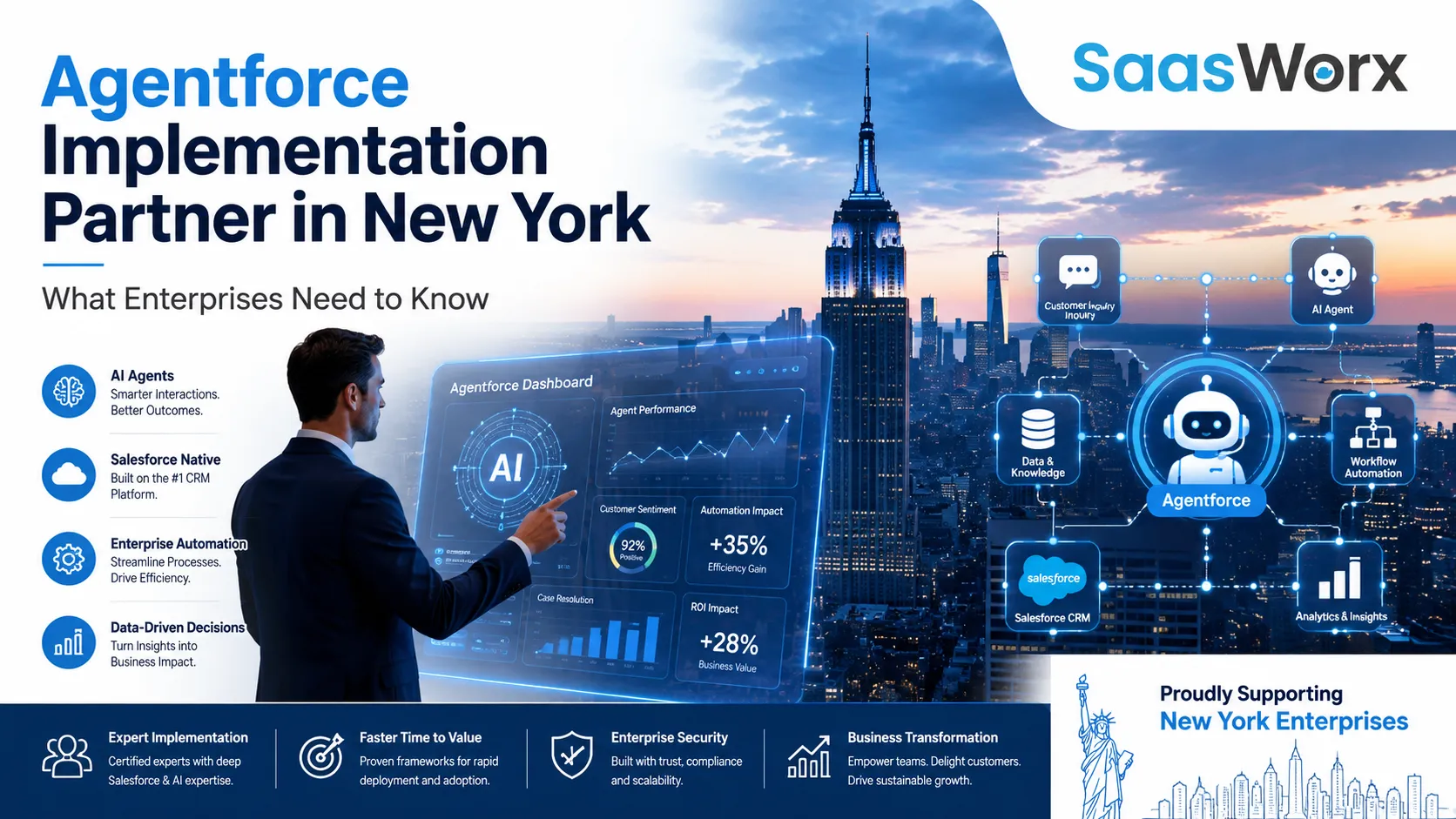
An Agentforce implementation partner in New York handles the technical configuration, data integration, and business process mapping required to deploy AI agents inside your Salesforce org. They are not resellers. Their work is architectural connecting your data, defining agent logic, and aligning the platform to specific business outcomes.
Scoping and Business Process Analysis
The first phase of any Agentforce engagement is process analysis. The partner identifies which workflows have sufficient volume, data quality, and defined resolution paths to benefit from automation. Not every process is agent-ready. Skipping this step leads to deployments that automate the wrong things.
Data Readiness and Salesforce Org Configuration
Agentforce performs only as well as the data it has access to. Partners assess your Salesforce Data Cloud setup, clean up duplicate or incomplete records, and build the data pipelines agents need to operate accurately. Poorly structured data is the single most common reason AI agent deployments fail at enterprise scale.
Agent Training, Testing, and Go-Live
Agent configuration involves defining each agent's goals, knowledge sources, escalation rules, and channel behaviour. Partners run simulation testing against historical data before go-live. For enterprises exploring Salesforce AI implementation in New York, the detailed scope of this process is covered across this Agentforce implementation guide for New York enterprises, which outlines the technical and commercial structure of a typical engagement.
What Industries in New York Benefit Most From Agentforce?
Financial services, healthcare administration, professional services, and SaaS companies in New York show the highest ROI from Agentforce deployment. These sectors share a common profile: high query volume, complex compliance requirements, and customer relationships that depend on speed and accuracy.
Financial Services and Compliance-Heavy Environments
Banks, insurance firms, and asset managers use Agentforce to handle policy queries, account servicing, and regulated communication workflows. The platform's audit trail and role-based access controls meet the compliance requirements of regulated industries operating under New York State financial law and federal oversight.
SaaS Companies Managing High-Volume Support
SaaS companies with large customer bases and lean support teams use Agentforce to handle Tier-1 support without scaling headcount. Agents manage login issues, billing queries, onboarding steps, and feature guidance freeing human teams for churn risk conversations and upsell opportunities.
Professional Services and Knowledge-Intensive Firms
Consulting, legal, and accounting firms use Agentforce to manage client intake, project status updates, and document request workflows. These firms have complex client relationships stored in Salesforce that agents can reference to give contextually accurate responses without involving a partner or senior staff member.
Is Agentforce Suitable for Large Enterprises in New York?
Yes. Agentforce is built for enterprise scale. It handles concurrent multi-channel deployments, integrates with legacy systems through Salesforce MuleSoft, and supports governance frameworks required by large organisations. Enterprises with 500 or more customer-facing staff see the strongest productivity gains from Agentforce deployment.
Governance and Security for Enterprise Deployments
Agentforce operates within Salesforce's Trust Layer, which controls what data agents can access, how they use it, and what actions they can take. Enterprises configure permission sets and data masks to ensure agents never access or expose sensitive data outside defined boundaries. This is auditable and exportable for compliance reviews.
Integration With Existing Enterprise Systems
Most New York enterprises run Salesforce alongside ERP systems, data warehouses, and third-party tools. Agentforce connects to these through MuleSoft integrations or native Salesforce APIs. Implementation partners map these integration points during the scoping phase to ensure agents have complete data context, not just Salesforce data.
Conclusion
Agentforce represents a structural shift in how enterprises handle customer interactions moving from reactive, human-dependent processes to proactive, AI-driven resolution. For New York enterprises, the quality of implementation determines whether that shift creates real efficiency or just adds complexity. Choosing an Agentforce implementation partner in New York with genuine Salesforce architecture experience is the critical decision.
As AI agent capabilities expand and Salesforce continues building out its autonomous agent roadmap, the enterprises that invest in correct, well-scoped deployments now will hold a durable operational advantage. The question is not whether to adopt Agentforce it is whether your implementation is built to last.



























Sign in to leave a comment.